The earth produces enough energy in the form of geothermal heat to meet global electricity demand more than 100 times over. Historically, this clean energy resource has been accessible only in specific geographies, where natural groundwater circulation carries the earth’s heat close to the surface. Now, next-generation geothermal technologies—which adapt drilling techniques developed in the oil and gas industry to access geothermal energy outside of regions with natural hydrothermal systems—promise to unlock geothermal resources almost anywhere in the world. In regions with high natural heat flow, like the western United States, the potential for existing next-generation geothermal technologies to deliver cost-competitive, clean, firm, on-demand power is already clear. For such promise to become a global reality, however, several technical hurdles must still be overcome.
This brief examines the technological advances that are driving the promise of widespread geothermal-sourced electricity, and the scale of opportunity in the United States for next-generation geothermal to generate electricity, provide flexible energy storage, and reduce grid load demand through cogeneration of heat.1While the focus of this report is on electricity generation, geothermal can also provide solutions for industrial heat and building heating and cooling. Additionally, we examine how historic federal support for innovation in the oil and gas industry can provide a roadmap to ensuring the potential of geothermal energy can be fully realized.
The U.S. government can take several strategic actions to support the development of next-generation geothermal. These actions include:
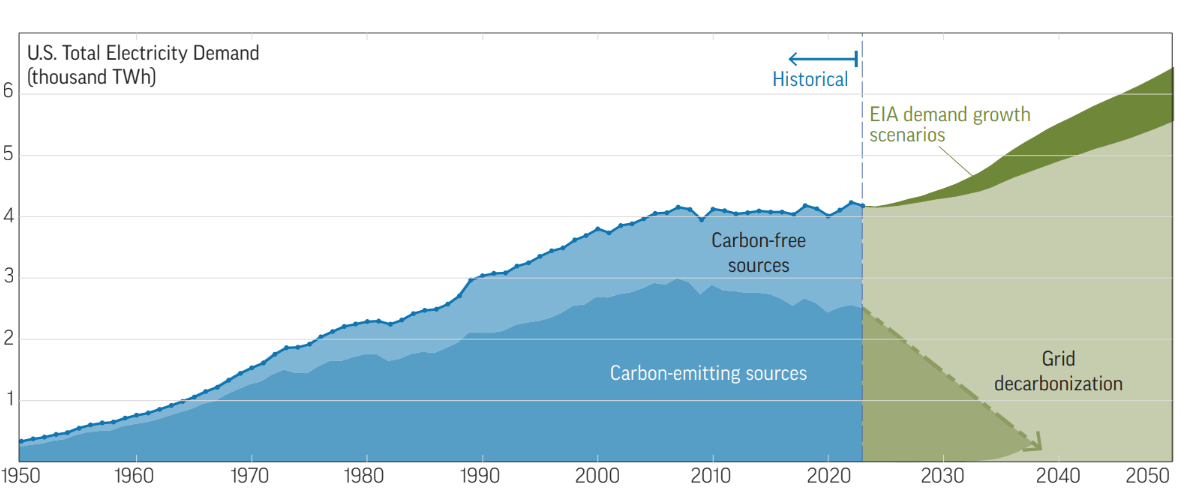
The United States—and the world more broadly—is facing the simultaneous challenges of rapidly growing electricity demand and the need for aggressive grid decarbonization (Figure 1). Over the next quarter century, U.S. electricity demand is estimated to increase by 50 percent or more, due to rising standards of living, widespread electrification of activities traditionally powered by combustion of fossil fuels (e.g., transportation, heating and cooling, industrial processes), and advances in computing and artificial intelligence.2U.S. Energy Information Administration, Annual Energy Outlook 2025, April 15, 2025, https://www. eia.gov/outlooks/aeo/. At the same time, keeping global temperatures well below 2 degrees C of average warming will require large industrialized nations like the United States to rapidly decarbonize their electricity grid.3United States of America, The United States’ Nationally Determined Contribution: Reducing Greenhouse Gases in the United States: A 2035 Emissions Target (December 19, 2024), https:// unfccc.int/sites/default/files/2024-12/United%20States%202035%20NDC.pdf.
FIGURE 1: ELECTRICITY DEMAND IS EXPECTED TO INCREASE
Any pathway the United States pursues toward grid decarbonization will require a diverse portfolio of new carbon-free electricity sources to come online to replace retiring facilities and meet rising demand.4Morgan Browning, et al., “Net-zero CO2 by 2050 scenarios for the United States in the Energy Modeling Forum 37 study,” Energy and Climate Change 4 (2023): 100104, https://doi.org/10.1016/j. egycc.2023.100104. However, three factors will also be critical to ensuring electricity can continue to be delivered affordably and reliably as this sector scales and reduces its emissions intensity:
1. an increase in the capacity and distribution of clean, firm, on-demand power generation
2. mechanisms for storing energy within the grid for periods of peak demand
3. reduction of total load demand via increased efficiency.
Technological advances, originally developed in the oil and gas industry—but recently demonstrated in geothermal applications—now give a new suite of technologies called next-generation geothermal the promise to deliver on all three of these needs in potentially transformative ways. In terms of addressing capacity, recent estimates suggest the technical potential for carbon-free geothermal power generation in the United States is around 3,400 to 5,500 GW nationwide.5Mehdi Yusifov and Nico Enriquez, From Core to Code: Powering the AI Revolution with Geothermal Energy (Boston, Massachusetts: Project Innerspace, July 2025), https:// projectinnerspace.org/resources/Powering-the-AI-Revolution.pdf; Doug Blankenship, et al., Pathways to Commercial Liftoff: Next-Generation Geothermal Power (U.S. Department of Energy, March 2024), https://negpa.org/wp-content/uploads/2024/08/LIFTOFF_DOE_NextGen_Geothermal_v14.pdf. By comparison, the United States had about 1,300 GW of total electricity generation capacity—from all sources—in 2024.6Lindsey Buttel, America’s Electricity Generation Capacity: 2025 Update (Arlington, Virginia: American Public Power Association, April 2025), https://www.publicpower.org/system/files/ documents/Americas-Electricity-Generation-Capacity-2025-Update.pdf. In addition to firm power generation, techno-economic modeling of domestic geothermal resources suggest they could be economically developed to provide load-following generation and energy storage—helping to balance the grid and meet demand peaks—as well as direct-use heating.7Mehdi Yusifov and Nico Enriquez, From Core to Code: Powering the AI Revolution with Geothermal Energy. The latter application is so efficient that models indicate its widespread deployment could appreciably reduce electricity grid demand and grid system costs.8Xaobing Liu, et al., Grid Cost and Total Emissions Reductions Through Mass Deployment of Geothermal Heat Pumps for Building Heating and Cooling Electrification in the United States (Oak Ridge, Tennessee: Oak Ridge National Laboratory, November 2023), ORNL/TM-2023/2966, https://info.ornl.gov/sites/publications/Files/Pub196793.pdf; Chen Chen and Daniel S. Cohan, “Potential Geothermal Deployments for U.S. Electricity and Industrial Heat,” Energy Conversion and Management 348(B) (January 15, 2026):120711, https://doi.org/10.1016/j.enconman.2025.120711.
But what would it take to realize all of this promise? In theory, geothermal energy is available and abundant everywhere on Earth, and is effectively an inexhaustible resource. In fact, so much geothermal energy is passively released via heat loss from the Earth’s continental surface every day, it could meet more than 100 times global electricity demand.9Global continental heat flow is 13.8 TW, or ~331 TWh per day of energy release; in 2024, global electricity consumption was 1,080 TWh, or about 2.96 TWh per day. J.H. Davies and D.R. Davies, “Earth’s surface heat flux,” Solid Earth, 1 (2010): 5–24, https://doi.org/10.5194/se-1-5-2010; Rhet Allain, “How Long Could the World Run on Geothermal Power?” Wired, March 10, 2020, https://www.wired. com/story/how-long-will-earths-geothermal-energy-last/; International Energy Agency, Global Energy Review 2025 (Paris, France: March 2025), https://www.iea.org/reports/global-energy-review-2025. But, economically harnessing that energy requires drilling to where it is concentrated and can be extracted in a useful form. In some places, like the western United States, geothermal heat is available relatively close to Earth’s surface, and can already be extracted using well-established conventional or novel next-generation methods at costs competitive with other electricity generation techniques. But in other parts of the United States and the world, tapping into geothermal energy at temperatures that can produce electricity means drilling far deeper, which can be costly or—in some cases—beyond the limits of current drilling capabilities.
In this brief, we examine the technological innovations that have made geothermal energy so promising, as well as the hurdles that must be overcome to reach widespread, low-cost deployment. In particular, we examine the geographic limitations of low-cost next-generation geothermal deployment today, what technical advances are needed to overcome these limitations, and the role of federal policy in helping achieve those advances.
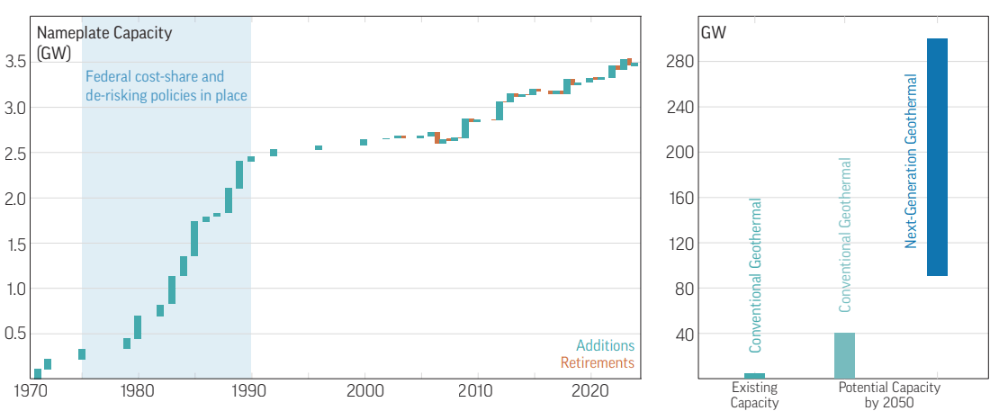
Geothermal energy has been used to produce electricity since the early 1900s, but the prevalence of cheap fossil fuel-derived energy has largely disincentivized its use beyond regions where naturally circulating groundwater carries heat near (and in some cases above) the earth’s surface, making energy extraction relatively simple.10John W. Lund, “100 years of geothermal power product” (paper presented at Thirtieth Workshop on Geothermal Reservoir Engineering, Stanford University, Stanford, CA, January 31–February 2, 2005), SGP-TR-176, https://pangea.stanford.edu/ERE/pdf/IGAstandard/SGW/2005/lund.pdf. A notable exception was in the 1970s and 1980s, when a global energy crisis spurred U.S. interest in finding alternative domestic energy solutions like wind, solar, geothermal, and unconventional natural gas. To encourage geothermal development, Congress passed a series of legislation that reduced royalty fee requirements for geothermal development on federal lands and created investment and production tax credits, loan guarantees, research grant programs, cost-share grants for exploration and drilling, and technical assistance programs.11John W. Lund and R. Gordon Bloomquist, “Development of geothermal policy in the United States: What works and what doesn’t work” (paper presented at Thirty-Seventh Workshop on Geothermal Reservoir Engineering, Stanford University, Stanford, California, January 30–February 1, 2012), SGP- TR-194, https://pangea.stanford.edu/ERE/pdf/IGAstandard/SGW/2012/Lund.pdf. The investment led to over 2.7 GW of new geothermal generation capacity in the 1970s and 1980s, and projects developed in these two decades still account for more than half of the United States’ existing geothermal capacity (Figure 2).12“Nearly half of U.S. geothermal power capacity came online in the 1980s,” U.S. Energy Information Association, updated November 20, 2019, https://www.eia.gov/todayinenergy/detail. php?id=42036; “Electricity: Form EIA-860 detailed data with previous form data (EIA-860A/860B),” U.S. Energy Information Association, updated June 11, 2025, https://www.eia.gov/electricity/data/ eia860/.
FIGURE 2: CUMULATIVE AND POTENTIAL GEOTHERMAL CAPACITY IN THE U.S.
As projects proliferated, it became increasingly clear that conventional geothermal energy production—in which wells tap deep, circulating fluids in natural, high-temperature hydrothermal systems—was a highly bespoke process. Each generation facility had to be designed for the specific temperature conditions and fluid chemistry of the geothermal field. Heterogeneity in natural geologic systems meant that exploration for economic projects was time-consuming, costly, and came with the same risks of failure as drilling for oil, gas, and mineral resources, but without the possibility of high returns like those that come from discovery of a world-class mineral deposit or an immense oil field. At best, a successful project could only generate steady electricity at a modest profit. The hope of being able to develop modularized, low-cost infrastructure that could benefit from economies of scale, or of developing geothermal resources beyond regions with high groundwater flow and geothermal gradients waned, and with it, so did federal support.
By the early 1990s, only a few federal incentives for geothermal production remained: an investment tax credit (reduced to 10 percent of capital costs), a tax credit for intangible drilling costs such as labor, fuel, and materials for drilling (which has limited utility given the temporal disparity between when costs are incurred and when taxable income is generated), and a small technical assistance program housed by the U.S. Department of Energy (DOE).13Tax Reform Act of 1986, Pub. L. No. 99-514 §421 (1986); Energy Tax Act of 1978, 26 U.S.C. §263 (2025); Geothermal Research, Development, and Demonstration Act of 1974, 24 U.S.C. §1101-1164 (repealed in 2020); Arnab Datta and Ashley George, The Long Game: A Technical Tax Change to Boost American Energy Production (Washington, DC: Employ America, February 19, 2025), https:// www.employamerica.org/expanding-energy-production/the-long-game-a-technical-tax-change-to-boost-american-energy-production/. Risk reduction, loan, and grant programs were all terminated due to lack of congressional support.14John W. Lund and R. Gordon Bloomquist, “Development of geothermal policy in the United States: What works and what doesn’t work.” With the loss of these programs and the reemergence of low-cost fossil fuels by the late 1980s, development slowed (Figure 2), as did research into expanding geothermal energy production beyond regions with ideal geologic conditions. Today, geothermal energy produces only about 0.4 percent of U.S. electricity. Production is concentrated in regions with well-characterized, optimal hydrothermal characteristics, mostly in California and Nevada. Even in such regions, only about 10 percent of known geothermal resources have been developed for electricity generation, primarily due to the distance of such resources from centers of electricity demand, such as urban areas, and the high investment risk associated with resource exploration.15Bethany Speer, et al., Geothermal Exploration Policy Mechanisms: Lessons from International Applications (Golden, CO: National Renewable Energy Laboratory, Technical Report NREL/TP- 6A20-61477, May 2014), https://docs.nrel.gov/docs/fy14osti/61477.pdf.
As the limits of conventional geothermal production became increasingly clear, researchers were already examining the potential of a new approach: creating artificial geothermal systems that would not be reliant on natural hydrothermal circulation. The aim was to apply a variety of stimulating techniques (see Box 1) to access geothermal heat that was not economically available, either because of low fluid availability (e.g., hot, dry rock), or low permeability (i.e., ground water might be present, but there is limited interconnectivity between water-bearing pore spaces).16Katrin Breede, et al., “A Systematic Review of Enhanced (or Engineered) Geothermal Systems: Past, Present and Future,” Geothermal Energy 1 (2013): Article 4, https://doi.org/10.1186/2195-9706-1-4
Developers first attempted to improve permeability in water-rich geothermal fields in Iceland in the early 1970s.17Gudni Axelsson, Sverrir Thórhallsson, and Grímur Björnsson, “Stimulation of Geothermal Wells in Basaltic Rock in Iceland” (paper presented at the Enhanced Geothermal Innovative Network for Europe Workshop 3, Zürich, Switzerland, June 29–July 1, 2006), https://www.researchgate.net/ publication/242234259_Stimulation_of_geothermal_wells_in_basaltic_rock_in_Iceland. There, drillers injected fluids to over-pressurize a newly drilled conventional well as a way to stimulate production—the pressurization reopened fractures clogged by drilling mud or the formation of hydrothermal minerals. At the same time, Los Alamos National Laboratory researchers were experimenting with how to create a fully artificial hydrothermal system in hot, dry rock at Fenton Hill, a site in the Jemez Mountains of New Mexico.18Donald Brown and David Duchane, “Scientific Progress on the Fenton Hill HDR Project Since 1983” (paper presented at Geothermics on the Academic Review of HDR/HWR, Sendai, Japan, March 1998), https://www.osti.gov/servlets/purl/653964. Their earliest experiments, between 1974 and 1978, demonstrated that it was physically possible to create an entirely engineered—or enhanced—geothermal system (Box 1). However, subsequent experiments over the next 20 years demonstrated the challenge of characterizing and controlling what was happening in the subsurface. For EGS to work, fractures created through stimulation would have to connect between an injection well and a production well. If they were too close, fluids might not get sufficiently hot before returning to the surface. If the fractures were too big, fluid would circulate too rapidly, and cool down the rocks to the point they were no longer productive. If the fractures propagated in the wrong direction, injected fluids would be lost in the surrounding rock, instead of returning in the production well.
The complexities of these challenges, combined with rapid recovery of oil prices, resulted in limited investment in enhanced geothermal systems. In the half-century that followed since those first tests in New Mexico, only a few dozen EGS projects have been developed globally—most of which are stimulation of conventional wells, like the projects in Iceland.19Ahinoam Pollack, Roland Horne, and Tapan Mukerji, “What Are the Challenges in Developing Enhanced Geothermal Systems (EGS)?”
At the same time that the promise of widespread geothermal appeared to be waning, another energy story was unfolding that would ultimately be critical for reigniting its potential: The shale gas revolution was taking place in the oil and gas industry and was doing so with significant federal support (see Box 2). As with geothermal, the 1970s energy crisis led the U.S. government to provide funding for research and development (R&D) and oversight to industry-led efforts to develop shale fracturing and directional drilling technologies. Congress also fostered demand through a production tax credit for unconventional gas sources, including shale gas and gas from tight—or impermeable—sands, which was in effect from 1980–2002.20Alex Trembath et al., Where the Shale Gas Revolution Came From (Oakland, California: Breakthrough Institute, May 2012), https://thebreakthrough.org/issues/energy/where-the-shale-gas- revolution-came-from.
However, unlike geothermal, federal support did not dissipate in the 1990s, but continued providing subsidies and cost-sharing programs for demonstration projects that were transformational for the natural gas industry, unlocking an energy resource that had previously been deemed inaccessible. By the early 2000s, the number of gas wells drilled in the United States had increased nearly seven-fold relative to 1970 (tens of thousands relative to a few dozen EGS wells), and by 2012, the United States was the world’s largest producer of natural gas.21Cutler Cleveland, “Four Million Wells and Counting: The History of Oil and Gas Drilling in the U.S.,” Boston University Institute for Global Sustainability, September 4, 2023, https://visualizingenergy. org/four-million-wells-and-counting-the-history-of-oil-and-gas-drilling-in-the-u-s/; “U.S. Natural Gas Production,” European Parliamentary Research Service, June 26, 2014, https://epthinktank. eu/2014/06/26/unconventional-gas-and-oil-in-north-america/140815rev1-us_natural_gas_production/.
Importantly, the tools that unlocked natural gas from impermeable shale layers are the same ones that hold the potential to transform EGS from an expensive, niche, and risky technique to a globally available and cost-competitive energy resource. The hydraulic fracturing and horizontal drilling technologies developed for shale gas, combined with microseismic imaging, make it possible to control the directionality and scale of induced fractures and create a strong interconnected network of fractures between an injection well and a recovery well. This means that an enhanced geothermal system could be optimized to maximize the heating and recovery of injected fluids. Additionally, because wells can be drilled at angles ranging up to 90 degrees, and for distances over 3 miles, large areas of a resource field can be accessed with a single well, reducing the need—and costs—of developing many wells for a single resource.22Xuefeng Yan, et al., “World Record 5.2 km HDD Twin Crossings of the Hong Kong Harbor,” in Pipelines 2019: Condition Assessment, Construction, and Rehabilitation, eds. Jeffrey W. Heidrick, et al., (Reston, VA: American Society of Civil Engineers, 2019), 699–706, https://ascelibrary.org/ doi/10.1061/9780784482490.075; “Did You Know… Geothermal Wells Can Be Highly Deviated Too?” Utah FORGE, accessed January 13, 2026, https://utahforge.com/did-you-know-geothermal- wells-can-be-highly-deviated-too/; Kirsten Marcia, et al., “Horizontal Drilling for Geothermal Power Generation in the Williston Basin (Canada),” GRC Transactions 45 (2021): 1981–1993, https:// publications.mygeoenergynow.org/grc/1034503.pdf. Horizontal drilling also provides a pathway for development of another novel geothermal technology—closed loop geothermal (sometimes called advanced geothermal), in which injection and production wells are directly connected.
Knowledge transfers of these critical technologies between the oil and gas and geothermal industries are just beginning, but they are leading to a momentous shift in the apparent potential of next-generation geothermal systems like EGS and closed loop (see Box 3). As recently as 2022, the International Energy Agency (IEA) estimated that geothermal energy would remain at 1 percent of global electricity generation for the foreseeable future.23International Energy Agency, World Energy Outlook 2022, October 2022, https://www.iea.org/ reports/world-energy-outlook-2022. Two years later, the same agency proposed that with a high rate of technological transfer from
oil and gas, geothermal energy could supply as much as 15 percent of global electricity demand growth through 2050.24International Energy Agency, The Future of Geothermal Energy, December 13, 2024, https://www. iea.org/reports/the-future-of-geothermal-energy.
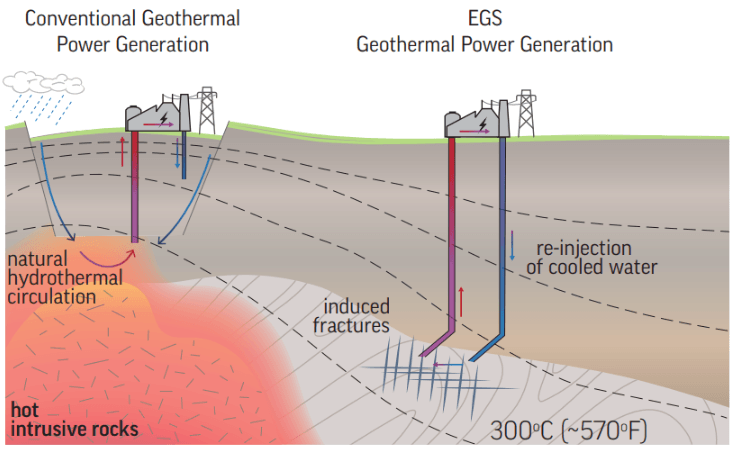
In conventional geothermal power generation, wells tap deep, naturally circulating hydrothermal fluids that generally have temperatures around 150–300 degrees C (~300–570 degrees F). Hot fluids are brought to the surface in a production well in the form of hot liquid, steam, or a mix. Fluids that reach the surface as steam or are hot enough to convert to steam at surface pressures (dry steam and flash steam systems) are directly used to drive a turbine that generates electricity. Lower-temperature or highly saline fluids that are below their boiling point are run through a binary cycle: the geothermal fluids are passed through a heat-exchanger, where heat energy is conductively transferred to another liquid with a lower boiling point, that converts to steam to drive the generator. In all types of conventional systems, fluids may be injected back into the subsurface to extend the lifetime of the geothermal field, but it is natural hydrothermal circulation—not reinjection of cooled fluids—that are the primary source of produced fluids.
In enhanced geothermal systems (EGS), developers create permeability in deep, hot rocks by fracturing the rock reservoir. Cold water injected into the reservoir is then able to migrate through the fractures, absorbing heat from the surrounding rock before being pumped through a production well for use at a flash steam or binary cycle power plant. Hydraulic fracturing—over-pressurizing a well through injection of fluids until fractures form to release stress—is the most common tool for generating fractures. To a lesser degree, fractures have also been formed by injecting cold fluids into hot rock to drive rock contraction and fracture formation (thermal fracturing), injecting chemically corrosive fluids to dissolve hydrothermal minerals that have filled up pre-existing natural fractures (chemical treatment), or some combination of these.25Katrin Breede, et al., “A Systematic Review of Enhanced (or Engineered) Geothermal Systems”; Ahinoam Pollack, Roland Horne, and Ta- pan Mukerji, “What Are the Challenges in Developing Enhanced Geothermal Systems (EGS)? Observations from 64 EGS Sites” (paper pre- sented at World Geothermal Congress 2020+1, Reykjavik, Iceland, April – October 2021), https://www.worldgeothermal.org/pdf/IGAstandard/ WGC/2020/31027.pdf.
FIGURE 3: CONVENTIONAL VS. EGS GEOTHERMAL POWER GENERATION
Since the mid-1980s, federal research and development dollars for geothermal energy and unconventional natural gas resources has been relatively comparable,26From 1976–1982, federal energy R&D investments peaked in response to the 1970s oil crisis. By 1983, energy R&D funding stabilized, and annual R&D funding for geothermal and unconventional gas averaged $64 and $73 million (in 2025 US$) from 1983–2019, respectively, exclusive of the 2009 American Recovery and Reinvestment Act (ARRA). Cumulative R&D funding over that time period was $2.3 billion (in 2025 US$) for both technologies (again exclusive of the ARRA). Data from: Jody C. Robins, et al., 2021 U.S. Geothermal Power Production and District Heating Market Report (Golden, CO: National Renewable Energy Laboratory, 2021), https://docs.nrel.gov/docs/fy21osti/78291.pdf; MIT Energy Initiative, The Future of Natural Gas (2011), https://energy.mit.edu/wp-content/uploads/2011/06/MITEI-The-Future-of-Natural-Gas.pdf; U.S. Energy Information Administration, Direct Federal Finan- cial Interventions and Subsidies in Energy in Fiscal Year 2016, April 2018, https://www.eia.gov/analysis/requests/subsidy/archive/2016/pdf/subsidy.pdf; U.S. Energy Information Administration, Federal Financial Interventions and Subsidies in Energy in Fiscal Years 2016–2022, August 2023, https://www. eia.gov/analysis/requests/subsidy/pdf/subsidy.pdf. but one sector saw a commercial revolution, whereas the other did not. A critical difference was that in addition to R&D, natural gas also saw early and substantive government support for demonstration and subsurface characterization.
From 1976 to 1999, federal investment in large-scale, public-private demonstrations of hydraulic fracturing, horizontal drilling, and microseismic imaging exceeded $620 million (inflation adjusted to 2025$).27This includes the Eastern Shales Gas Project, the Western Gas Sands Project, and DOE investment in developing the Barnett Shale; National Acad- emies of Sciences, Engineering, and Medicine, Energy Research at DOE: Was It Worth It? (2001), https://nap.nationalacademies.org/catalog/10165/ener- gy-research-at-doe-was-it-worth-it-energy-efficiency; Michael Shellenberger, “Interview with Dan Steward, Former Mitchell Energy Vice President,” The Breakthrough Institute, December 12, 2011, https://thebreakthrough.org/issues/energy/interview-with-dan-steward-former-mitchell-energy-vice-president. These programs de-risked first-of-a-kind projects and incorporated information-sharing requirements that allowed multiple stakeholders to benefit from early projects’ learnings. They also pulled along private investment, first by requiring some percentage of cost-matching for demonstration projects, and later through the resulting proof of commercial viability.
By comparison, federal support for next-generation geothermal demonstrations began in earnest about 10 years ago, with the development of the Utah Frontier Observatory for Research in Geothermal Energy (FORGE) program,28Federal funding for next-generation geothermal demonstrations began in 2008, but over 75 percent of funding has been through the FORGE pro- gram, which launched in 2015; “Enhanced Geothermal Systems (EGS) Pilot Demonstrations,” U.S. Department of Energy, no date, https://www.energy. gov/eere/geothermal/enhanced-geothermal-systems-egs-pilot-demonstrations; “Enhanced Geothermal Systems Demonstration Projects,” U.S. Depart- ment of Energy, accessed January 13, 2026, https://www.energy.gov/eere/geothermal/enhanced-geothermal-systems-demonstration-projects. and (including the few pilots pre-dating it) comprises less than half of the investment in unconventional gas—about $270 million (in 2025$) to date. Support for geothermal also lags behind other novel clean energy technologies. For example, the 2021 Infrastructure Investment and Jobs Act and 2022 Inflation Reduction Act authorized billions of dollars for carbon capture and storage, advanced nuclear, hydrogen, and energy storage demonstration projects, but only $84 million for geothermal demonstrations.29“Infrastructure Programs at Department of Energy,” US Department of Energy, accessed January 13, 2026, https://www.energy.gov/infrastructure/ infrastructure-programs-department-energy.
Even with its comparatively low budget, FORGE has demonstrated its value, hosting a series of demonstration wells that have helped improve drilling speeds by 500 percent in the past three years.30Ian Dexter Palmer, “Third Energy Innovation Signaling a Golden Age: Enhanced Geothermal,” Forbes, January 30, 2025, sites/ianpalmer/2025/01/30/third-energy-innovation-signaling-a-golden-age-enhanced-geothermal/. It is a program that warrants continued and expanded federal support.
Next-generation geothermal takes advantage of regions that have hot rocks—but not necessarily the permeability or circulating hydrothermal fluids that are required for conventional geothermal power generation. While EGS was the first of these approaches to be developed, there is now a suite of next-generation geothermal technologies:
• Enhanced geothermal systems create artificial hydrothermal reservoirs by fracturing hot, dry
rocks (see Box 1).
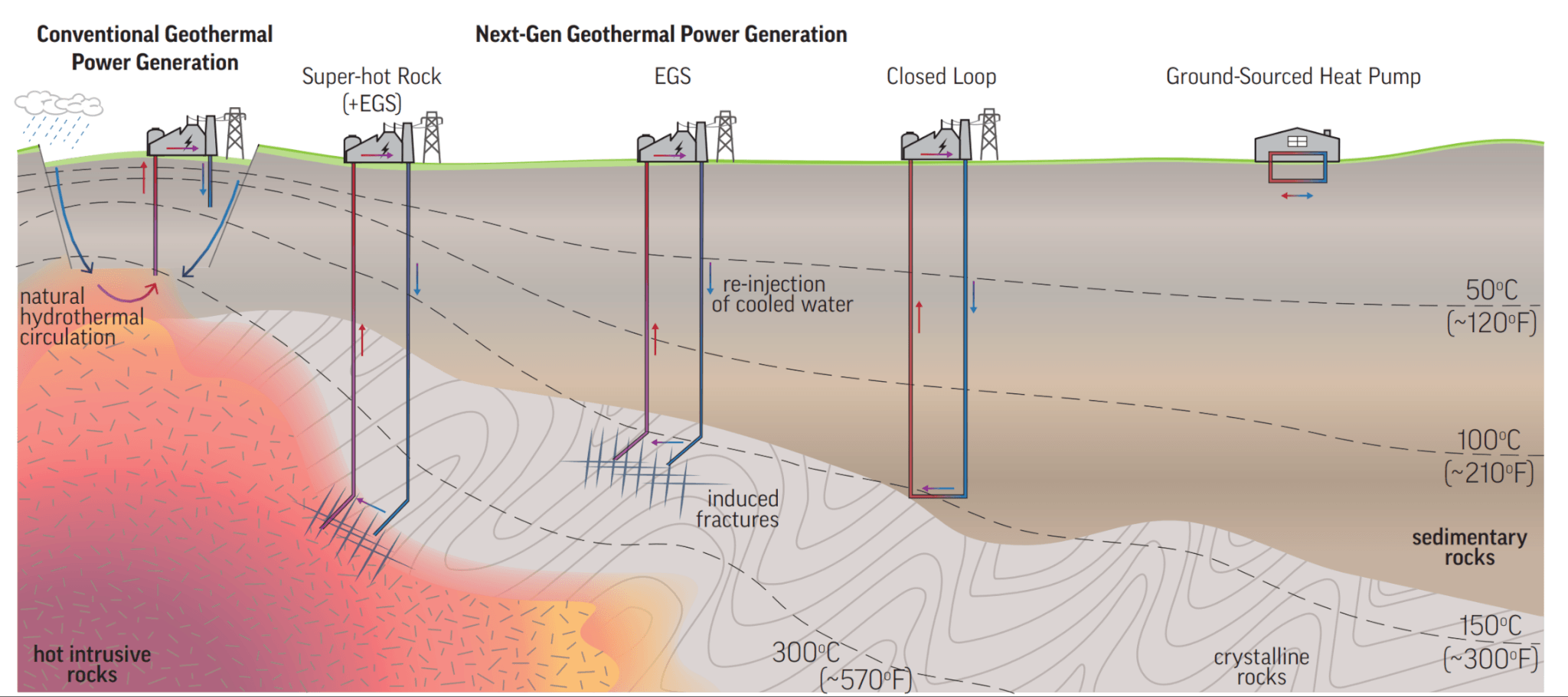
• Closed-loop geothermal systems drill a fully connected, sealed circulation path, in which a working fluid is circulated through an impermeable, looped wellbore and conductively absorbs heat from the surrounding hot rock before returning to the surface. The working fluids can be continuously recycled, never come in direct contact with the subsurface rocks, and can have a variety of compositions, including brine, carbon dioxide, or refrigerants like those used in heat pumps. The sealed wellbore can also have a variety of configurations, including U-shaped (schematically pictured in Figure 4), tube-in-tube, or multilateral.31Multilateral configuration consists of multiple laterally-extending connected injection and production well pairs being sited on a single well pad at the surface.
•Supercritical or superhot rock geothermal refers to developing traditional or next-generation geothermal systems at temperatures and pressures above the supercritical point of water (about 374 degrees C, or ~705 degrees F). The fluids of these systems have significantly higher energy density than non-supercritical fluids, thereby offering the potential of a higher return on energy per well drilled (the number of wells strongly controls both project costs and environmental impacts of geothermal development).
FIGURE 4: APPROACHES TO GEOTHERMAL RESOURCE USE
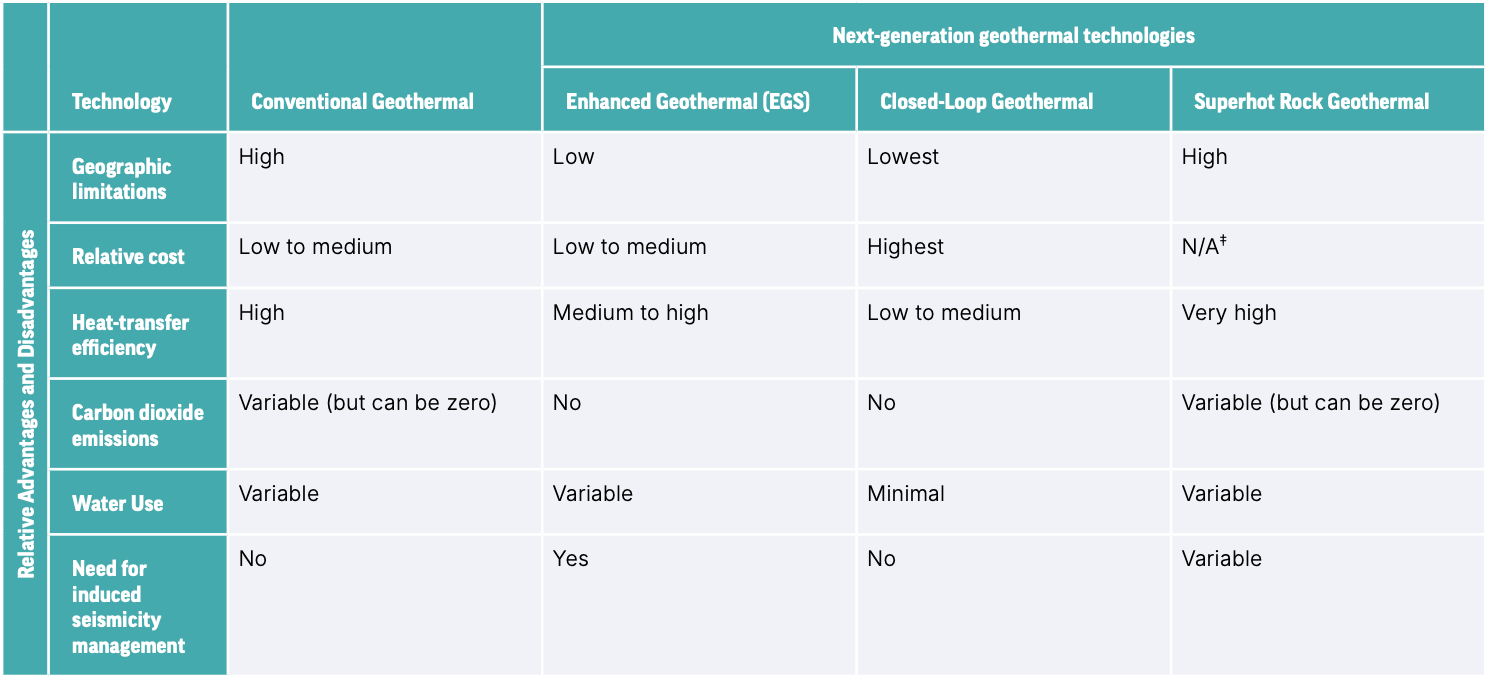
The sudden growth in the potential of geothermal energy generation stems both from recent successful demonstrations of next-generation geothermal technologies, and from progress in critical supporting technologies. Below is a brief examination of the status and impact of each key technology. A summary of key metrics for the primary categories of next-generation geothermal technologies (e.g., EGS, closed-loop, and superhot rock) is also given in Table 1.
Of the leading next-generation geothermal technologies, EGS is the most technologically ready, with decades of research laying the foundation for significant recent advances. It is also generally the lowest-cost next-generation technology, as it is more thermally efficient than closed-loop systems, and does not require the specialized materials and deeper drilling that superhot rock geothermal systems would need.32Milo McBride, et al., Unlocking Global Geothermal Energy: Pathways to Scaling International Deployment of Next-Generation Geothermal (Washington, DC: Carnegie Endowment for International Peace, July 10, 2025), https://carnegieendowment.org/research/2025/07/unlocking- global-geothermal-energy-pathways-to-scaling-international-deployment-of-next-generation- geothermal?lang=en. EGS does have two notable environmental risks: induced seismicity and water use. However, both can be effectively mitigated with responsible project management. In the case of induced seismicity, hydraulic fracturing during past EGS demonstration projects has induced nearby earthquakes, notably in South Korea and Switzerland, where seismicity was significant enough to cause injuries and physical damage.
However, several projects, including those described below, have successfully managed seismicity risk, and the increased learnings from the growing portfolio of EGS projects has made evaluating and mitigating such risk increasingly possible.33Wen Zhou, et al., “Managing Induced Seismicity Risks From Enhanced Geothermal Systems: A Good Practice Guideline,” Reviews of Geophysics 62, no. 4 (October 8, 2024): 1–57, https://doi. org/10.1029/2024RG000849. In terms of water use, the greatest potential risk is water loss in the geothermal reservoir, in which injected water remains trapped in the subsurface (e.g., due to migration away from the induced fracture network via other natural rock fractures) rather than returning to the surface via the production well to be recycled (Figure 4).
Existing pilots have demonstrated loss rates on the order of 10–20 percent, but also indicate that long-term, steady-state losses will drop to below 1 percent.34Corrie E. Clark, et al., Life Cycle Water Consumption and Water Resource Assessment for Utility-Scale Geothermal Systems: An In-Depth Analysis of Historical and Forthcoming EGS Projects (Argonne, IL: Argonne National Laboratory, August 1, 2013), https://doi.org/10.2172/1117360. If such low levels of water loss are achieved, the water intensity of EGS would be comparable to or lower than other energy generation technologies, and brackish or non-potable water could be used.35Katrina McLaughlin, et al., Next-Generation Geothermal: Considerations and Opportunities for Responsible Development (Washington, DC: World Resources Institute, November 26, 2024), https:// doi.org/10.46830/wriib.24.00015.
As of March 2026, there is one operational demonstration of a 3.5 MW EGS system—Project Red in northern Nevada—and two small commercial projects in Europe. The U.S. project, operated by Fervo Energy and developed in collaboration with the federally funded FORGE laboratory in Utah, is notable in that it adapted oil-and-gas–specific horizontal drilling and field stimulation technologies to the geothermal reservoir, which optimized flow rates and power output relative to earlier EGS projects. Initiated in January 2022 and completed in July 2023, Project Red involved creating two L-shaped wells that each reached depths of 8,000 ft (2,400 m) before being projected horizontally for 3,250 ft (990 m). Hydraulic stimulation created a suite of vertical fractures between the horizontal sections of the wells, enabling the system to achieve 3.5 MW of electric power generation.36Jack H. Norbeck and Timothy M. Latimer, “Commercial-Scale Demonstration of a First-of-a-Kind Enhanced Geothermal System,” EarthArXiv.org (July 18, 2023), https://doi.org/10.31223/X52X0B.
In September 2023, Fervo broke ground on the much larger Project Cape Station in Beaver County, Utah, adjacent to the FORGE laboratory. A 30-day well test in September 2024 demonstrated significant progress from learning-by-doing, achieving record-breaking flow rates that produced 10 MW of electricity, triple the output of the Project Red site.37Trent Jacobs, “Fervo and FORGE Report Breakthrough Test Results, Signaling More Progress for Enhanced Geothermal,” Journal of Petroleum Technology, September 16, 2024, https://jpt.spe. org/fervo-and-forge-report-breakthrough-test-results-signaling-more-progress-for-enhanced- geothermal. Cape Station will be operational in 2026, with an initial nameplate capacity of 100 MW, and plans to expand to 500 MW by 2028.38“Fervo Energy Secures $206 Million in New Financing to Accelerate Cape Station Development,” Fervo Energy, June 11, 2025, https://fervoenergy.com/fervo-secures-new-financing-to-accelerate- development/. Geothermal projects generally have high capacity factors, generating 80–95 percent of their nameplate capacity.39“Geothermal Energy,” Stanford University, accessed January 13, 2026, https://understand- energy.stanford.edu/energy-resources/renewable-energy/geothermal-energy.
TABLE 1A: GEOTHERMAL TECHNOLOGIES AT A GLANCE
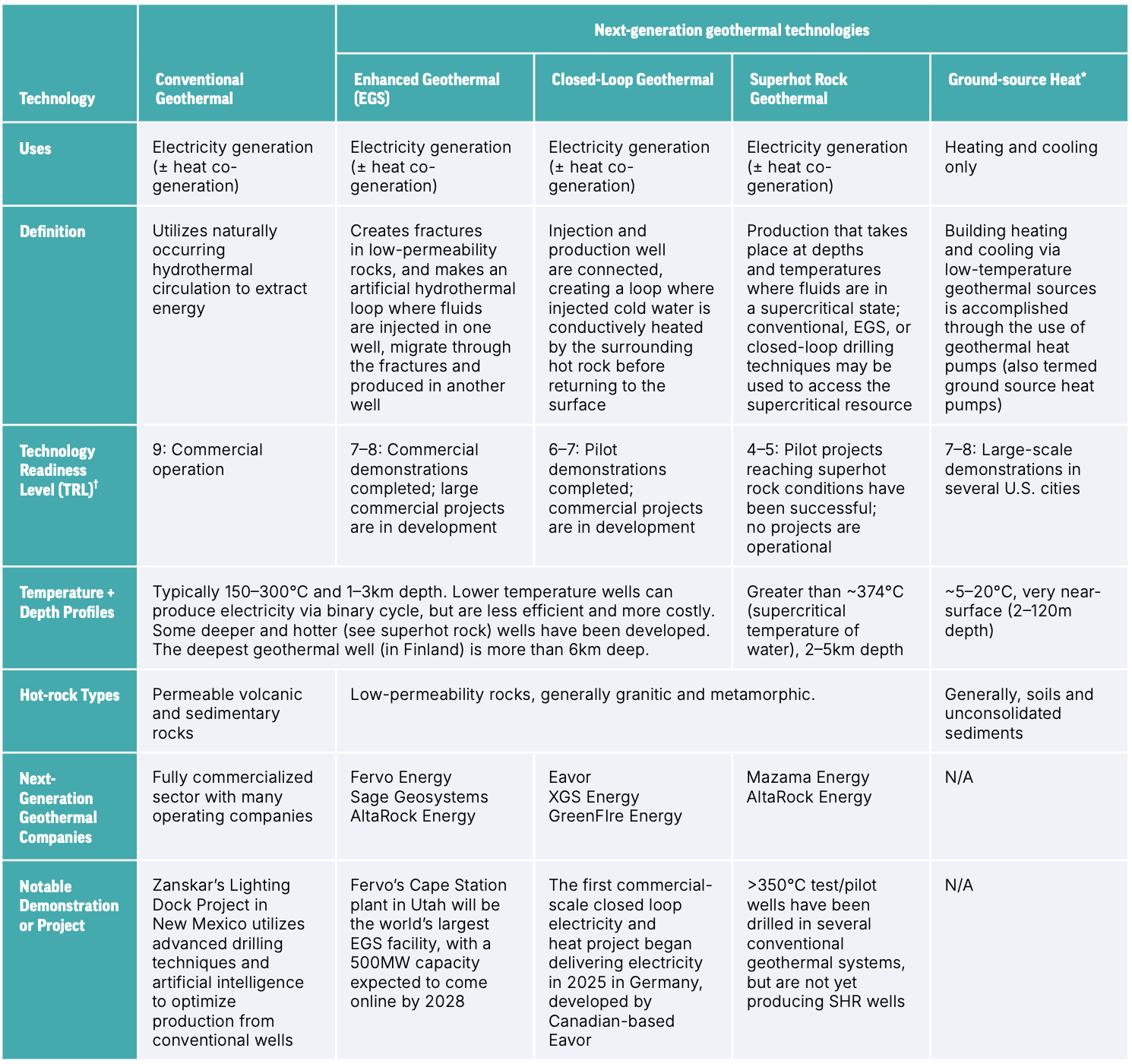
TABLE 1B: GEOTHERMAL TECHNOLOGIES AT A GLANCE (CONTINUED)
Beyond Fervo, several other EGS, or EGS-adjacent companies, are advancing field demonstrations in the United States, with a notable example being Sage Geosystems. Sage is developing a suite of projects—mostly in Texas, and many in partnership with the U.S. Air Force—that leverages both the heat and pressure of enhanced geothermal systems to provide electricity generation and energy storage.40Sonal Patel, “Geothermal Breakthrough in South Texas Signals New Era for ERCOT,” Power Magazine, September 2, 2025, https://www.powermag.com/geothermal-breakthrough-in-south- texas-signals-new-era-for-ercot/; “Project Pip Commercial EGS operations are also in development in Canada, Mexico, United Kingdom, Germany, Romania, and Australia.41Milo McBride, et al., Unlocking Global Geothermal Energy.
Closed-loop systems are less technologically ready than EGS and generally more costly for power generation, but also boast the lowest environmental impact of any geothermal approach.42Sri Kalyan Tangirala and Víctor Vilarrasa, “On the Limitations of Closed-Loop Geothermal Systems for Electricity Generation Outside High Geothermal-Gradient Fields,” Communications Engineering 4 (July 1, 2025): 116, https://doi.org/10.1038/s44172-025-00458-7. This is because closed-loop systems use a continuous sealed wellbore loop that circulates a working fluid from the surface to the deep subsurface and back again: by recirculating 100 percent of the working fluid, which need not be water, they have the highest water efficiency of geothermal techniques. They also eliminate the need for hydraulic fracturing, mitigating the risk of induced seismicity. The added cost, however, comes from the necessity of longer and more complex well-bores than EGS and reduced efficiency due to fluids not directly interacting with hot rock. Rather, heat is conductively transferred from the rock to working fluid across the wellbore interface. Some companies are testing the utility of refrigerants or carbon dioxide as working fluids, both to further reduce water intensity and to optimize heat transfer from the geothermal reservoir to the surface.43Michelle Ma, “Geothermal Startup Uses Refrigerants, Not Water, to Make Energy,” Bloomberg, September 15, 2025, https://www.bloomberg.com/news/articles/2025-09-15/in-utah-geothermal- startup-prepares-to-drill-first-test-site. In regions where water is scarce, or the risk of induced seismicity could be a barrier to social acceptance, the environmental advantages of closed-loop geothermal could balance the added cost. Finally, because there is no dependence on—or risk from—the presence of natural rock fractures in a closed-loop system, this technology is also the most geographically flexible, being deployable anywhere where there is sufficient subsurface heat flow to make the project economic.
Closed-loop geothermal has been successfully demonstrated by Canadian-based Eavor, with a pilot project in Canada employing a U-shaped design, where two vertical wells were connected by a horizontal well, creating a multi-kilometer scale heat exchanger.44“Eavor-Deep: Our Next-Generation Geothermal Demonstration Project,” Eavor, accessed January 13, 2026, https://eavor.com/eavor-deep/; Joseph A. Scherer, et al., Closed-Loop Geothermal Demonstration Project, GreenFire Energy Consultant Report prepared for California Energy Commission, June 2020, https://www.energy.ca.gov/sites/default/files/2021-05/CEC-300-2020-007. pdf. In addition, Eavor developed two additional projects: another demonstration project in New Mexico, and their first commercial heat- and electricity-generating project began operating in December 2025, in southern Germany.45Eavor, “Eavor Technologies Achieves First Electricity Production at Geretsried Site,” news release, December 4, 2025, https://eavor.com/press-releases/eavor-technologies-achieves-first-electricity- production-at-geretsried-site/. Another successful demonstration project was undertaken by GreenFire Energy in a conventional geothermal field in Coso, California where they converted an unproductive well into a tube-in-tube system—injectant flows down the outer tube, heats via contact with the surrounding rock, and rises through an insulated inner tube.46Joseph A. Scherer, et al., Closed-Loop Geothermal Demonstration Project. GreenFire is also working with the Wells2Watts research consortium, where they are testing the feasibility of converting an existing oil and gas well into a closed-loop geothermal well.47The Wells2Watts consortium, hosted by Baker Hughes at their Energy Innovation Center in Oklahoma City, includes oil and gas companies Continental Resources, INPEX, Chesapeake Energy, and California Resources Corporation, and provides R&D support and a testing venue for technologies that could be used to convert decommissioned oil and gas wells into closed-loop geothermal wells “Discovering Geothermal Ground Truths Through Wells2Watts,” Baker Hughes, April 8, 2024, https:// www.bakerhughes.com/company/energy-forward/discovering-geothermal-ground-truths-through- wells2watts. Currently, there are several announced commercial scale projects that use a version of either the U-shaped or tube-in-tube closed-loop configuration worldwide.48Milo McBride, et al., Unlocking Global Geothermal Energy North American examples include XGS Energy’s plans to develop a 150 MW facility in New Mexico, and VERO’s three 20 MW wells being developed in Salton Sea, California.49Lamar Johnson, “Meta Signs Geothermal Power Deal for New Mexico Data Centers,” Utility Dive, June 17, 2025, https://www.utilitydive.com/news/meta-xgs-energy-announce-geothermal-deal- new-mexico-data-centers-ai/750913/; “VERO Geothermal Closed-Loop Projects,” Vero Geothermal, accessed January 13, 2026, https://verogeothermal.energy/projects/.
Among the three next-generation geothermal technologies explored in this brief, superhot rock geothermal is the least technologically ready, but holds incredible promise due to the significantly higher energy density of supercritical fluids and steam relative to hot or boiling water.50Clean Air Task Force, Gaps, Challenges, and Pathways Forward for Superhot Rock Geothermal: Synthesis Report, February 2025, https://www.catf.us/resource/gaps-challenges-pathways-forward- superhot-rock-energy-summary-report/. With a five- to ten-fold increase in the energy production of a single supercritical well (>374 degrees C, or ~705 degrees F) relative to a typical high-temperature well (150–300 degrees C, or ~300–570 degrees F), fewer wells need to be drilled to achieve the same electricity generation level, proportionately reducing both project costs and environmental impact.51Guðmundur O. Friðleifsson, et al., “The Iceland Deep Drilling Project 4.5 km deep well, IDDP-2, in the Seawater-Recharged Reykjanes Geothermal Field in SW Iceland Has Successfully Reached Its Supercritical Target.” Scientific Drilling 23 (November 30, 2017): 1–12, https://doi.org/10.5194/sd-23-1- 2017. Wells have reached supercritical conditions in several conventional geothermal fields around the world, but none are operational, generally because the well-casing materials and above ground circulation systems cannot withstand the extreme temperature and pressure conditions, and in many cases the highly corrosive nature of naturally occurring supercritical fluids or steam.52“The Next Generation of Geothermal Energy,” Clean Air Task Force, accessed March 20, 2026, https://www.catf.us/shr-map/.
Several engineering advancements and field investigations are needed before superhot rock geothermal can be commercialized. In particular, heat resistant drilling and well materials will be needed, as will further research on how permeability can be sustained in systems that are below the brittle-ductile transition zone (where rocks respond to stress by folding rather than faulting).53Clean Air Task Force (2025), Gaps, Challenges, and Pathways Forward for Superhot Rock Geothermal As superhot rocks are generally deeper, faster and cheaper drilling techniques will also be important to reducing capital costs for superhot geothermal (although progress is being made in this field).
In addition to the geothermal technologies themselves, several supporting technologies promise to expand the geographic and economic potential of next-generation geothermal. These technologies also warrant a closer look, as their advancement and scaling will be integral to the success of sector growth as a whole.
For any geothermal development, drilling presents the highest cost—as much as 57 percent of overall project costs—and the highest risk, and thus closely influences whether next-generation geothermal technologies can be cost competitive with other energy generation technologies like wind, solar, and natural gas.54International Energy Agency, The Future of Geothermal Energy; Dayo Akindipe and Erik Witter, “2025 Geothermal Drilling Cost Curve Updates” (paper presented at 50th Workshop on Geothermal Reservoir Engineering, Stanford University, Stanford, California, February 10–12, 2025), SGP-TR-229, https://pangea.stanford.edu/ERE/db/GeoConf/papers/SGW/2025/Akindipe.pdf. Recent project development, notably in Fervo’s Red and Cape Station projects, Zanskar’s Lightning Dock project in New Mexico, and Eavor’s closed loop system in Germany, has demonstrated rapid learning rates in drilling speed, the key metric of performance.55Roland Horne, et al., “Enhanced Geothermal Systems for Clean Firm Energy Generation,” Nature Reviews Clean Technology 1 (February 2025): 148–160, https://doi.org/10.1038/s44359- 024-00019-9; “Lightning Dock: From Underperforming to Unmatched,” Zanskar, May 28, 2025, https://zanskargeothermal.substack.com/p/from-underperforming-to-unmatched; Eavor, “Eavor Technologies Achieves First Electricity Production at Geretsried Site.” Fervo’s most recently announced drilling project—an appraisal well in their Cape Station site that was drilled in advance of full-scale development to validate subsurface conditions—reached a depth of 15,765 ft (4,800 m) in 16 drilling days.56“Fervo Energy Drills 15,000-ft, 500°F Geothermal Well Pushing the Envelope for EGS Deployment,” Fervo Energy, June 10, 2025, https://fervoenergy.com/fervo-energy-pushes-envelope/. The maximum average rate of penetration (ROP) for this well was 95 feet per hour, a nearly five-fold improvement over drilling rates in 2017 at the nearby FORGE demonstration site. However, room for improvement remains—the standard ROP for oil and gas wells is 120 feet per hour.57Katrina McLaughlin, et al., Next-Generation Geothermal.
Drilling geothermal wells is slower than oil and gas because while fossil fuel deposits are reliably found in relatively soft sedimentary rocks like sandstones and shale, geothermal systems exist in a diversity of rock types, and in the case of next-generation systems, are mostly in hard, crystalline rocks like granite. Technological improvements to drill bit composition have the potential to improve drilling rates, but novel drilling technologies are also being developed that could be more effective for very deep drilling (i.e., >20,000 ft, or 6 km) or drilling in superhot rock systems. These include technologies that pre-crack the rock using plasma pulsed drilling or vaporize the rock entirely with millimeter wave technology.58GA Drilling, accessed January 13, 2026, https://www.gadrilling.com/plasmabit/; Quaise, accessed January 13, 2026, https://www.quaise.com/; “Plasma Pulsed Geo Drilling,” Fraunhofer IEG, accessed January 13, 2026, https://www.ieg.fraunhofer.de/en/references/ppgd.html. Both of these approaches involve non-contact drilling mechanisms, which prevents frequent equipment failure due to wear and tear, thus promising faster and more efficient drilling. Both technologies—plasma cracking and millimeter waves—are also in the early pilot stage, and continued cultivation of these and like technologies will be critical to the expansion of geothermal to regions with deeper heat sources, like the eastern United States.
Another technology still in the early pilot stage of development is carbon dioxide plume geothermal (CPG). These are projects that combine permanent carbon dioxide sequestration with electricity generation via EGS. Here, carbon dioxide—which could be derived from direct air capture or captured from an industrial point source—is injected into a natural or engineered permeable geothermal reservoir. Most of the carbon dioxide remains permanently stored in the reservoir, but some can be returned to the surface via a production well to generate electricity before reinjection. Carbon dioxide is an ideal fluid for electricity generation via EGS, as it has a higher kinematic viscosity than water, meaning it can flow more effectively through a reservoir, and could potentially double the amount of heat or power output that water would produce. Several deep saline aquifers that are being investigated for their suitability as permanent geologic storage sites for carbon dioxide are one to two miles (1.6 to 3.2 km) deep and likely have geothermal temperatures above 100 degrees C (~210 degrees F). Developing a hybrid carbon capture and storage–geothermal project at such sites could improve project economics by providing a secondary revenue stream through delivery of carbon-free heat and electricity, and would increase the storage capacity of the reservoir itself by maximizing flow from injection wells to production wells. While some pilots have demonstrated that carbon dioxide can be used as a working fluid, most work in this field is still focused on technological feasibility.59Jonathan Ogland-Hand, et al., “Beneath the Surface: Exploring Synergies Between Geothermal Energy and Carbon Capture” (webinar, United States Energy Association, July 10, 2025), https://usea. org/event/geothermal-ccs; Joseph A. Scherer, et al., Closed-Loop Geothermal Demonstration Project.
Three-dimensional microseismic imaging was a critical advancement for developing natural gas reservoirs in shales and tight sands, because it helped developers visualize what was taking place in the subsurface. Similarly, advanced computing is helping to provide a clearer—and more promising—picture of the availability of geothermal resources. For more than a decade, researchers in the United States relied on a 2011 assessment of domestic geothermal resources from investigators at Southern Methodist University. Their work primarily relied on interpolating available one- or two-dimensional heat flow measurements to create a three-dimensional regional analysis.60David Blackwell, et al., “Temperature-at-Depth Maps for the Coterminous U.S. and Geothermal Resource Estimates,” Geothermal Resource Council Transactions, 35 (2011):1545–1550, https:// publications.mygeoenergynow.org/grc/1029452.pdf. They concluded that for much of the United States, particularly east of the Rocky Mountains, temperatures sufficient for geothermal development lay seven kilometers (4.3 miles) or more below the surface (Figure 5). As the deepest geothermal well in the world is just over six kilometers deep, this presented a clear obstacle for geothermal development.
FIGURE 5: ECONOMIC GEOTHERMAL ENERGY IS CLOSER THAN WE THOUGHT
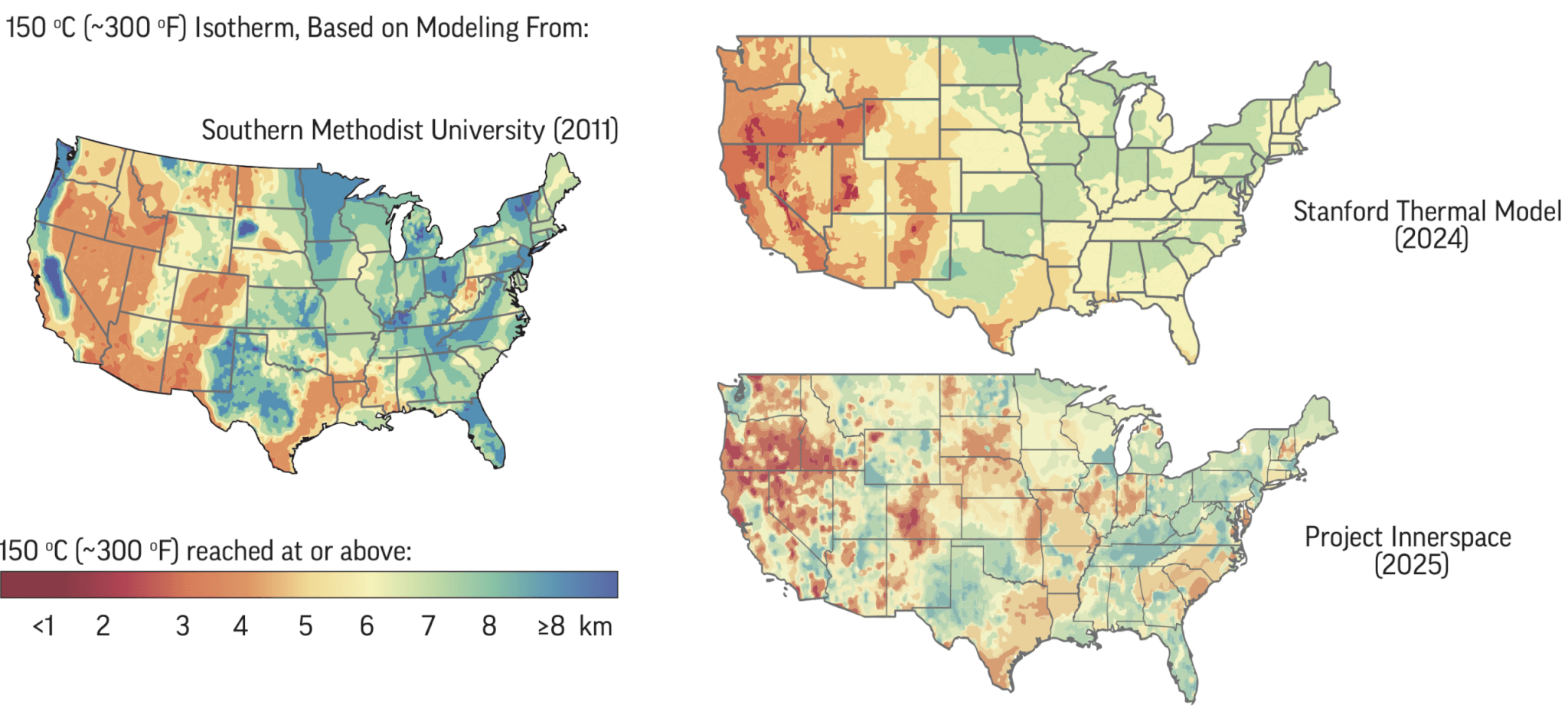
However, advanced computing and machine learning has allowed new heat flow models to assess information at a higher resolution and integrate a wider variety of data inputs—including thermal characteristics measured from hundreds of thousands of geothermal, oil and gas, groundwater, and monitoring wells; elevation; sediment thickness; magnetic and gravity anomalies; intensity of geologic radioactivity; and proximity to faults and volcanoes.61Mohammad Aljubran and Roland Horne, “Thermal Earth Model for the Coterminous United States Using an Interpolative Physics-Informed Graph Neural Network,” Geothermal Energy 12, no. 25 (2024):1–48, https://doi.org/10.1186/s40517-024-00304-7; International Energy Agency, The Future of Geothermal Energy. The new models, like the Stanford Thermal Model or the GeoMap tool from Project Innerspace (Figure 5), are more detailed, much better able to reproduce observed geothermal gradients in existing deep wells, and indicate that geothermal potential is much greater than previously thought, with economically viable geothermal resources available at depths less than six kilometers across most of the United States.
These newer and more promising models are now being validated in the field. Zanskar, a company that uses its own AI tools to identify potential hotspots and optimize conventional geothermal prospects, recently announced the discovery of a “blind” geothermal system—one in which there is no surface expression of geothermal activity less than 1 km deep in western Nevada.62Casey Crownhart, “How AI is uncovering hidden geothermal energy resources,” MIT Technology Review, December 4, 2025, https://www.technologyreview.com/2025/12/04/1128763/ai-geothermal- zanskar/. The likely prevalence of many such “blind systems,” and our improved ability to identify where such systems are located through advanced modeling, is arguably as valuable to near-term geothermal energy development as the recent advances in drilling and reservoir design.
Geothermal energy offers the potential to satisfy each of the critical needs emerging in the domestic energy sector: increasing the capacity of clean, reliable electricity generation, creating a pathway for reduced electricity load demand through direct heating, and providing energy storage to maximize the use of variable low-cost generation from wind and solar.
The potential for geothermal to provide clean, firm, on-demand electricity in the United States is enormous. According to the IEA, even considering only resources that are less than 5 km deep, the technical potential for next-generation geothermal in the United States is greater than 7 terawatts (TW), more than five times the nation’s total existing electricity generation capacity.63International Energy Agency, The Future of Geothermal Energy. The Department of Energy projects that as much as 300 GW of that geothermal energy could be economically deployed by 2050, accounting for about 30–40 percent of overall anticipated demand growth, and creating or preserving hundreds of thousands of jobs that require skills comparable to those used in oil and gas extraction and fossil energy power generation.64Doug Blankenship, et al., Pathways to Commercial Liftoff: Next-Generation Geothermal Power.
In terms of grid reliability, geothermal energy offers firm, on-demand electricity that is available when needed, and can quickly adjust output to meet changes in demand, or to balance out periods where lower-cost variable energy sources like solar and wind are at their highest capacity. In comparison with other clean firm energy technologies, geothermal is less geographically constrained than hydropower, has zero rather than low emissions (e.g., in comparison with natural gas with carbon capture and storage), does not rely on a fuel source like natural gas or nuclear, and has more rapid demand flexibility than nuclear, without producing a radioactive waste stream. Geothermal also offers a relatively low environmental footprint, with near-minimal land use demands (nuclear is the only energy technology requiring less), and lower or equivalent fresh water use relative to all energy technologies except solar and wind.65Katrina McLaughlin, et al., Next-Generation Geothermal.
Data centers—which are one of the major drivers of the anticipated growth in electricity demand—are a particularly well-suited market for next-generation geothermal, given their need for continuous firm power. Recent analysis by the Rhodium Group estimates that with strategic deployment, geothermal energy could economically provide 64 to 100 percent of anticipated data center load growth in the next decade. The opportunity is greatest when centers are located where geothermal resources are strongest, or when geothermal power generation is paired with ground-sourced heat-exchange systems for direct cooling, which can account for as much as 40 percent of data centers’ energy consumption.66Ben King et al., The Potential for Geothermal Energy to Meet Growing Data Center Electricity Demand (New York, NY: Rhodium Group, March 11, 2025), https://rhg.com/research/geothermal-data- center-electricity-demand/; Mehdi Yusifov and Nico Enriquez, From Core to Code: Powering the AI Revolution with Geothermal Energy.
The production of heat—for both industrial purposes and to heat buildings—accounts for nearly 40 percent of all energy use in the United States, and produces most of the carbon dioxide directly emitted by industrial processes each year.67Renewable Thermal Collaborative, The Renewable Thermal Vision, 2022, https://www. renewablethermal.org/vision/; “Energy for Buildings,” Stanford University, accessed January 13, 2026, https://understand-energy.stanford.edu/energy-services/energy-buildings; “U.S. Energy Facts Explained,” U.S. Energy Information Administration, updated July 15, 2024, https://www.eia.gov/ energyexplained/us-energy-facts/. While this paper is focused primarily on the power-generation potential of geothermal energy, it is important to note the enormous role geothermal energy can play in reducing fuel use or electricity demand for heating buildings via highly efficient ground-sourced heat pumps, or for low-and medium-temperature industrial processes through direct-use heating or heat and power co-generation. The possibility of direct-use heating is a critical co-benefit of the development of geothermal resources.68Nathan Mariano, et al., Unlocking Next-Generation Geothermal Heat for Industry (Santa Barbara, CA: University of California, Santa Barbara, July 2025), https://www.2035initiative.com/unlocking- next-generation-geothermal-heat-for-industry; Xiaobing Liu, et al., Grid Cost and Total Emissions Reductions Through Mass Deployment of Geothermal Heat Pumps for Building Heating and Cooling Electrification in the United States (Oak Ridge, Tennessee: Oak Ridge National Laboratory, November 2023), ORNL/TM-2023/2966, https://info.ornl.gov/sites/publications/Files/Pub196793.pdf.
Electricity and heat cogeneration—also called combined heat and power generation, or CHP—is notable here. Already used by more than 4,700 facilities in the United States, CHP can provide electricity, steam, and water for industrial uses, and to a lesser degree for institutional and commercial buildings like hospitals, schools, and office buildings.69U.S. Environmental Protection Agency, “Combined Heat and Power: Frequently Asked Questions,” factsheet, updated April 2022, https://www.epa.gov/sites/default/files/2015-07/documents/combined_ heat_and_power_frequently_asked_questions.pdf. Currently, CHP is almost exclusively generated from fossil fuels, but in many cases, could be replaced and expanded upon with next-generation geothermal CHP. Geothermal CHP is already utilized in conventional geothermal systems in countries like Iceland, New Zealand, Germany, Austria, Türkiye, and Thailand, and modeling indicates that geothermal energy could provide as much as 35 percent of global industrial heat needs at temperatures below 200 degrees C.70John W. Lund and Andrew Chiasson, “Examples of Combined Heat and Power Plants Using Geothermal Energy” (paper presented at the European Geothermal Congress, Unterhaching, Germany, May 30 – June 1, 2007), https://pangea.stanford.edu/ERE/pdf/IGAstandard/EGC/2007/091.pdf; Milo McBride, et al., Unlocking Global Geothermal Energy; Nathan Mariano, et al., Unlocking Next- Generation Geothermal Heat for Industry. Further, a 2024 analysis of next-generation geothermal heating indicates that even without cogeneration, geothermal heat is cost competitive with industrial use of natural gas boilers or electric heat pumps in most parts of the United States.71Jesse Griffin-Carney, “Geothermal for Industrial Steam,” Evolved Energy Research, September 4, 2024, https://www.evolved.energy/post/geothermal-for-industrial-steam. Combined with electricity generation that could be used to power industrial facilities, or sold to the nearby electrical grid, geothermal CHP could have a strong economic upside, and reduce industrial reliance on grid-sourced heating operations (e.g., air-sourced electric heat pumps or thermal batteries).
Enhanced geothermal systems not only have the potential to provide baseload power, but can also provide energy storage if the geothermal power plant is designed for flexible operation. In this case, reservoir injection can take place when lower-cost, variable energy production (e.g., wind and solar) is abundant, and pressurized geofluid can be stored in the subsurface reservoir, to be discharged when needed. Such a facility would provide a certain baseload power at all times, which could be curtailed to “charge” the system when demand and energy prices are low, and then could generate electricity above the baseload capacity when the excess energy storage is discharged. Modeling suggests that EGS reservoirs could store hundreds of megawatt-hours of energy per MW of surface capacity, with round trip efficiency rates of 61–91 percent, comparable to other forms of long-duration energy storage.72Wilson Ricks, Jack Norbeck, and Jessie Jenkins, “The Value of In-Reservoir Energy Storage for Flexible Dispatch of Geothermal Power,” Applied Energy 313 (May 1, 2022): 118807, https://doi. org/10.1016/j.apenergy.2022.118807.
Such flexibility could be used to shift energy generation to follow both daily and seasonal variation in energy generation and demand, and significantly expands the market opportunity for EGS—even given the current technology cost. Modelling suggest that in the western United States, EGS power plants designed with flexible storage capacity could reduce overall costs of a fully decarbonized electricity system by 1–11 percent, with advances in drilling and high-temperature reservoir engineering increasing those cost reductions to 12–27 percent.73Wilson Ricks, et al., “The Role of Flexible Geothermal Power in Decarbonized Electricity Systems,” Nature Energy 10 (January 15, 2025): 28–40, https://doi.org/10.1038/s41560-023-01437-y.
East of the Rocky Mountains, Sage Geosystems’ first-of-a-kind commercial project in Christine, Texas, demonstrates that dedicated geothermal energy storage is economically feasible. The 3 MW geothermal storage facility—completed in August 2025 and awaiting grid interconnection as of this report’s publication—is designed to complement existing wind and solar assets by providing 4 to 6 hours of power during discharge to the local electricity grid in rural south Texas.74Sonal Patel, “Geothermal Breakthrough in South Texas Signals New Era for ERCOT.” However, technological advancements would be necessary to economically deploy geothermal energy for baseload generation or flexible energy options in the midwest or eastern United States, and that is due to the most fundamental challenge of geothermal energy development, even for next-generation technologies: geography still matters.
Like conventional geothermal systems, the commercial viability of next-generation geothermal depends first and foremost on the geothermal potential of a region. The western United States has been volcanically active for millions of years, and as such, has a much higher natural geothermal gradient than the eastern United States (Figure 5). This means that every state west of the Great Plains is favorable for the exploitation of geothermal energy through next-generation technologies. Some localized regions in the eastern United States demonstrate potential as well, notably the Gulf Coast region. Here, the unique geological conditions that helped create world-class oil and gas reserves also contribute to the region’s elevated geothermal potential. Miles-long, near vertical fault structures and salt diapirs (where buoyant rock salt rises through denser overlying rock layers) have provided conduits for very deep, hot, pore fluids—over-pressurized by the thick sediment pile above—to rise toward the surface.75Kevin McCarthy, et al., “Geothermal Play Fairway Analysis (GPFA): A Texas/Gulf Coast Case Study,” (paper presented at the 49th Workshop on Geothermal Reservoir Engineering, Stanford University, Stanford, California, February 12–14, 2024), SGP-TR-227, https://pangea.stanford.edu/ERE/ db/GeoConf/papers/SGW/2024/Mccarthy.pdf; Daniel P. Bodner, et al., “Variations in Gulf Coast Heat Flow Created by Groundwater Flow,” Gulf Coast Association of Geological Societies Transactions 35 (1985): 19–27, https://archives.datapages.com/data/gcags/data/035/035001/0019.htm.
A common metric for assessing commercial viability of a power generation project is the levelized cost of electricity (LCOE), or the cost per kWh of producing electricity averaged over the lifetime of the project. The value incorporates both the upfront capital costs of designing and building the facility, and the continuous staffing and maintenance costs necessary to operate the facility over its lifetime. LCOE does not provide a holistic assessment of benefits or services of a given technology that provides energy (for example, it does not account for dispatchability, storage flexibility, carbon intensity, etc.), and so has limitations in its usefulness for comparing net grid benefits of different electricity generation technologies. However, LCOE can be useful for examining how costs of a specific technology, like next-generation geothermal, vary over time or geographies, and why.
Geothermal projects are capital-intensive, with up to 60 percent of the per-kWh cost of electricity originating from drilling expenses alone.76IEA’s LCOE analysis for current-technology next-generation geothermal assesses operation and maintenance costs as 25% of overall levelized costs, drilling costs as 58%, and other construction costs comprising the remainder; International Energy Agency, The Future of Geothermal Energy. As such, the deeper a geothermal resource is, the more expensive it will be to commercialize.77“Geothermal Electricity Technology Evaluation Model,” U.S. Department of Energy, accessed February 9, 2026, https://www.energy.gov/eere/geothermal/geothermal-electricity-technology- evaluation-model; “Stanford Temperature Model,” Stanford University, no date, https://stm.stanford. edu/; Mohammad J. Aljubran and Roland N. Horne, “Power Supply Characterization of Baseload and Flexible Enhanced Geothermal Systems,” Nature Scientific Reports 14 (2024): 17619, https://doi. org/10.1038/s41598-024-68580-8. In Figure 6, LCOE of the lowest-cost nearby geothermal resource from the publicly available Stanford Temperature Model is shown for 29 major U.S. metropolitan areas, relative to the depth at which geothermal temperatures reach 150 degrees C (~300 degrees F).78While it is possible to utilize geothermal energy for electricity generation at temperatures as low as 90-100 degrees C (~195–210 degrees F), it is generally uneconomical to do so unless complemented with direct-use heating. As such the industry standard for assessing economic viability for a power-generating geothermal resource is generally 150 degrees C (~300 degrees F); Mohammad J. Aljubran and Roland N. Horne, “Power Supply Characterization of Baseload and Flexible Enhanced Geothermal Systems.” Cities were chosen to reflect a representative distribution of regions across the contiguous United States to illustrate how LCOE varies geographically. Also shown are sites where existing conventional geothermal energy is developed (Salton Sea and Geysers in California), and the FORGE test site in Utah.
FIGURE 6: LCOE OF NEXT-GENERATION GEOTHERMAL IN THE UNITED STATES
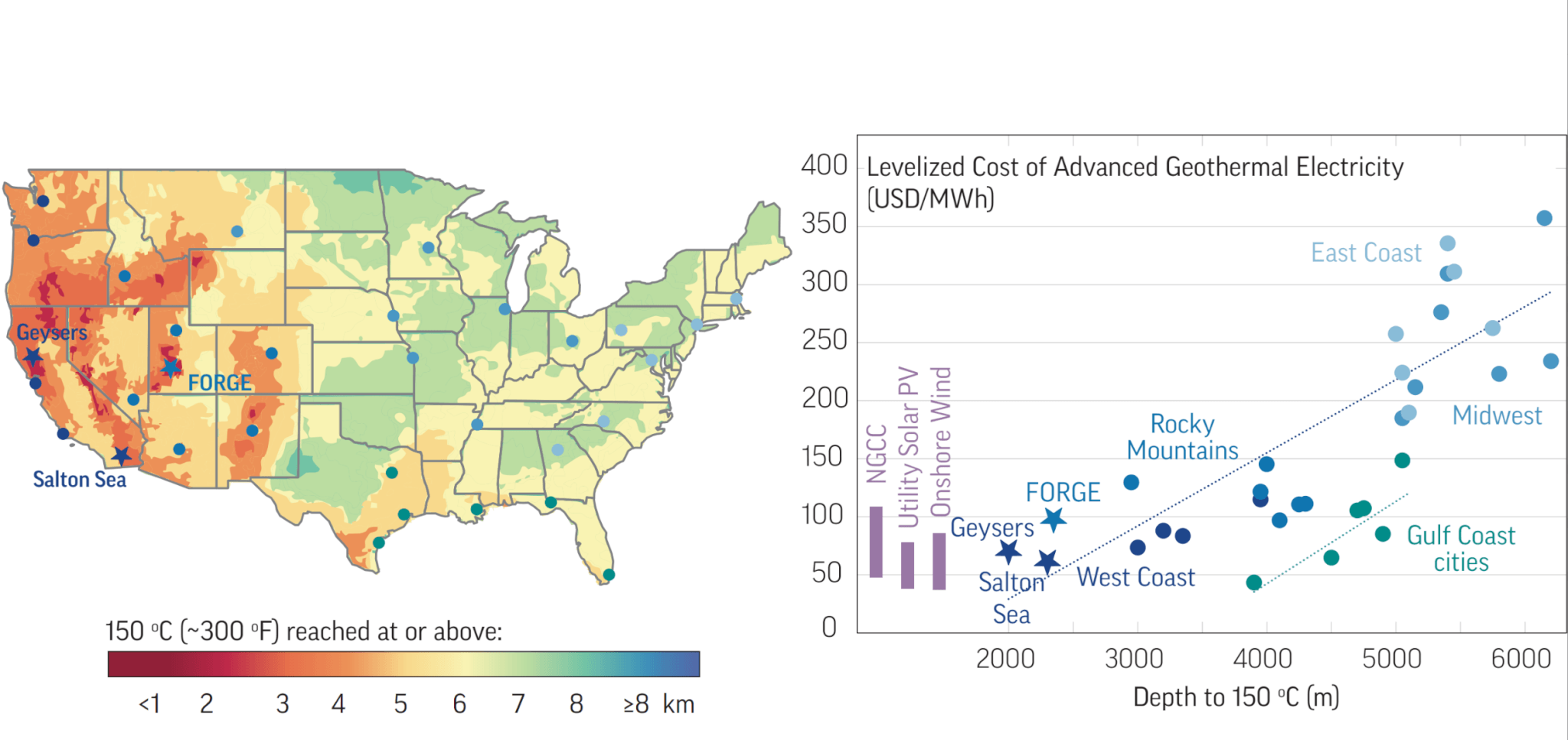
As might be expected, there is a strong linear relationship between the depth of geothermal sources generally considered to be economic (>150 degrees C) and the LCOE of developing those sources, but there are two additional takeaways to note. First, while most continental U.S. cities follow a linear relationship between LCOE and depth—in line with the developed sites in California and test site in Utah—cities along the Gulf Coast follow their own, offset linear trend. In these cities, wells can be drilled to four or five kilometers depth at the same cost as two- to three-kilometer deep wells in the rest of the United States. Just as the advantageous geology itself is related to the occurrence of oil and gas resources in this region, the lower cost of development is related to exploration and development of those resources. No other region in the world has been as heavily explored or drilled as the Gulf Coast, and as such, the geothermal potential of the region is already well-characterized, requiring little additional exploratory work. Drilling in the region is also faster and more straightforward, as the host rock of the geothermal resource is sedimentary rather than crystalline.79Study.” Kevin McCarthy, et al., “Geothermal Play Fairway Analysis (GPFA): A Texas/Gulf Coast Case While still in the early stages of technological investigation, if the hundreds of thousands of active, retired, or abandoned oil and gas wells in the region could be repurposed, geothermal developers could forgo much of the cost of exploration and drilling entirely and lower costs even further. Conversion of oil and gas wells to geothermal wells would provide benefits to the oil and gas industry as well, by reducing the environmental risk of abandoned and retired wells, and increasing the return on investment for producing wells by extending their useful lifetime.80E.g., Wei Xiong, et al., “Repurposing Oil/Gas Wells for Geothermal Applications: An Experimental Study on the Geothermal Impacts of the Cycling System,” (paper presented at 50th Workshop on Geothermal Reservoir Engineering, Stanford University, Stanford, California, February 10–12, 2025), SGP-TR-229, https://pangea.stanford.edu/ERE/db/GeoConf/papers/SGW/2025/Xiong.pdf; L. Santos, A. Dahi Taleghani, and D. Elsworth, “Repurposing Abandoned Wells for Geothermal Energy: Current Status and Future Prospects,” Renewable Energy 194 (June 1, 2022): 1288–1302, https://doi. org/10.1016/j.renene.2022.05.138.
The second notable feature in Figure 6 is that in much of the western United States and Gulf Coast, next-generation geothermal is already cost competitive with other power generation sources like natural gas combined cycle, utility-scale photovoltaic solar (utility solar) and onshore wind.81The 2025 United States unsubsidized LCOE for NGCC is $48–109/MWh, for utility solar is $38–78/MWh, and for onshore wind is $37–86/MWh; Lazard, Levelized Cost of Energy+, June 2025, https://www.lazard.com/research-insights/levelized-cost-of-energyplus-lcoeplus/. If costs can decrease by as much as 80 percent, as predicted by the IEA in their 2024 assessment of geothermal technology, next-generation geothermal energy would be cost-competitive with other electricity sources across the United States by 2035.82International Energy Agency, The Future of Geothermal Energy. The metropolitan areas illustrated in Figure 6 would have geothermal LCOEs in the range of $10–67/kWh.
While ambitious, an 80 percent reduction in the LCOE of geothermal is achievable, in light of the rapid reduction in drilling time observed over multiple next-generation geothermal projects in the past 24 months, and in the wider adoption of advanced drilling techniques from oil and gas (e.g., use of polycrystalline diamond compact bits, multi-well drilling pads, horizontal drilling, multistage stimulation) in geothermal development more broadly.83Roland Horne, et al., “Enhanced Geothermal Systems for Clean Firm Energy Generation.” However, such a reduction is also not guaranteed. Given the complexity of the Earth’s subsurface, and the myriad geologic environments in which next-generation geothermal might be deployed, first-, second-, and third-of-a-kind projects will need to be demonstrated across a range of geographic settings to see cost benefits from learning-by-doing and efficiencies of scale. De-risking such wide-scale early deployment and ensuring the wide dissemination of lessons learned from those projects will require collaboration and commitment from not only the technology providers themselves, but a broad ecosystem of stakeholders that includes energy industry incumbents, utilities, large electricity buyers, investors, financiers, academic institutions, and government. The federal government, in particular, has a role to play in aligning such stakeholders, and ensuring the United States takes advantage of the current momentum to become a global leader in next generation clean, firm, geothermal energy.
Next-generation geothermal energy is on the cusp of a commercial breakthrough that could rival the scale and impact of the shale gas revolution. By virtue of its advantageous natural resources and the high potential for knowledge, workforce, and supply chain transferability between geothermal and fossil energy industries, the United States is particularly well-poised to benefit from the sector’s growth—both as a source of cost-effective, low-carbon domestic energy, and in its capacity to export geothermal technologies and expertise worldwide. More than half of U.S. states are already providing state-level incentives and streamlined regulatory policies to encourage the development of geothermal power generation.84Dayo Akindipe, et al., 2025 U.S. Geothermal Market Report, National Laboratory of the Rockies, January 2026, https://docs.nrel.gov/docs/fy26osti/91898.pdf. But, just as they were for the shale gas revolution, supportive federal policies will also be critical to reducing project risk and encouraging private investment for next-generation geothermal deployment. The policy recommendations below highlight key, limited-term actions the United States government can take to support the geothermal industry as it continues to innovate and scale.
FORGE is a DOE-sponsored field laboratory dedicated to developing, testing, and accelerating breakthrough geothermal technologies. The program already boasts a significant success story in Fervo Energy, a company that was able to test its hydraulic stimulation technologies at the FORGE site and is now building a 500 MW commercial facility in southern Utah. Continued testing of advanced technologies are critical to expanding the efficiency and geographic potential of low-cost geothermal energy. This includes technologies that can speed drilling, improve the efficiency of surface components (like heat exchangers, working fluids, or condensers), effectively drill in superhot or high-pressure conditions, and more effectively conduct heat through closed-loop geothermal systems. While FORGE has secured federal funding commitments through 2028, those commitments are contingent on continued appropriations from Congress. As such, Congress should appropriate necessary funds to continue field lab testing of geothermal technologies; Congress should also support the development of at least two other demonstration sites in diverse geographies.
In tandem, Congress should continue funding R&D activity through the DOE’s Office of Geothermal (OG) and the United States Geological Survey to ensure (1) characterization of subsurface heat resources continues to improve, and (2) early-stage geothermal technologies—like paired geothermal-carbon storage projects and conversion of retired oil and gas wells for geothermal use—can develop. Federal support for programs that encourage partnerships between academia, industry partners, and national labs are particularly important for ensuring that geothermal technology continues to advance, and that research and teaching programs can foster a skilled workforce to meet the needs of this growing industry.
The investment and production clean energy tax credits (48E and 45Y, respectively)—established by the Inflation Reduction Act of 2022—are strong incentives for scaling a robust domestic energy supply that can meet the rapid growth in electricity demand anticipated over the next decade.85Inflation Reduction Act of 2022, 26 U.S.C. § 45Y and 26 U.S.C. § 48E (2022, amended 2025). Such demand-side support parallels the unconventional gas production tax credit that operated from 1980–2002, which helped ensure early projects could compete in existing energy markets, allowing novel technologies to mature and come down the cost curve.86Alex Trembath, et al., Where the Shale Gas Revolution Came From. While recent legislation has accelerated the termination of the investment and production clean energy tax credits for some energy generation technologies (i.e., wind and solar), the full value of the tax credits is still available for geothermal projects until 2033. Congress should ensure that these tax credits are retained for at least the entirety of the current eligibility period to (1) ensure next-generation geothermal can similarly compete in existing energy markets, and (2) provide investment certainty as new projects are developed.
Geothermal projects have high upfront costs and face key challenges in securing private financing. First, like oil and gas projects, the highest investment risk occurs at the beginning of the project: during the resource exploration and drilling phases. Second, projects’ high fixed capital costs combined with low investment returns and long return horizons reduce appetite for private investment.
To address financing challenges that stem from the nature of geothermal projects (i.e., high upfront capital and risk with long return horizons), the federal government can refer back to its own early successes in supporting geothermal energy. In the 1970s and 1980s, several federal financing programs existed to incentivize conventional geothermal development but were phased out as the bespoke and location-specific nature of conventional geothermal reduced the promise of future cost reductions and broader adoption. Next-generation geothermal approaches eliminate those barriers; reviving such programs over the next decade as new technologies become established is warranted.
The Office of Energy Dominance Financing (EDF), formerly the Loan Program Office, has the authority to issue federal low-interest loans and loan guarantees for geothermal projects that could unlock the capital needed to realize rapid cost reductions anticipated for this sector. The president, through executive action, could direct EDF to proactively solicit applications for next-generation geothermal and exploratory projects, through its 1706 “Energy Dominance Financing” program.87Similar to Executive Order no. 14302, “Reinvigorating the Nuclear Industrial Base,” Code of Federal Regulations, 90 FR 22595, May 23, 2025, https://www.govinfo.gov/app/details/FR-2025-05- 29/2025-09801, and Executive Order no. 14008, “Tackling the Climate Crisis at Home and Abroad,” 86 FR 7619, February 1, 2021, https://www.govinfo.gov/content/pkg/FR-2021-02-01/pdf/2021-02177. pdf. Congress should authorize cost subsidy appropriations to the 1703 “Innovation Energy” program that match or exceed the $1 billion in cost subsidies currently in place for 1706 to ensure EDF has an adequate budget and program direction capacity.88“Credit Subsidy,” U.S. Department of Energy, accessed January 13, 2026, https://www.energy. gov/lpo/credit-subsidy; Taite R. McDonald, Elizabeth M. Noll, and James Steinbauer, “How the One Big Beautiful Bill Act Reshapes DOE Loan Programs,” Holland & Knight Energy Technology Blog, August 15, 2025, https://www.hklaw.com/en/insights/publications/2025/08/how-the-one-big-beautiful-bill- act-reshapes-doe-loan-programs. While next-generation geothermal energy could qualify for EDF financing under the 1703 or 1706 programs, increasing existing program funding levels for either or both programs is important to ensure they can effectively help address growing energy demand in the United States.
Continued funding also signals to potential applicants that the EDF will remain a reliable financing partner over the length of the application period and project lifetime.
Congress could also make loans issued through EDF contingent on making non-proprietary geologic information, such as heat flow and subsurface lithology, available to better inform our understanding of national geothermal resources. As deployment accelerates through these kinds of investments, federal loans and loan-guarantees will become increasingly unnecessary: Through learning-by-doing and economies of scale, both exploration risk and capital costs will decrease, making traditional financing pathways feasible.
In addition to the exploration risk that geothermal projects must contend with, additional project risk comes from long and uncertain project development timelines, driven in large part by the complexity of existing national and subnational permitting and environmental review processes.
The former Biden administration and the current Trump administration have both taken steps to alleviate this latter challenge, by providing a National Energy Policy Act (NEPA) categorical exclusion for geothermal exploration and resource confirmation operations and by adopting emergency expedited permitting procedures for “strategically important” geothermal projects.89Bureau of Land Management, “BLM Takes Steps to Accelerate Geothermal Energy Development,” news release, January 16, 2025, https://www.blm.gov/announcement/blm-takes-steps-accelerate- geothermal-energy-development; U.S. Department of the Interior, “Department of the Interior Implements Emergency Permitting Procedures to Accelerate Geothermal Energy Development for National Security and Energy Independence,” news release, May 30, 2025, https://www.doi.gov/ pressreleases/department-interior-implements-emergency-permitting-procedures-accelerate- geothermal. However, congressional action will be critical to alleviate widespread permitting challenges. For instance, Congress should codify NEPA exclusions for geothermal projects (already the case for oil and gas exploration), streamline the permitting process, and ensure agencies are adequately staffed and trained to carry out environmental reviews for geothermal projects.
The bipartisan e-Permit Act, currently under congressional review, is an example of legislation that could significantly improve permitting efficiency and transparency. The bill would create common data standards and a shared digital permitting portal to allow all relevant federal agencies and public stakeholders access to relevant permitting materials and timelines.90ePermit Act, H.R. 4503, 119th Congress, (2025); Morgan Brummund,” Permitting Modernization: Enhancing Transparency and Efficiency to Unlock Better Outcomes,” Center for Climate and Energy Solutions (blog), September 9, 2025, https://www.c2es.org/2025/09/permitting-modernization- enhancing-transparency-and-efficiency/. This portal could ultimately serve as a framework for standardized and concurrent review across agencies and jurisdictions, which could reduce permitting timelines for geothermal projects that require review under state and/or tribal jurisdictions as well as at the federal level.91Andrea Diggs and Chris Chrisman, “State, Federal Incentives Heat Up Geothermal Projects,” Holland & Hart, December 4, 2025, https://www.hollandhart.com/state-federal-incentives-heat-up- geothermal-projects.
The federal government has several existing tools it can leverage to help develop projects both domestically and internationally in regions with high geothermal potential. Broadening such pathways can help ensure that more early-stage geothermal projects are developed, producing clean energy in regions where it is cost-competitive with other forms of firm power generation while increasing project learning and accelerating the sector’s progression down the cost curve.
One such tool is DOE’s other transaction authority (OTA), which allows flexibility in the way departments within the executive branch can partner with developers or industry consortia to help mission-relevant technologies advance and scale. For example, the Department of Defense (DOD) is working to deploy geothermal energy at several military installations, with many of these projects piloted or financed through the department’s OTA.92Defense Innovation Unit, “Three Additional Next Generation Geothermal Technology Companies Advancing DoD Energy Resilience,” April 15, 2024, https://www.diu.mil/latest/three-additional-next- generation-geothermal-technology-companies-advancing; Defense Innovation Unit, “Department of Defense Expands Geothermal Initiative To Support Mission Assurance,” August 11, 2025, https://www. diu.mil/latest/department-of-defense-expands-geothermal-initiative-to-support-mission. While the DOE has historically underutilized its OTA, the agency updated its administrative rules in January 2025. They can now make better use of OTA to provide flexible financing support, which can help de-risk geothermal projects.93Update and Relocation of the Department of Energy Technology Investment Agreement Regulations, 2 C.F.R. § 930 (2025); Alice Wu, Breaking Ground On Next-Generation Geothermal Energy (Washington, DC: Federation of American Scientists, January 8, 2024), https://fas.org/ publication/breaking-ground-on-next-generation-geothermal-energy/. Congress should appropriate additional funds for Department of Defense’s OTA to ensure the success of announced projects and allow for program expansion. Congress should also appropriate funds for the Department of Energy to use their OTA for similar projects on the 2.4 million acres of land over which it has authority.
Another tool is the Development Finance Corporation (DFC). Internationally, DFC can provide specialized financing for exploratory drilling projects in developing countries, and the State Department can help U.S.-based next-generation geothermal companies access international energy markets by supporting bilateral or multilateral energy development initiatives in those countries. To ensure that federal dollars can be more thoughtfully distributed to support innovative and promising projects, Congress should also amend the scoring methodology for DFC projects to account for risk of loss, rather than require full dollar value for every project.94Shayerah I. Akhtar and Nick M. Brown, U.S. International Development Finance Corporation: Overview and Issues (Washington, DC: Congressional Research Service, R47006, January 10, 2022), https://www.congress.gov/crs-product/R47006.
Electricity demand in the United States is rapidly increasing. As new generation capacity comes online in response, firm, flexible, low-carbon electricity generation will be particularly important for balancing the growth of low-cost variable sources like wind and solar. Geothermal energy is a promising solution to meet this moment. Already, next-generation technologies have broken through geographic barriers that have historically limited widespread geothermal deployment, and improved subsurface modeling indicates domestic geothermal energy potential is richer and nearer to the surface than previously thought. For the promise of next-generation geothermal to translate into performance, however, the industry will need support to overcome remaining near-term technical barriers: reducing drilling costs, demonstrating commercial viability in diverse geologic settings, and maximizing efficiency through improvements in drilling and well-casing technologies.
Federal support mechanisms that facilitated the shale gas revolution over the last three decades provide a blueprint for effectively supporting commercialization of next-generation geothermal energy, through reducing exploration risk and incentivizing first-of-a-kind and next-of-a-kind commercial demonstrations. Exploration risk is addressed through increasing the quality and availability of high-resolution subsurface heat flow data with direct federal research and public-private agreements. De-risking early project financing through lending support mechanisms and cultivating production domestically and abroad through existing Department of Defense, State Department, and tax credit programs creates the incentives needed for commercial demonstration, and streamlining the permitting process through digital tools could reduce length and uncertainty of project timelines. Finally, continued federal R&D support through FORGE and OG is critical for achieving the longer-term promises of geothermal energy—like flexible energy storage, paired carbon management, and superhot rock geothermal—and for establishing the workforce training pipelines that will be key to a robust commercial geothermal industry in the coming decades.