South Central Texas is experiencing rapid population and economic expansion, making it one of the fastest-growing regions in the country. This growth is occurring alongside more frequent and intense extreme weather hazards, putting people, infrastructure, businesses, and communities at risk. Extreme heat, wildfire, and flooding, like the deadly July 4, 2025, floods that impacted the Hill Country, do not respect jurisdictional boundaries, making coordination difficult and exposing capacity gaps among urban, suburban, and rural communities. And while communities across the region have developed innovative initiatives to mitigate risk, these efforts are often under-resourced and fragmented.
In 2025, the Center for Climate and Energy Solutions (C2ES) launched the South Central Texas Climate Resilient Communities Accelerator (the Accelerator) to address these challenges and strengthen regional resilience to extreme heat, wildfire, and flooding through cross-sector collaboration. This Roadmap was developed in collaboration with local leaders across the region through ongoing engagement and action-oriented convenings.
Together, cross-sector leaders outlined a future vision for South Central Texas where growth is paired with reliable infrastructure, connected communities, a protected workforce, accessible insurance, and success measured by continuity, not just recovery. This Roadmap represents the culmination of the first year of a two-year collaboration and showcases the shared priorities regional leaders—from the private, public, nonprofit, and academic sectors—seek to advance in the Accelerator’s second year.
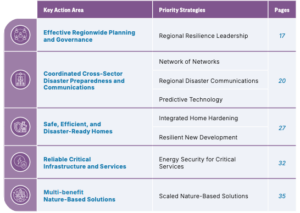
5 key action areas were identified by regional leaders to catalyze resilience:
• effective region-wide planning and governance
• coordinated cross-sector disaster preparedness and communication
• safe, efficient, and disaster-ready homes
• reliable critical infrastructure and services
• multi-benefit nature-based solutions.
These key action areas contain eight priority strategies developed by the cohort, each with implementation steps and an emphasis on cross-sector, regional-scale collaboration. Recurring themes of the strategies include understanding the importance of public-private partnerships, building the business case for resilience, utilizing trusted local messengers, leveraging existing regional models, and addressing the needs of small and rural communities.
South Central Texas has the leadership, models, and momentum needed to build a safe and prosperous future. The work required now is to scale and connect these strengths to maximize regional impact. Now, in the second year of the Accelerator, the program will shift from coordination to activation, with local leaders selecting one or more of the roadmap’s priority strategies to begin implementing. The Accelerator also seeks to support regional partners in carrying additional strategies forward on the ground and through an emerging national Accelerator network.
The Interstate 35 corridor between Austin and San Antonio is one of the fastest growing regions in the country. Spanning Bastrop, Bexar, Caldwell, Comal, Guadalupe, Hays, Travis, and Williamson counties, this area—the South Central Texas region—is home to more than 5 million people and is projected to grow to over 8 million by 2050. The region is an economic powerhouse, home to regional and global innovators that span tech, manufacturing, health care, defense, transportation, professional services, and more. Multiple natural ecosystems intersect in South Central Texas, like the rocky limestone hills and natural springs of the Edwards Plateau, the fertile soils of the Blackland Prairie, and the rolling forests of the Piney Woods.
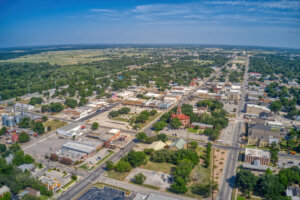
Communities are a vibrant mix of urban, suburban, and rural, including the urban centers of Austin and San Antonio, peri-urban communities like Kyle and Pflugerville, midsized communities like San Marcos and New Braunfels, and rural towns across the eight-county region. The region’s rapid population growth and development over the past decade has been especially notable in the nonurban centers. Since 2020, the population in Hays County has grown by almost 20 percent, while cities like New Braunfels and Kyle have grown by 35 percent to 40 percent.
The central question is not whether South Central Texas will continue to grow, but how it will grow—and whether new homes, infrastructure, businesses, and public systems are built in ways that reduce risk, protect natural assets, and strengthen long-term economic prosperity.
Population growth and development are not the only changes that South Central Texas is experiencing. While the region has always faced extreme weather— Hill Country in particular has long been known as “flash flood alley”—extreme weather events have increased in frequency and intensity in recent years, especially as the region’s developed footprint has expanded into risk areas such as the wildland urban interface.
Within a single calendar year, residents across the region experience multiple hazardous weather events, including extreme heat and cold, flooding, winter storms, wildfire, drought, and severe convective storms. These hazards, combined with rapid population growth, are shaping how the region grows, works, and lives, straining infrastructure, public health systems, ecosystems, and the regional economy, particularly for vulnerable residents, such as low-income households, older adults, people with disabilities, and others who face greater barriers to preparing for and recovering from hazard impacts.
Community leaders have highlighted pressing risks and impacts resulting from these growing hazards, including threats to public health, disparities in access to emergency warnings and safe structures during events, availability and affordability of insurance, and threats to the stability of the energy grid. The region’s businesses face additional continuity threats from related workforce disruptions, financial losses, rising insurance costs, and supply chain instability. For small businesses especially, these impacts can be existential—40 percent of small businesses never reopen after a disaster.
Flooding: The 2025 Hill Country floods resulted in 137 deaths, billions of dollars in damages, increases to unemployment rates, and decreases in tourism.
Extreme Heat: Between May and October 2026, more than 1,000 people have gone to the emergency room for heat-related illnesses in the Austin metropolitan region.
Wildfire: Texas carries the greatest risk of wildfire in the United States outside of California, with much of that risk concentrated in South Central Texas.
In a region defined by entrepreneurship and rapid growth, resilience should not be treated solely as a public-sector responsibility, but also as a market opportunity: Businesses that reduce risk, protect workers, and deliver practical resilience solutions can help the region grow more safely while strengthening long-term competitiveness.
The Accelerator uncovered the following strategic approaches to exponentially scale multisector resilience solutions and impact across the region:
Texans have long met big challenges with practicality, grit, and a strong tradition of neighbors helping neighbors. Across South Central Texas, that spirit is already visible in local governments, businesses, universities, faith communities, nonprofits, and residents working to reduce risk and protect what makes the region thrive. Many promising initiatives are already emerging in communities big and small (see Box 2). However, these efforts, which are largely led by governments, public universities, and community-based organizations, are often siloed and hampered by limited funds, constraining their collective impact and highlighting the need for stronger collaboration, coordination, creative financing, and information sharing.
Efforts like these across the region demonstrate that South Central Texas already has practical models to build on; the regional opportunity is to connect, adapt, and scale them across jurisdictions and sectors.
The San Antonio Climate Ready Neighborhoods is network of community partners linking resilience trainings, resources, and funding through a network of trusted community groups and spaces.
The Bandera Electric Cooperative Smart Battery Storage Program is a program to lease and manage energy storage systems for members, allowing them to maintain power during weather-related emergencies while also contributing to a stronger, more reliable Texas energy grid.
The Hill Country Alliance Guide for HOAs offers model homeowner’s association guidelines to encourage water conservation, native landscapes, and other actions that build resilience against drought and heat.
The Austin Disaster Relief Network is a trained network of churches offering support to disaster survivors to meet short and long-term needs.
The H-E-B Disaster Response is a corporate initiative that mobilizes mobile kitchens, support fleet, direct aid, rapid supply chain routing, and more to assist communities affected by a natural disaster.
The BeforeDuringAfter is a coalition led by Texas State University to help small businesses in Texas prepare for, respond to, and recover from natural disasters and other unpredictable incidents.
The Resilient Austin Playbook provides a strategic roadmap for coordinated action to strengthen community resilience, enhance critical infrastructure, and expand economic opportunity in the face of growing extreme weather, affordability, and infrastructure challenges.
The San Marcos Land Development Code (LDC) Update is a 2026 update with significant focus on stormwater regulations and incentives, cluster and conservation development, and landscaping and tree mitigation to mitigate localized heat and flooding impacts.
The Planet Texas 2050 is a University of Texas at Austin initiative to advance interdisciplinary research on resilience and to codesign adaptative strategies with stakeholders and frontline communities in Texas.
The Pflugerville Fire FLAME Initiative is a proactive wildfire mitigation program that brings housing, design, landscaping, and emergency services leaders together to reduce wildfire risk.
The Reforestation and Restoration by TreeFolks is a tree-planting initiatives to restore flood-damaged creek and river corridors, and use tree equity scores and community maps to plant trees to mitigate urban heat islands.
Despite examples of strong local leadership and innovation, regional resilience efforts remain fragmented and underfunded as disasters grow more frequent and costly, outpacing state and federal budget resources.
The South Central Climate Resilient Communities Accelerator was launched in 2025 to complement existing resilience initiatives and advance effective solutions at a regional scale by aligning stakeholders, surfacing scalable high-impact resilience solutions, supporting cross-sector engagement and collaboration, and cultivating new financing mechanisms like public-private partnerships. In this Roadmap, we chart a course toward resilience that focuses on the practical work of keeping people safe, businesses open, infrastructure reliable, homes insurable, water available, and communities connected before, during, and after extreme weather events.
C2ES launched the Climate Resilient Communities Accelerator in 2023 to facilitate regional crosssector coordination, uncover multihazard strategies, and elevate local needs to national policy efforts. Communities and organizations across South Central Texas invited the Accelerator to coordinate and catalyze regional resilience action.
The Accelerator provides two years of flexible support and convenings to enable local leaders to share learnings, align efforts, and design and advance innovative solutions that protect communities, businesses, and local economies. The Accelerator’s multiyear framework coordinates and activates a cross-sector cohort around shared risks and collaborative solutions (see Figure 1).
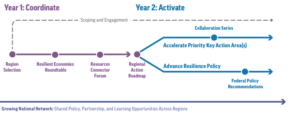
After the initial two-year regional effort, each Accelerator cohort joins a growing national network as the initiative expands into new regions across the United States, collaborating on emerging opportunities to share learnings, develop new partnerships, and improve national policy.
The program was piloted in 2023–24 in Colorado’s North Front Range, developing a regional roadmap for wildfire and heat and advancing a network of resilience hubs and microgrids. In 2025, C2ES launched the second Accelerator in Washington’s South-Central Puget Sound, now advancing regional disaster communications for heat and wildfire smoke.
South Central Texas is well positioned to demonstrate a Texas model of resilience—one that is locally led, business-engaged, infrastructure-focused, and grounded in practical solutions that protects communities while supporting continued economic growth. C2ES launched the South Central Texas Accelerator in September 2025 to bring together local governments, businesses, utilities, universities, and community organizations across the greater Austin–San Antonio corridor to coordinate and accelerate resilience leadership to extreme heat, wildfire, and flooding.
The Accelerator is designed to move from coordination to activation: in its first year, it identifies shared risks and strategies, leaning on local solutions already working across the region. This Regional Action Roadmap synthesizes this first year of collaboration and charts a course to advance key action areas and demonstrate early wins in its second year.
Between October 2025 and February 2026, C2ES conducted scoping calls with 120 regional leaders from local governments, emergency management, businesses, utilities, community and nonprofit organizations, academia, and philanthropies to understand past experiences with extreme weather, identify emerging solutions and key implementers, and understand what risks, gaps, and priorities the Accelerator could help address.
These calls highlighted five primary climate hazards: extreme heat, wildfire, intense rainfall and flooding, drought and water availability, and winter storms and deep-freeze events. These hazards were often described as interconnected, with cascading impacts as a key concern. Scoping also made clear that perspectives on the relative risks and impacts of these hazards varied significantly across the region’s communities, although almost all shared concerns about compounding impacts and interaction with the region’s significant population growth and development. Leaders suggested that resilience solutions that center energy resilience, the built environment, insurance affordability, workforce development, community-level preparedness, and coordination across jurisdictions may be regional priorities.
• 120 scoping calls with cross-sector leaders
• 2 in-person convenings with 76 organizations participating
• 7 Key action areas identified
• 154 brainstormed strategies for implementation
After extensive scoping and consultation, the South Central Texas Accelerator selected extreme heat, wildfire and grassfire, and flooding as the focal hazards for this regional effort.
High temperatures are not new to the region; however, the increasing frequency, duration, and intensity of extreme heat events are creating growing challenges for communities and businesses. For more information on extreme heat impacts, see C2ES’ resource on Extreme Heat and Climate Change.
Wildfire risk in peri-urban and rural areas of South Central Texas has grown markedly in recent years. Central Texas now carries the greatest wildfire risk outside of California.Recent events, including the Bastrop County Complex (2021), Oak Grove (2022), and Blanco County (2024) fires, highlight how prolonged heat, drought, and vegetation stress are expanding ignition potential across the region.
For more information on wildfire impacts, see C2ES’ resource on Wildfires and Climate Change.
The Austin–San Antonio corridor straddles the Balcones Escarpment, one of the most flashflood-prone regions in the country. Texas had the most number of flood-related deaths in the United States between 1958 and 2008, and San Antonio and Bexar County experienced the highest number of flood-related deaths in Texas between 1996 and 2024.
For more information on extreme precipitation and flooding impacts, see C2ES’ resource on Extreme Precipitation and Climate Change.
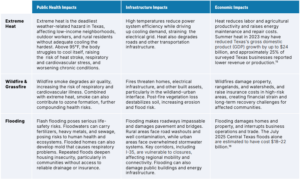
Extreme heat, wildfire and grassfire, and flooding have significant consequences for local public health, infrastructure, and economies.
South Central Texas provides fertile ground for unearthing solutions to extreme heat, wildfire, and flooding. These three hazards are intensified by shared regional drivers, including rapid growth, land-use change, and water stress, and are increasingly interconnected. For example, extreme heat can heighten wildfire risk, while post-fire conditions can increase erosion and flood risk during heavy rainfall. At the same time, shared vulnerabilities, such as expanding impervious surfaces and limited access to resilient infrastructure in vulnerable communities, amplify exposure across hazards.
Addressing heat, wildfire, and flooding through a coordinated, regionwide approach presents a significant opportunity to advance multibenefit solutions that improve community and economic outcomes. Examples include home retrofits, urban greening, disaster management, and watershed restoration, which can reduce heat exposure, manage stormwater, and lower wildfire risk. Some of the benefits of taking a multihazard, multibenefit approach include:
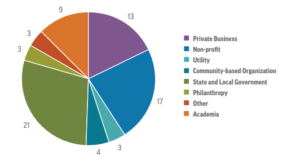
Resilience challenges and solutions do not fall neatly within one jurisdiction, sector, or funding source. Our scoping process identified a cross-section of individuals and institutions that were invested in or dependent on successful outcomes, that were already developing resilience solutions, or had local knowledge or unique perspectives. This mix was intentional—the cohort of 76 leaders who joined the convenings during the first year of the Accelerator brought together decision-makers and implementers who influence land-use decisions, infrastructure, emergency response, public health, insurance, energy reliability, housing, business continuity, and community trust. Participants came from urban and rural communities across the region, representing institutions including local governments, private companies, universities, philanthropies, nonprofits, and community-based organizations.
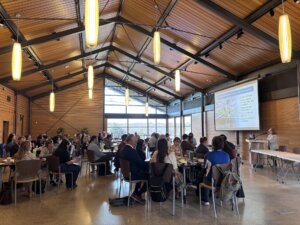
The Accelerator convened two collaborative events in 2026: the Resilient Communities and Economies Roundtable in March in San Antonio and the Resources Connector Forum in May in Austin. These meetings gave participants a chance to link their work with other communities, highlight common needs and priorities, and start creating a plan for a safer, more sustainable, and more prosperous South Central Texas. Together, the convenings moved the Accelerator cohort from shared risk identification to implementation design, establishing the priority strategies that organize the latter half of this Roadmap.
The March Roundtable included discussions on shared experiences and insights into the physical impacts of heat, wildfire, and flooding; visions for a resilient future; practical paths to resilience; and opportunities to accelerate collaborative action. Participants identified five key action areas to focus resilience efforts on.
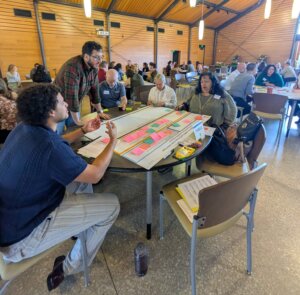
The May Forum reconvened participants and additional cross-sector leaders to build on earlier discussions and further explore pathways for regional resilience action. Attendees collaboratively developed action plans across the key action areas developed at the Roundtable and reflected on goals, opportunities, and priorities for the Accelerator to drive impact over the next year.
Private, philanthropic, and public resources should be stacked earlier and more intentionally, including through public-private partnerships. Public funders increasingly favor “shovel-ready” projects with measurable economic benefits. That leaves behind communities with urgent needs but limited staff, engineering plans, match dollars, and grant-writing capacity. Public-private partnerships, together with philanthropic and private funding, can fill this pre-development gap by paying for planning, design, partnership-building, and match requirements. For work that is not about building things—like communications, training, and network building—catalytic philanthropy, local grants, and in-kind support may be a more direct fit.
The cross-sector cohort of South Central Texas leaders moved from broad needs to eight implementable strategies through small-group exercises in the May Forum, identifying lead actors, potential partners, funding needs, nearterm steps, and barriers to execution. C2ES further refined these strategies using input from regional leaders over the first year of engagement and insights across the Accelerator program.
Although developed independently, priority strategies share recurring themes, highlighting common conditions, opportunities, and agreement among South Central Texas leaders on the path forward.

The five key action areas define the regional resilience outcomes that South Central Texas should pursue, while the priority strategies identify specific initiatives to achieve those outcomes (see Table 2). The priority strategies are a menu, not a mandate, and their ordering does not indicate a ranking.
NEED: South Central Texas faces interconnected hazards—flooding, wildfire, extreme heat—that do not stop at jurisdictional boundaries. Yet planning, data, and investment decisions are often fragmented across counties, municipalities, agencies, utilities, universities, and private businesses, making it difficult to understand multiple risks, prioritize high-impact resilience investments, and coordinate action before disasters occur. Smaller and rural communities may have fewer planning resources and less access to technical expertise, while larger jurisdictions and regional institutions often hold data, tools, and lessons learned that could benefit the whole region if shared more systematically. A regionwide planning and data-sharing structure can help South Central Texas align priorities, identify cross-jurisdictional vulnerabilities and interdependencies, reduce duplication of efforts, and accelerate resilience investments that protect communities, infrastructure, businesses, and ecosystems across the urban-rural spectrum.
This planning and governance key action area can be foundational to the other strategies in the Roadmap: the shared structures it establishes can support the other four key action areas in moving from strategy to implementation.
Establish a regional resilience network to coordinate pre-disaster planning, research, data sharing, and investment across jurisdictions. A regional resilience governing structure can align priorities, share data and best practices, support local decision-making, facilitate development of public-private partnerships, and accelerate investments across urban and rural communities, creating the coordination required to drive action and investments. Successful implementation of this strategy will create a centralized hub for resilience planning, project development, partnership building, and investment coordination, helping communities across South Central Texas strengthen their capacity to reduce future disaster impacts.
STEPS TO IMPACT
ESSENTIAL LEADERS & PARTNERS
ENABLING FACTORS
EXAMPLES AND EXISTING EFFORTS
NEED: The South Central Texas region has many disaster preparedness efforts, but they are fragmented and lack standardized messaging and best practices. Flooding, wildfire, and extreme heat impact the dense urban cores in San Antonio and Austin as well as small towns and rural communities across the region, and no single organization or jurisdiction can address these risks alone. Organizations are often unaware of each other’s work, critical tools go unattended, and many small and rural communities lack access to the resources and information available in larger cities. Some private-sector participants report significant staff time spent engaging county by county with emergency management leaders, while small businesses lack the capacity to engage, leaving them underprepared for extreme weather. In response to natural disasters in recent years, including the devastating 2025 Hill Country floods, emergency managers have improved coordination across jurisdictions. Even greater coordination among a broader set of actors, supported by shared data, technology, and standardized best practices, can help communities and companies prepare more effectively, reduce duplication of efforts, and ensure that residents are not caught off guard when disaster strikes.
Establish a regional resilience network to coordinate pre-disaster planning, research, data sharing, and investment across jurisdictions. A regional resilience governing structure can align priorities, share data and best practices, support local decision-making, facilitate development of public-private partnerships, and accelerate investments across urban and rural communities, creating the coordination required to drive action and investments. Successful implementation of this strategy will create a centralized hub for resilience planning, project development, partnership building, and investment coordination, helping communities across South Central Texas strengthen their capacity to reduce future disaster impacts.
STEPS TO IMPACT
ESSENTIAL LEADERS & PARTNERS
ENABLING FACTORS
EXAMPLES AND EXISTING EFFORTS
NEED: The South Central Texas region has many disaster preparedness efforts, but they are fragmented and lack standardized messaging and best practices. Flooding, wildfire, and extreme heat impact the dense urban cores in San Antonio and Austin as well as small towns and rural communities across the region, and no single organization or jurisdiction can address these risks alone. Organizations are often unaware of each other’s work, critical tools go unattended, and many small and rural communities lack access to the resources and information available in larger cities. Some private-sector participants report significant staff time spent engaging county by county with emergency management leaders, while small businesses lack the capacity to engage, leaving them underprepared for extreme weather. In response to natural disasters in recent years, including the devastating 2025 Hill Country floods, emergency managers have improved coordination across jurisdictions. Even greater coordination among a broader set of actors, supported by shared data, technology, and standardized best practices, can help communities and companies prepare more effectively, reduce duplication of efforts, and ensure that residents are not caught off guard when disaster strikes.
Develop a regional “network of networks” to coordinate disaster management and resources across sectors and communities. A lack of regional coordination can hamper disaster preparedness, response, and recovery efforts, leading to duplication of efforts and leaving small and rural communities without adequate support. Successful implementation of this strategy will connect and coordinate disparate efforts across the region while strengthening two-way disaster communication through trusted community leaders and collaborative outreach, empowering local governments, employers, and schools to better prepare for and respond during disasters. This “network of networks” will streamline interagency communications and establish a living database of resources and information providers while efficiently allocating resources across urban and rural areas, strengthening community trust and reducing loss of life and property.
STEPS TO IMPACT
ESSENTIAL LEADERS & PARTNERS
ENABLING FACTORS
EXAMPLES AND EXISTING EFFORTS
Establish a regional disaster communications toolkit for extreme heat, wildfire, and flooding with tailored messaging to equip local leaders across communities, businesses, and K–12 institutions. Success will look like residents, regardless of language, location, internet access, or income, having more accessible resources and support to take action across the full disaster cycle of preparedness, response, and recovery. This strategy can also include a K–12 preparedness curriculum to better reach students and their families across the region.
STEPS TO IMPACT
ESSENTIAL LEADERS & PARTNERS
ENABLING FACTORS
EXAMPLES AND EXISTING EFFORTS
Deploy technologies that strengthen disaster forecasting, monitoring, modeling, and decision support across the region. This strategy advances the use of predictive analytics, environmental sensing, hazard modeling, and data integration to help communities and organizations anticipate risks, prioritize mitigation investments, and support operational decision-making before and during extreme heat, wildfire, flooding, and other regional hazards. Successful implementation will result in a coordinated regional capability that provides emergency managers, infrastructure operators, businesses, and other decision-makers with more accurate, localized, and actionable hazard intelligence, shared in accessible formats through trusted local organizations.
STEPS TO IMPACT
ESSENTIAL LEADERS & PARTNERS
ENABLING FACTORS
EXAMPLES AND EXISTING EFFORTS
NEED: The San Antonio–Austin corridor is one of the fastest-growing regions in the United States.49 While some population growth has increased density in heat-vulnerable urban areas, much of the development is pushing into the wildland-urban interface, placing more homes in terrain at higher risk of wildfire, particularly during prolonged droughts. Growth is also expanding into the Texas Hill Country, which is especially vulnerable to flash flooding. Existing homes face their own vulnerabilities: a significant share of the housing stock in both urban and rural areas predates modern standards for wildfire resistance, thermal performance, and flood protection. Meaningful resilience benefits often require neighborhood- or community-scale improvements, as risk reduction is driven not only by individual properties but also by the collective performance of interconnected homes, infrastructure, and systems during a disaster. Without proactive investment to harden both existing homes and new construction, the region’s rapid growth will compound its hazard exposure for decades to come.
Develop a phased multihazard home hardening initiative across the region. An integrated “one-stop shop” for homeowners and renters will scale needed home hardening to protect households from growing extreme heat, wildfire, and flooding risks, while delivering benefits such as lower electricity bills and reduced grid demand. This approach will leverage existing single-focus approaches to home upgrades (e.g., energy efficiency or wildfire mitigation) and seek to enhance neighborhood- or community-scale resilience and attract new partners, such as insurance companies. It is designed to reduce home losses and insurance claims while expanding regional financing pathways and building a workforce trained to deliver hardening upgrades and maintenance. This strategy will seek to leverage future post-disaster recovery funds to support and scale the initiative, helping residents rebuild stronger and better prepare for future hazards. The initiative could begin by addressing wildfire and extreme heat risks together and integrating flood risks over time.
STEPS TO IMPACT
ESSENTIAL LEADERS & PARTNERS
ENABLING FACTORS
EXAMPLES AND EXISTING EFFORTS
Promote resilient growth and new development through voluntary standards and code updates that mitigate the risk of flooding, wildfire, and extreme heat. As the region continues to rapidly expand into flood- and wildfireprone areas, new development must be built to updated standards to avoid devastating economic impacts from future disasters. Because building codes are adopted and enforced locally, regional efforts are most effective when they enable, incentivize, and coordinate local action rather than replace it. This strategy will deliver a regionally coordinated approach to adopting future-proof building standards and systemic code updates to scale resilient development, reducing losses, damage, and insurance claims. New resilience-designed developments will be safer to live in and easier to insure, helping to protect long-term housing access and affordability, as well as local government tax bases and budgets.
ESSENTIAL LEADERS & PARTNERS
ENABLING FACTORS
EXAMPLES AND EXISTING EFFORTS
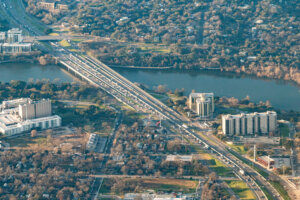
NEED: Strong infrastructure and reliable public services—from cooling centers and hospitals to water, transportation, and communication systems—are the foundation of community resilience and business continuity before, during, and after disasters. In South Central Texas, these systems share a common vulnerability: they all depend on a reliable power supply, and each summer tests the limits of the region’s electric grid. The Electric Reliability Council of Texas (ERCOT) broke its all-time peak demand record in July 2026 when demand exceeded 91 GW, as Texans used unprecedented amounts of electricity to cool their homes and offices during an extreme heat event. Because ERCOT largely operates as a separate grid from the rest of the continental United States, Texas cannot easily draw on neighboring power systems when demand spikes or generation falters, making the region uniquely exposed when extreme weather and grid stress hit, like during the 2021 winter blackout. The consequences of outages can directly impact public services. For example, when power fails, water treatment systems can halt, pump stations can cease operations, and residents can face life-threatening exposure without heating or cooling. Flood events stress water and wastewater systems at the moment when power is most needed to keep them running, while wildfire events can damage power lines and communication infrastructure that emergency response depends on. Some communities and utilities have begun to implement backup storage, but many households and communities across the region are underserved by current efforts.
STEPS TO IMPACT
ESSENTIAL LEADERS & PARTNERS
ENABLING FACTORS
EXAMPLES AND EXISTING EFFORTS
NEED: South Central Texas is home to ecological and water systems that cross jurisdictional boundaries and provide essential services to communities and businesses throughout the region, including drinking water and cooling. For example, the Edwards Aquifer supplies drinking water to approximately 2 million people and depends on recharge from the Hill Country watershed. Meanwhile, urban areas, including San Antonio and Austin, experience intensifying heat-island effects as increasing impervious surface areas and a shrinking tree canopy drive temperatures higher. Investment in nature to reduce weather hazards—known as nature-based solutions (NbS)—also yields multiple dividends, or cobenefits, including improved habitat, water and air quality, carbon sequestration, public health, recreation, and more. Nature-based solutions can include tree canopy and green infrastructure that address heat and stormwater in urban centers, vegetative buffers that mitigate flooding in suburban areas, and fire-aware landscaping, shaded fuel breaks, and defensible space programs that reduce wildfire risk in communities at the wildland-urban interface.

Design and implement nature-based solutions that deliver multihazard benefits at the site, watershed, and regional levels. This strategy will scale up intentional NbS efforts that reduce risks from multiple hazards— including flood, extreme heat, and wildfire—while improving water resources, habitat, and community well-being across urban and suburban areas and communities at the wildland-urban interface. A prioritized NbS project pipeline would be anchored in regional goals and replicable designs, enabled via new partnerships and financing, and designed to be accessible to individual landowners and businesses. Although many NbS are location specific, hazards and ecosystems extend across multiple communities and jurisdictions. This strategy will advance place-based NbS to deliver watershed-scale benefits over time, with the option to establish an ongoing regional program.
STEPS TO IMPACT
ESSENTIAL LEADERS & PARTNERS
ENABLING FACTORS
EXAMPLES AND EXISTING EFFORTS
Advancing this Regional Action Roadmap and each priority strategy will require regional leadership and resourcefulness. In a shifting resource environment, leading organizations across South Central Texas will need to pioneer new ways to achieve impact, from stacking diverse funding and financing and building public-private partnerships to leveraging nonfinancial resources like technical assistance and data sharing to build regional capacity. How these efforts are communicated and marketed to stakeholders matters as much as how they are funded. In Texas, resilience projects can achieve broad support when framed around risk reduction, cost savings, and economic competitiveness. Strategic communication that speaks to these priorities will be essential to building the buy-in needed to scale solutions across the region.
Delivering on the actions identified in this Roadmap will require sustained investment to move from planning to implementation. South Central Texas organizations can draw on a wide range of funding and financing resources to support resilience efforts through public, private, and philanthropic avenues. However, securing resources can be challenging given increasing competition, evolving federal and state funding priorities, and limited local capacity or knowledge in seeking funds. This landscape presents both an opportunity and a challenge to (1) look beyond traditional resilience programs, as many funding opportunities can support resilience outcomes through investments in infrastructure, transportation, water, public health, economic development, and community development; and (2) stack multiple sources that meet project needs across different phases.
Available resources generally fall into two categories: funding (non-repayable) and financing (repayable). The following sections provide an overview of funding and financing sources that can help advance resilience efforts in South Central Texas.
Federal grants have traditionally served as a primary source of funding for resilience planning, hazard mitigation, and infrastructure improvements.99 While these programs can provide significant investment, they are often highly competitive and may require matching funds, staff capacity, or alignment with federal priorities. Several FEMA programs offer significant funds for resilience projects. These FEMA programs, such as the Building Resilient Infrastructure and Communities (BRIC) program and the Hazard Mitigation Grant Program, which the Texas Division of Emergency Management (TDEM) coordinates in Texas, generally require projects to be included in an adopted hazard mitigation plan. Many counties in the region build their hazard mitigation plans through their council of governments. Organizations seeking resilience funding should incorporate priority projects into these plans well before a funding cycle opens to preserve eligibility for future federal investment and to build a project pipeline. However, these organizations should not rely solely on federal grant availability, as federal grants are competitive and their availability has become increasingly uncertain.
State programs provide important opportunities to support resilience planning and implementation, particularly when federal funding availability fluctuates. State agencies and infrastructure funding programs can provide both financial resources and technical assistance while helping align projects with state priorities. In Texas, agencies such as the Texas General Land Office and the Texas Water Development Board play important roles in supporting resilience, flood mitigation, and infrastructure investments. The Texas Energy Fund, administered by the Public Utility Commission of Texas, also supports weatherization and grid resilience. One successful example of a Texas community leveraging state funding for resilience comes from Caldwell County. Using a grant from the Texas Water Development Board’s Flood Infrastructure Fund, Caldwell County completed a flood hazard and stormwater planning assessment to identify high-priority flood risk areas across the county.
Foundations and philanthropic organizations can support planning, capacity building, community engagement, and pilot projects. These funding sources are often more flexible than government programs and can help advance innovative or community-led efforts. Participants in Accelerator convenings noted that philanthropic investment can play a catalytic role in the early stages of planning and implementation, paving the way to attract public and private funding as efforts develop. Access to funding usually requires established relationships and partnerships with foundations or philanthropic organizations.
Private capital, including public-private partnerships and impact investment, can support large-scale resilience projects and other initiatives with identifiable economic benefits. These approaches can help leverage private-sector expertise and resources but often require clearly defined project benefits, revenue streams, or risk-sharing arrangements. Access to private funding usually requires established relationships and partnerships with private partners.
Public-private partnerships, in particular, have been successfully used to accelerate community resilience efforts across the country and might be models for Texas, such as the IBHS FORTIFIED initiative in Alabama that funded the installation of wind-resistant roof upgrades, as well as the partnership between AT&T and the city of Longmont, Colorado, where modeling and data sharing improved efforts to protect residents from extreme heat. Accelerator participants emphasized that public-private partnerships in South Central Texas could be particularly relevant for companies focused on HVAC, internet of things and smart-home technology, health care, and construction, as well as companies needing to improve supply chain resilience.
Private capital or financing is best used to complement or leverage public and philanthropic funding, and vice versa. Most projects will be funded via a capital stack of multiple sources. Private capital differs fundamentally from funding: it requires repayment through, for example, rates, fees, taxes, assessments, or contract payments. This distinction means that investors are ultimately looking for assets that generate reliable revenue, protect existing revenue, or reduce costs enough to justify investment. Projects that achieve this are deemed “financeable,” “bankable,” or “investable.” In other words, they have a credible way to pay the money back.
Green banks are typically public, quasi-public, or nonprofit entities that use public or mission-driven capital to draw in private coinvestment for projects. Green bank financing is not limited to public-sector projects; it is designed for projects that might otherwise struggle to attract conventional lenders, such as nonprofit- or business-sponsored projects. A financeable project for a green bank is generally a credible project with an energy benefit, resilience benefit, or both, and a repayment path.
The Clean Energy Fund of Texas is the state’s first and only green bank. The nonprofit lends to businesses and homeowners, providing capital for infrastructure upgrades that enhance efficiency and resilience. For example, its Texas Energy Relief and Resilience Fund finances home improvements, such as new roofs, more efficient HVAC systems, and storm windows.
Community development financial institutions (CDFIs) are mission-driven lenders certified by the U.S. Department of the Treasury. They often offer more flexible financing terms than conventional banks and typically finance projects led by businesses, nonprofits, or community organizations. Generally, these projects should have a creditworthy borrower, a documented community benefit, and a clear explanation of why conventional financing is not a fit for the project. In Texas, LiftFund, a CDFI based in San Antonio, provides disaster-relief loans for small businesses, and Business and Community Lenders (BCL), based in Austin, offers lending for community-focused infrastructure.
On-bill and utility financing refers to financing that is repaid through a customer’s utility bill, often paired with efficiency, resilience, or weatherization upgrades. This type of financing is available to utility customers, either residential or commercial. This type of financing depends on a utility’s willingness to administer it, and not every utility offers on-bill financing. Since much of Texas has a competitive retail market, on-bill financing is offered mainly through municipal utilities and electric cooperatives. In Texas, Austin Energy offers zero percent financing on air-conditioning system replacement, tied to its Weatherization Assistance program.
Commercial property assessed clean energy (C-PACE) offers financing for efficiency and resilience upgrades repaid through a voluntary property assessment. It is available for owners of existing commercial, industrial, nonprofit, and multifamily residential properties. C-PACE financing is only available to local governments that have first adopted a C-PACE program. Third-party financiers typically provide capital, which is administered by the local government. Since Texas adopted statewide legislation to enable PACE programs in 2013, a number of counties and municipalities in South Central Texas have adopted PACE programs, including Hays County, Bastrop County, Travis County, Caldwell County, Comal County, Guadelupe County, the city of San Antonio, the city of Converse, and many more.
Bonds for resilience projects can take several forms. One form is insurance-linked securities, such as catastrophe bonds. For a catastrophe bond, investors provide money up front and earn a return, but if a previously specified disaster occurs, some or all of that money is redirected to cover losses instead of being paid back. Catastrophe bonds do not inherently reduce vulnerabilities but can be structured so that rebuilding is tied to resilience. In 2025, the North Carolina Insurance Underwriting Association became the first insurer to issue a catastrophe bond tied to resilience when it issued a $600 million bond that provides incentives for homeowners to install IBHS FORTIFIED roofs.
Another form of resilience bond is a traditional municipal bond for resilience infrastructure where repayment is tied to measured performance. Traditional bonds can be a challenging tool for resilience projects. It can be difficult to quantify the economic benefits of resilience projects, and in comparison to other types of infrastructure, such as toll roads, they frequently do not produce a direct revenue stream. However, there are innovative strategies to address this challenge, such as repayment based on avoided losses. Energy resilience projects, such as microgrids, may be a better fit for bonds than other forms of resilience infrastructure because they can generate revenue or cost savings.
Harris County, Texas, offers an example of innovative bond financing for resilience. In 2018, voters approved a $2.5 billion bond for flood protection, including watershed-scale restoration, infrastructure upgrades, and home buyouts. Central to the bond’s financing model is the idea that protecting the county’s property tax base from flood losses helps maintain the fiscal ability to repay the bond over time, showing how quantifiable risk reduction investments can provide a strong rationale for public financing.
Environmental impact bonds are another form of outcome-linked financing. They provide upfront capital and tie investor returns to independently verified performance. These bonds require a public authority or utility able to issue debt, collect revenue, and support third-party verification. Washington, DC, offers one example of environmental impact bonds. DC Water issued a $25 million environmental impact bond to manage stormwater runoff, with investor returns linked to project performance.
Beneficiary-pays, also known as aggregated financing, is a model where multiple organizations that benefit from a project share its cost. Investors pay the upfront cost, so a project can start immediately, and each beneficiary repays a share over time based on what it gains. This model is especially useful for multipartner and regional-scale projects. This financing model requires a nonprofit or other intermediary to serve as its financial sponsor and a way to quantify who benefits and by how much. An example of this comes from California, where the Forest Resilience Bond funded forest restoration for wildfire prevention upstream of a water-supply source. Water utilities, hydropower operators, insurers, local governments, philanthropic organizations, and investment firms bundled $4 million in financing, which was recovered through contractual payments based on how much each organization benefited from the project. For example, the Yuba Water Agency repaid $1.5 million because the forest restoration protected its source watershed. While the financing structure is not the same, San Antonio’s Edwards Aquifer Protection Program is a strong regional example of a mechanism where those who benefit contribute funds through a voter-approved sales tax that protects land over the recharge zone to safeguard the water supply.
Some federal programs offer low-interest financing, such as the Clean Water State Revolving Fund and the Drinking Water State Revolving Fund, both of which are managed by the Texas Water Development Board and support water infrastructure projects. These financing programs function similarly to grants: they are seeded by federal funding, offer zero-interest loans and principal forgiveness, and are given through a competitive application process.
The state can also play a role in project financing. For example, the Texas Water Development Board’s State Water Implementation Fund for Texas and the Texas Water Development Fund programs offer low-interest loans for water and flood infrastructure. Eligible applicants include governments, public agencies and authorities, and nonprofit water supply corporations.
While funding is an essential ingredient for resilience implementation, nonfinancial resources like technical assistance, data and planning tools, training opportunities, and peer networks are equally important. These nonfinancial resources are especially useful for helping communities understand risks and solutions, as well as building collaboration mechanisms and aligning priorities.
In partnership with community organizations, academia becomes a force multiplier—it amplifies community expertise with data, research capacity, and tools to extend impact beyond what either could accomplish independently.
Local examples of nonfinancial resources already being marshaled for resilience include the UT Austin’s Planet Texas 2050, a research challenge that has brought together over 150 researchers from across the university to advance interdisciplinary research on resilience and codesign adaptive strategies with stakeholders and communities. Other examples include the Texas A&M Forest Service’s Texas Wildfire Risk Explorer and the Texas A&M Agrilife Extension.
To build broad-based support, regional organizations should present their resilience projects in terms of what each audience already works toward. Since resilience challenges rarely stay in one sector, there will be some spillover. Extreme heat is a public health, workforce, and energy reliability issue. Flooding affects housing stability, transportation, and business continuity. Wildfire affects land stewardship, insurance markets, and water supply. Projects become more fundable when organizations spell out these overlaps and show how one investment moves several priorities forward. Tree canopy and green stormwater projects are one example. They can be presented as heat-health interventions, flood mitigation, neighborhood revitalization, and local workforce development all at once. The following potential pairings of audiences with framings illustrate which benefits might be most relevant:
In practice, this means building one clear regional story that each organization can adapt, not a single message for everyone. Organizations should put together short, audience-specific project briefs that lead with the outcomes each partner cares most about. Those briefs should back up claims with local data where possible, such as avoided losses, health impacts, jobs supported, and return on investment.
Choosing messengers matters as much as the message. Stories from affected residents and businesses can make the stakes concrete. Business leaders often carry more weight with private-sector peers, health professionals with health funders, and trusted local networks with residents. Organizations that coordinate their messaging, share proof points, and point to the cobenefits of their projects will be better able to attract a range of partners. They will also be better positioned to combine public, private, and philanthropic resources and to present the region’s resilience agenda as an investment in its long-term prosperity.
This Roadmap covers the five key action areas and eight priority strategies that represent shared cross-sector priorities for strengthening regional resilience to extreme heat, wildfire, and flooding. When implemented, they will move South Central Texas toward a future defined by resilient growth despite increasing risk, with communities and private-sector partners across the region benefiting from connectivity, insurability, and overall economic stability.
As the Accelerator enters its second year, the work will shift from planning to implementation as the cohort reconvenes to advance one or more priority strategies presented in this Roadmap. The Accelerator will foster the necessary collaboration across the public, private, community, nonprofit, and academic sectors to ensure selected strategies are implemented holistically to achieve regional impact. The remaining strategies are intended to be used as a starting point for the cohort and other regional partners, helping to catalyze action and advance implementation as needs and opportunities evolve.
Beyond Texas, the Accelerator will connect leaders across regions to collaborate on shared learning, partnership, and policy opportunities as the effort continues to expand across the United States. C2ES will also elevate local insights to federal and state policymakers to create the enabling conditions for communities across the country to thrive amid growing climate hazards and extreme weather events.
South Central Texas has weathered extreme heat, wildfire, and flooding events before, and it will again. The strategies in this Roadmap address these challenges head-on—and they did not emerge from outside experts or top-down mandates. They came from the leaders, businesses, and communities who call South Central Texas home. Now, these regional leaders have a path forward to face the next disaster prepared, together, and on the region’s own terms.