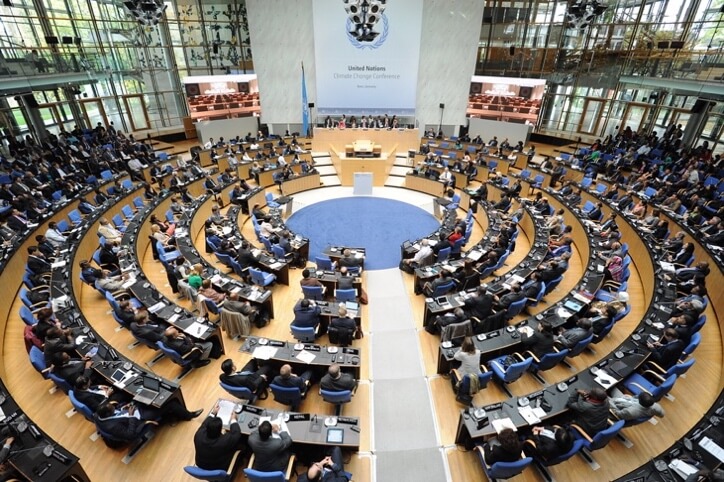
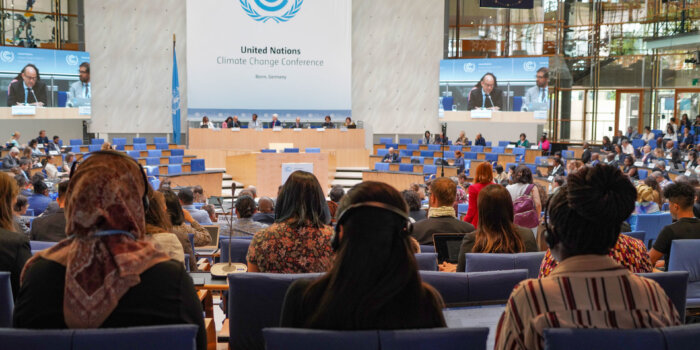
COP31 must show that the UNFCCC can both deliver on its core mandates and honestly reckon with what it means to enter a period of climate overshoot. Doing so will require a climate regime that is responsive to growing pressures for UN reform, tighter budgets, and an international landscape shaped by increasingly interconnected risks. As an indispensable forum for coordinating collective action in a more complex and constrained world, the UNFCCC’s ability to steer a response to overshoot while adapting to these broader pressures will determine its relevance in the decades to come.
Success at COP31 need not hinge on a major new political breakthrough—in a more contested and constrained world, the continued ability of countries to come together, find common ground, and advance collective action remains significant in its own right. A successful COP31 would therefore deliver meaningful—but perhaps not headline-grabbing—progress across several core areas, including:
- Responding to Today’s Reality: As the world enters a period of overshooting the Paris Agreement’s 1.5°C limit—and the devastating impacts of that become increasingly evident in all countries—the overarching negotiated outcome from Antalya must meet the moment. A COP31 cover decision should: (1) commit to limiting the intensity and duration of the overshoot, (2) send a strong signal of solidarity to support the most vulnerable developing countries to deal with climate impacts, and (3) create a strong foundation for the start of the second ambition cycle of the Paris Agreement.
- Just Transition: Parties are expected to operationalize the Just Transition Mechanism and define its functions in the context of the wider just transition architecture under the UNFCCC. At the same time, the effectiveness and efficiency of United Arab Emirates Just Transition Work Programme is being reviewed.
- Mitigation: Parties are due to decide whether to extend and strengthen the Sharm el-Sheikh Mitigation Ambition and Implementation Work Programme (MWP)—the UNFCCC’s only formal agenda item dedicated to mitigation—which is due to close this year with the possibility of renewal.
- Finance: Climate finance will cut across multiple negotiation workstreams at COP31. Parties will primarily discuss: whether to continue engaging in the newly established climate finance work programme; whether to further define the call to triple adaptation finance by 2035 agreed at COP30; and how to transition the governance of the Adaptation Fund, which disperses finance for adaptation and resilience projects in vulnerable communities, to the Paris Agreement.
- Adaptation: Parties need to agree the details of the composition, deliverables, and modalities of the Global Goal on Adaptation Technical Task Force —whose job it will be to support the development of methodologies and metadata for the Belém Adaptation Indicators.
- The global stocktake: COP31 will mark the launch of the technical assessment phase of the second global stocktake (GST2), through which Parties and non-Party stakeholders will evaluate collective progress towards the Paris Agreement’s goals and chart the way forward. The outcome of GST2 at the end of 2028 will be pivotal in determining the peak and duration of overshooting the Paris Agreement’s 1.5°C temperature limit.
- UNFCCC reform: COP31 provides an important opportunity to advance discussions on process improvement, including at the ministerial level. Australia and Türkiye could play a key role through consultations with countries at COP31.
- Ocean-climate Action: COP31 has an opportunity to advance practical action on ocean resilience and ocean-based climate solutions as countries confront growing climate impacts in an era of overshoot.
- Loss and damage: At COP31, Parties will review the report of the Fund for responding to Loss and Damage (FRLD) and guidance to the FRLD as well as the joint annual report of the Executive Committee of the Warsaw International Mechanism and the Santiago Network.
- Global Climate Action Agenda: Governments and non-state actors are making progress across the 6 Axes and 30 Activation Groups, each focused on GST1 outcomes and a COP31 Yearbook of Climate Action capture this progress, highlighting gaps and opportunities to inform GST2.
- Reviewing Transparency: The Paris transparency reporting rules—or MPGs—are due for review by 2028. Agreeing a start date for the review soon, ideally at COP31, would help jumpstart a deeply technical review process in 2027. After talks stalled at COP29, Parties will once again discuss whether features of NDCs—essentially what information NDCs should contain—should be expanded. Could these build on lessons learned from three cycles of NDCs?