As federal funding for climate resilience recedes and the impacts from more frequent extreme weather events continue to grow, communities from across the South-Central Puget Sound in Washington state have turned to an innovative collaborative approach to identify solutions that will better protect families and businesses from harmful wildfire smoke and extreme heat events.
In early 2025, the Center for Climate and Energy Solutions (C2ES) launched the South-Central Puget Sound Climate Resilient Communities Accelerator, convening government, community, and business leaders from across the region to strengthen relationships in pursuit of a healthy and resilient South-Central Puget Sound.
Today, the South-Central Puget Sound Accelerator released a Regional Action Roadmap for Extreme Heat and Wildfire Smoke, outlining six key action areas to strengthen heat and smoke resilience through a framework that supports future collaborative, cross-sector, regional action.
Expanding a Flexible Model
C2ES launched the Climate Resilient Communities Accelerator in 2023 in Colorado’s North Front Range. Designed to adapt to local context, the Accelerator supports government, tribal, community, and business leaders in building climate‑ready communities. With this flexible model, C2ES began meeting with South‑Central Puget Sound applicants in early 2025 to understand regional priorities, existing initiatives, and areas where collaboration could strengthen resilience efforts.
After selecting Washington for the second Accelerator cohort, the team expanded its engagement—meeting with over 100 participants across five counties between May and July 2025. As part of this engagement, C2ES leaned on the expertise and network of the University of Washington’s EarthLab—the Accelerator’s academic partner in 2025—whose place-based research and community-engagement model helped deepen understanding of local vulnerabilities and leaders.
These conversations revealed a clear theme: the public health risks posed by extreme heat and wildfire smoke are urgent and shared concerns across the region. Western Washington has faced record‑breaking heat and impactful wildfire smoke events in recent years. When combined, these hazards act as a “threat multiplier,” exacerbating existing vulnerabilities and limiting traditional coping strategies—like opening windows on hot days when smoke is present.
Key Action Areas for a Resilient South-Central Puget Sound
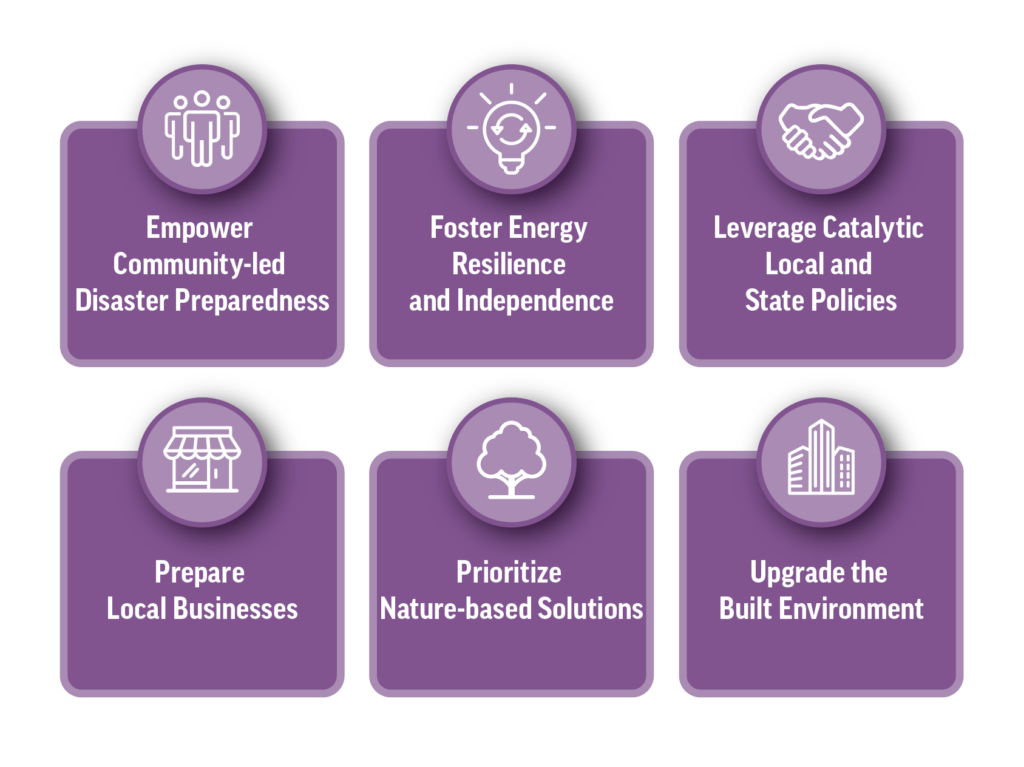
The 2025 Accelerator convenings elevated six action areas for building regional resilience to heat and smoke, focusing on opportunities to support a more connected and equitable South-Central Puget Sound region.
Across these action areas, cohort members consistently emphasized five cross‑cutting values—centering public health, furthering a just transition, prioritizing equity, exploring innovative financing, and maximizing cobenefits. These values shaped how the cohort evaluated regional needs, identified gaps, and developed strategies. They also mirror ongoing efforts across the South‑Central Puget Sound to pair climate resilience with broader community well‑being—from using health data to guide interventions, to ensuring that adaptation efforts are equitable, economically inclusive, and designed for long‑term sustainability.
A Menu of High-Impact Strategies
The Roadmap is designed as a resource for communities, organizations, and leaders both within and beyond the South-Central Puget Sound region. For each key action area, the cohort identified high-priority strategies and developed targeted action plans to implement them.
Empower community‑led disaster preparedness
- Build and activate a regional, cross‑sector trusted partner network to support locally led disaster preparedness, response, and recovery.
- Improve equitable access to disaster information through community‑driven outreach and engagement.
Foster energy resilience and independence
- Build a network of trusted community energy hubs that deliver essential services during outages and extreme heat or smoke events.
- Expand regional job pathways to grow a skilled, sustainable, clean energy workforce.
Leverage catalytic local and state policies
- Integrate community and business perspectives into state heat and smoke resilience policy and program design.
Prepare local businesses
- Invest in community‑based public‑private partnerships that help neighborhoods and businesses prepare for extreme heat and smoke.
- Support the development of business continuity plans that address heat and smoke risks.
Prioritize nature‑based solutions
- Expand climate‑smart tree canopy, prioritizing vulnerable and under‑resourced neighborhoods.
- Advance nature‑based solutions that protect water resources and provide cobenefits for heat resilience and air quality.
Upgrade the built environment
- Use public health data to shape models, plans, and codes that reduce heat and smoke exposure and enable safe indoor spaces.
- Streamline and scale upgrades to prepare homes and workplaces for extreme heat and wildfire smoke.
Grounded in insights from more than 70 organizations, this menu of strategies gives regional partners a practical path to extend the Accelerator’s impact. The Roadmap is designed to complement existing initiatives, spark collaboration, and support decision‑makers with a flexible and actionable set of tools.
Looking Ahead
The Roadmap also lays the groundwork for the second year of the South-Central Puget Sound Accelerator. In 2026, C2ES and cohort members will identify high-impact, feasible, and regionally aligned strategies from the Roadmap to refine and begin implementing. Over the coming months, public and private sector leaders will identify opportunities to drive momentum toward collaborative, equity-oriented resilience solutions that support a healthy, prepared, and thriving future for the South-Central Puget Sound.