Brazil President Luiz Inácio Lula da Silva declared the United Nations Framework Convention on Climate Change (UNFCCC) 30th Conference of Parties (COP30) the “COP of truth,” aiming to restore public confidence in climate policy.1 A note regarding usage: Use of “UNFCCC” broadly covers the Convention, the Kyoto Protocol, and the Paris Agreement. Reference to, e.g., “the Convention” indicates that the reference, Parties, or activi-ties pertain exclusively to that convention and not the Paris Agreement.
Reaching consensus outcome at COP30 was destined to be difficult, as the UNFCCC seeks to transition from decades of treaty negotiations toward a far greater focus on implementation. This task was made even harder given the wider context in which COP30 took place: extremely difficult and uncertain geopolitical conditions; the rise of populism in many countries, with climate action exploited as a divisive rather than unifying issue; increasingly severe and frequent global climate impacts; and a retreat from globalization and international cooperation, including reduced funding for international development and the United Nations.
Many Parties’ expectations for the climate conference included a robust response, through a consensus outcome, to the gap on collective ambition and implementation of nationally determined contributions (NDCs), which were due in February 2025. Expectations also included a call for all countries who have not yet done so to come forward with new and more ambitious NDCs. Parties expected COP30 to deliver on its mandates, such as adopting the indicators for the global goal on adaptation (GGA), as well as taking decisions on just transition and the global stocktake (GST). They further anticipated that the outcome should send a strong signal on finance as well as acknowledge and celebrate all that has been achieved to date under the Paris Agreement, given its ten-year anniversary.
Despite high temperatures, flooding from heavy thunderstorms, a violent protest, and even a fire in the conference venue, Parties in Belém, Brazil, concluded the COP by adopting a “Belém Political Package.”2“Belém Political Package,” UN Framework Convention on Climate Change, accessed January 5, 2026, https://unfccc.int/cop30/belem-political-package. This outcome was notable given the challenging geopolitical conditions, including the absence of the United States delegation for the first time since the UNFCCC was adopted in 1992.
The final day of COP30 ended after nearly 24 hours of continuous closed-door negotiations when Parties reached hard-fought compromises to adopt the decision on the “Global Mutirão: Uniting humanity in a global mobilization against climate change.” Mutirão is “a traditional knowledge inherited by the Brazilian society and born from cooperation.”3André Aranha Correa do Lago, “Eleventh Letter from the Presidency,” COP30, November 17, 2025, https://unfccc.int/sites/default/files/resource/20251117_Letter_COP30_President.pdf. The decision was the key consensus political outcome from COP30 and the headline decision for the Belém Political Package. The most contentious issues in reaching agreement on the Global Mutirão decision related to the COP30 response to the ambition of Parties’ NDCs, as well as issues of trade and finance.
Key elements of the Belém Political Package comprise:
Other key outcomes from COP30 include:
In addition to the formal outcome, COP30 President André Corrêa do Lago announced in the final plenary that he would support work on two roadmaps under the Presidency’s responsibility: one on halting and reversing deforestation and a second on transitioning away from fossil fuels in a just, orderly, and equitable manner. 4Felipe de Carvalho, “Belém COP30 delivers climate finance boost and a pledge to plan fossil fuel transition,” UN News, November 22, 2025, https://news.un.org/en/story/2025/11/1166433. He also welcomed Colombia’s April 2026 summit on fossil fuel phase-out, noting that the future COP30 Presidency roadmaps could build on its outcomes.
It was decided that COP31 will take place in Türkiye. In an unprecedented arrangement, Türkiye will be “COP31 President” and Australia the “President of Negotiations.”5“Türkiye-Australia Partnership Modalities,” UNFCCC, accessed December 8, 2025, https:// unfccc.int/sites/default/files/resource/20251121_COP31_Presidency_Modalities-CLEAN-AGREED. pdf. Therefore, while physically hosted in the city of Antalya, Türkiye, Australia will lead the negotiations; at the same time, Türkiye will lead and manage the action agenda. The Pacific Islands are expected to host the Pre-COP, the preparatory event for COP31.
The Global Mutirão decision was the key consensus political outcome from COP30 and the headline decision for the Belém Political Package. The Presidency faced political pressure to address the levels of ambition represented by Parties’ new NDCs, in the context of tense geopolitics and procedural challenges arising from proposals for four new agenda items.
Those proposals focused on: the implementation of Article 9.1, of the Paris Agreement on finance; responding to the NDC synthesis report and addressing gap between the ambition to limit global warming to 1.5 degrees C and implementation of existing commitments; promoting international cooperation and addressing the concerns with climate change related trade-restrictive unilateral measures; and the synthesis of biennial transparency reports. The result of two weeks of rigorous Presidency consultations with Parties, the content and title of the decision is meant to reflect the global spirit of cooperation.
A key outcome of the Global Mutirão is a new Presidency initiative, a “Global Implementation Accelerator.” The aim of this initiative is to accelerate implementation across all actors to keep 1.5 degrees C within reach and support countries in implementing their NDCs and NAPs. This initiative could complement the launch of the “Belém Mission to 1.5,” which builds on the first global stocktake’s “Roadmap to Mission 1.5.”12UNFCCC, Outcome of the first global stocktake, Decision 1/CMA.5, ¶ 191 (March 15, 2024), https://unfccc.int/sites/default/files/resource/cma2023_16a01E.pdf. The new Global Implementation Accelerator will enable implementation of NDCs and NAPs and reflect on accelerating the implementation, international cooperation, and investments in NDC and NAP plans.
At COP30, Parties for the first time agreed to discuss trade in the climate negotiations by launching a three-year dialogue to consider challenges and barriers to enhancing international cooperation on trade. The Convention sets out that unilateral and other measures to combat climate change “should not constitute a means of arbitrary or unjustifiable discrimination or a disguised restriction on international trade” because Parties should cooperate to promote an international economy that allows sustainable economic growth and development for all.13UNFCCC, Art. 3.5, May 9, 1992, S. Treaty Doc No. 102-38, 1771 U.N.T.S. 107.
Article 7.1 of the Paris Agreement established the GGA to provide a guiding framework to enhance adaptive capacity, strengthen resilience, and reduce vulnerability to climate change.18UNFCCC, “Paris Agreement,” Article. 7.1, December 12, 2015, T.I.A.S. No. 16-1104, https://unfccc. int/resource/docs/2015/cop21/eng/10a01.pdf#page=2. Parties at COP28 adopted the UAE Framework on Global Climate Resilience (UAE Framework) to guide efforts to achieve the GGA and monitor its progress. The UAE Framework aims to reduce the growing impacts, risks, and vulnerabilities of climate change, while also enhancing adaptation action and support and sets out thematic targets to be achieved by 2030.19UNFCCC, Global goal on adaptation, Decision 2/CMA.5 (March 15, 2024), https://unfccc.int/ sites/default/files/resource/cma2023_16a01E.pdf. Parties at COP28 also launched a two-year UAE-Belém work programme on indicators for measuring progress achieved toward the targets under the UAE Framework.20UNFCCC, Global goal on adaptation, Decision 2/CMA.5, ¶ 40. At COP29, Parties agreed to launch the Baku Adaptation Road Map, which aims to support progress under Article 7.1 of the Paris Agreement and help implement the UAE Framework.21UNFCCC, Global goal on adaptation, Decision 3/CMA.6, ¶ 29 (March 27, 2025), https://unfccc. int/sites/default/files/resource/cma2024_17a01E.pdf.
Adoption of the Belém Adaptation Indicators proved contentious. In September 2025, UAE-Belém work programme experts drafted a list of 100 potential indicators for Parties to work on. Some Parties were of the view that the 59 Belém Adaptation Indicators ultimately adopted at COP30 were not derived from this process and were not adequately considered prior to adoption, raising objections in the final plenary.
The indicators, which will help track progress against the targets of the UAE Framework for the second GST, are: voluntary; non-prescriptive; non-punitive; facilitative; global in nature; respectful of national sovereignty and national circumstances; and country driven.22UNFCCC, Global goal on adaptation, Decision 3/CMA.6, ¶ 7. The decision encourages Parties to utilize the indicators in reporting and planning processes.23UNFCCC, Global goal on adaptation, Decision 3/CMA.6, ¶ 12.
At COP30, Parties also launched the Belém-Addis vision on adaptation—a two-year, joint Subsidiary Bodies process to further operationalize the indicators. Parties will continue to work on the Belém Adaptation Indicators, including improving their metadata and methodologies.24UNFCCC, Global goal on adaptation, Draft Decision -/CMA.7, ¶¶ 1, 23, 25 (Advance unedited version). The metadata and methodologies will be considered at CMA9 (November 2027).25UNFCCC, Global goal on adaptation, Draft Decision -/CMA.7, ¶ 23 (Advance unedited version). Parties also agreed to undertake a review of the UAE Framework for Global Climate Resilience and the Belém Adaptation Indicators in 2029.26UNFCCC, Global goal on adaptation, Draft Decision -/CMA.7, ¶ 32 (Advance unedited version).
Parties at COP30 further adopted modalities for the first phase of the Baku Adaptation Road Map, which cover the years 2026–28. The work focuses on initial implementation of Baku Adaptation Road Map activities through two annual workshops and a technical paper by the secretariat.27UNFCCC, Global goal on adaptation, Draft Decision -/CMA.7, ¶¶ 26-30 (Advance unedited version).
Launched at COP27 and operationalized at COP28, the aim of the JTWP is to discuss pathways to achieve the goals of the Paris Agreement. The JTWP is built on and complements both the elements and structure of other work programs, workstreams, and bodies under the UNFCCC and the Paris Agreement. Each year, the JTWP holds two dialogues, hosts a high-level ministerial roundtable, and recommends a draft decision on its work for consideration and adoption at that year’s COP.31UNFCCC, United Arab Emirates just transition work programme, Decision 3/CMA.5 (March 15, 2024), https://unfccc.int/sites/default/files/resource/cma2025_L14E.pdf. At COP29, Parties were unable to agree on a decision recognizing the first year’s work of the JTWP or future guidance.
At COP30, despite differences of view, Parties ultimately agreed to launch a new “just transition mechanism,” to be implemented in a manner that builds on and complements “relevant workstreams under the Convention and the Paris Agreement.” Parties have yet to determine the function and scope of the mechanism and are expected to adopt a decision on the process to operationalize the mechanism at CMA8 (November 2026) in Türkiye.32UNFCCC, United Arab Emirates just transition work program, Draft Decision -/CMA.7, ¶¶ 25, 26 (Advance unedited version).
The JTWP decision sets out a non-exhaustive list of 22 key messages derived from Parties’ exchanges and sharing of information on opportunities, best practice, actionable solutions, challenges, and barriers from its global dialogues.33UNFCCC, United Arab Emirates just transition work program, Draft Decision -/CMA.7, ¶ 12 (Advance unedited version). Parties and non-Party stakeholders (NPS) were invited to consider the key messages in designing, implementing, and supporting just transition pathways in line with national circumstances, priorities, and capabilities, as applicable.34UNFCCC, United Arab Emirates just transition work program, Draft Decision -/CMA.7, ¶ 13 (Advance unedited version). The decision also encourages Parties to consider just transition pathways in their NDCs, NAPs, and long-term low-emission development strategies (LT-LEDS), recognizing the need for enhanced and continued support to developing countries.35UNFCCC, United Arab Emirates just transition work program, Draft Decision -/CMA.7, ¶ 15, 20 (Advance unedited version). The JTWP was invited to integrate relevant outcomes of the first GST in its work.36UNFCCC, United Arab Emirates just transition work program, Draft Decision -/CMA.7, ¶ 8 (Advance unedited version). In turn, it also invited other constituted bodies of the UNFCCC to integrate just transition elements and outcomes in their workplans and report on just transition-related progress in order to promote synergies.37UNFCCC, United Arab Emirates just transition work program, Draft Decision -/CMA.7, ¶ 16 (Advance unedited version).
In terms of future work, Parties requested that the Subsidiary Bodies develop the process for the review of the effectiveness and efficiency of the JTWP, including ways to improve existing modalities, in June 2026. The secretariat was requested to map and prepare a synthesis report on relevant instruments, initiatives, and processes under the UNFCCC and Paris Agreement, as well as relevant entities in the UN system.38UNFCCC, United Arab Emirates just transition work program, Draft Decision -/CMA.7, ¶ 24 (Advance unedited version). The review will feed into Parties’ consideration of the renewal of the JTWP at COP31.39UNFCCC, United Arab Emirates just transition work program, Draft Decision -/CMA.7, ¶¶ 27, 28 (Advance unedited version).
Established at COP26 and launched at COP27, the Sharm el-Sheikh mitigation ambition and implementation work programme (MWP) aims to scale up mitigation ambition and implementation before 2030 in a manner that complements the GST.44UNFCCC, Glasgow Climate Pact, Decision 1/CMA.3, ¶ 27 (March 8, 2022), https://unfccc.int/ documents/460950. It features two annual global dialogues and investment-focused events. The issues that conflicted Parties upon the MWP’s adoption at COP26 (e.g., whether to set recommendations or goals for specific sectors, and whether and how it would link to COP processes) continued to beset Parties in subsequent decisions (e.g., the scope of, improvements to, and messages from the MWP).
At COP30, Parties split over a proposed digital platform. With the MWP due to close in 2026, Parties ultimately requested the secretariat to improve the organization of future global dialogues and investment-focused events, including through enhancing Parties’ participation, as well as improving the investment-focused events’ cooperative matchmaking function to assist Parties in accessing finance. Parties, observers, and other stakeholders were invited to exchange views in June 2026 on the opportunities, best practices, actionable solutions, challenges, and barriers relevant to the continuation, functioning, and effectiveness of the work programme. At COP31, Parties will consider whether to extend the MWP.45UNFCCC, Sharm el-Sheikh Mitigation Ambition and Implementation Work Programme, Decision 4/CMA.4, ¶ 5
For several years, Parties have tried to explore whether the MWP could complement and address signals from the GST, such as the transition away from fossil fuels. In the plenary, some Parties protested the adoption of the MWP without language on a roadmap for the transition away from fossil fuels. Despite this, the decision was adopted. Subsequently, COP30 President André Corrêa do Lago announced that he would support work on two roadmaps under the Presidency’s responsibility: one on transitioning away from fossil fuels and a second on halting and reversing deforestation.46Felipe de Carvalho, “Belém COP30 delivers climate finance boost and a pledge to plan fossil fuel transition,” UN News, November 22, 2025, https://news.un.org/en/story/2025/11/1166433. He also welcomed plans for an April 2026 summit on fossil fuel phase-out, noting that the future COP30 Presidency roadmaps could build on its outcomes.
The MWP decision acknowledges past discussions on enhancing collaboration between governments, financial institutions, and other stakeholders to drive investable, country-owned mitigation projects. In that context, it set out a series of calls to operationalize use of the NMA Platform. Parties have been encouraged to record relevant projects to the NMA Platform.47UNFCCC, Sharm el-Sheikh mitigation ambition and implementation work programme, Decision -/ CMA.7, ¶¶ 9-10 (Advance unedited version). The Subsidiary Body for Scientific and Technological Advice (SBSTA) was requested to: consider how to improve Parties’ abilities to record or register their projects to the NMA Platform and interconnectivity with other platforms; and recommend a draft decision for consideration and adoption at COP31.48UNFCCC, Sharm el-Sheikh mitigation ambition and implementation work programme, Decision -/ CMA.7, ¶ 11 (Advance unedited version). The secretariat was asked to prepare a technical paper exploring how to operationalize the NMA Platform for this use by June 2026.49UNFCCC, Sharm el-Sheikh mitigation ambition and implementation work programme, Decision -/ CMA.7, ¶ 12 (Advance unedited version). (For more on the development of the NMA Platform, see “Article 6 on Carbon Markets and Non-Market Approaches.”)
Article 14 of the Paris Agreement requires Parties to undertake a GST every five years to assess collective progress toward the agreement’s long-term mitigation, adaptation, and finance goals and enhance international cooperation for climate action.53UNFCCC, “Paris Agreement,” Art 14.3. The first GST concluded at COP28 and, as part of the Paris Agreement’s “ambition cycle,” new NDCs that were due by February 10, 2025,54UNFCCC, Common time frames for nationally determined contributions referred to in Article 4, paragraph 10, of the Paris Agreement, Decision 6/CMA.3, ¶ 2 (Encourages Parties to communicate in 2025 a nationally determined contribution with an end date of 2035, in 2030 a nationally determined contribution with an end date of 2040, and so forth every five years thereafter); UNFCCC, Report on the 11th meeting of the Paris Agreement Implementation and Compliance Meeting, PAICC/2024/M11/4, ¶ 19 (April 17-19, 2024), https://unfccc.int/sites/default/files/resource/PAICC_11_meeting_report.pdf. must include information on how Parties have considered the GST outcome.55UNFCCC, Further guidance in relation to the mitigation section of decision 1/CP.21, Decision 4/ CMA.1, Annex I, ¶ 4(c) (December 17, 2020), https://unfccc.int/sites/default/files/resource/4-CMA.1_ English.pdf.56UNFCCC, “Paris Agreement,” Art. 4.3. The COP28 GST decision set out, in addition to key targets and signals from the first GST, several dialogues and a process to refine the second GST.
That decision established a dialogue on implementing the GST outcomes, which had been due to be operationalized at COP29. However, Parties disagreed on its scope and timeline, delaying its launch. The COP28 GST decision also called for Parties to consider refining the procedural and logistical elements of the overall GST process based on experience from the first GST. Parties have been considering refinements since June 2024. Parties had been unable to agree on procedural and logistical elements, including the timeline, as well as whether to request the Intergovernmental Panel on Climate Change (IPCC)—as a critical source of “best available science”—to align its Assessment Report cycle (typically seven to nine years) with the GST’s five-year cycle. The COP28 GST decision further established an “annual global stocktake dialogue” to “facilitate the sharing of knowledge and good practice on how the outcomes of the GST are informing the preparation of Parties’ next NDCs in accordance with the relevant provisions of the Paris Agreement.”57UNFCCC, Outcome of the first global stocktake, Decision 1/CMA.5, ¶ 187 (March 15, 2024), An annual GST dialogue was held in June 2024, but Parties were unable to agree on whether to set out key messages or on whether and when the dialogue should continue or conclude.
At COP30, Parties agreed to launch the UAE Dialogue on implementing the outcomes of the GST. It will be held at SB64 (June 2026) and SB66 (June 2027) before concluding.58UNFCCC, Matters related to the global stocktake, Draft Decision -/CMA.7, ¶ 5 (Advanced unedited version). The COP30 decision also establishes a high-level ministerial dialogue to be conducted at CMA9 (November 2027).59UNFCCC, Matters related to the global stocktake, Draft Decision -/CMA.7, ¶ 8 (Advanced unedited version). Summary reports of each dialogue will serve as inputs to the second GST (which will take place from 2026-2028).60UNFCCC, Matters related to the global stocktake, Draft Decision -/CMA.7, ¶¶ 7, 9 (Advanced unedited version).
With respect to refining the procedural and logistical elements of the overall GST process, Parties also decided to: invite the scientific community to provide best available inputs to feed into the GST in a timely manner, as available;61UNFCCC, Matters related to the global stocktake, Draft Decision -/CMA.7, ¶ 19 (Advanced unedited version). encourage the co-facilitators of the technical dialogue to enhance consideration of loss and damage, response measures, and international cooperation in the GST’s thematic areas;62UNFCCC, Matters related to the global stocktake, Draft Decision -/CMA.7, ¶ 20 (Advanced unedited version). and invite the Subsidiary Body Chairs to ensure sufficient time for each phase of the GST.63UNFCCC, Matters related to the global stocktake, Draft Decision -/CMA.7, ¶ 21 (Advanced unedited version).
Additionally, Parties considered and adopted conclusions on both the 2024 and 2025 reports of the annual GST dialogue, which encouraged Parties to draw on the lessons learned and good practice from the summary reports.64UNFCCC, Matters related to the global stocktake, Draft Decision -/CMA.7, ¶¶ 11-13 (Advanced unedited version). The next dialogue will be held at SB64 (June 2026), after which it will conclude.65UNFCCC, Matters related to the global stocktake, Draft Decision -/CMA.7, ¶ 14 (Advanced unedited version). Parties will consider the resumption of the dialogue in its consideration of the outcome of the second GST (2028).66UNFCCC, Matters related to the global stocktake, Draft Decision -/CMA.7, ¶ 14 (Advanced unedited version).
Article 2.1(c) of the Paris Agreement calls for making finance flows consistent with a pathway toward low greenhouse gas emissions and climate-resilient development. Since 2023, Parties, relevant organizations, and stakeholders have exchanged views on Article 2.1(c) and its complementarity with Article 9, which looks at climate finance more broadly, through the Sharm el-Sheikh Dialogue, which was set to end in 2025.
Building on the Sharm el-Sheikh Dialogue, Parties decided to extend discussions on financial alignment and consistency for three years under the Veredas Dialogue. Under the Dialogue, the COP Presidency will convene the Xingu Finance Talks, an annual high-level roundtable to exchange views on the challenges and opportunities of implementing Article 2.1(c). All interested Parties and NPS, including academia, international financial institutions, and the private sector, are encouraged to engage in and contribute practical solutions to these discussions.
The COP30 decision recognizes that there is no common interpretation of the scope of Article 2.1(c) or the manner of its implementation. The outcome also recognizes the need for safeguards for the domestic implementation of financial reforms, noting that any efforts to make finance flows consistent with the Paris Agreement’s goals are nationally determined, facilitative, non-punitive, and non-prescriptive.
COP16 established the Technology Mechanism (TM) to facilitate the implementation of enhanced action on climate technology development and transfer toward achieving the full implementation of the UNFCCC. The Technology Mechanism comprises the Technology Executive Committee (TEC) and the Climate Technology Centre and Network (CTCN). Parties to the Paris Agreement established a technology framework to provide overarching guidance to the TM and mandated that the TEC and CTCN also serve the Paris Agreement. In 2023, the GST established the TIP to: (i) strengthen support of technology priorities identified by developing countries; and (ii) address the challenges identified in the first periodic assessment of the TM. Parties have struggled to agree on its scope, timeline, relationship to the GST, and relationship to the existing technology architecture under the UNFCCC in order to operationalize the work.
At COP30, Parties adopted the Belém TIP to: contribute to the urgent action needed to limit temperature increase to 1.5 degrees C above pre-industrial levels; be implemented on the basis of principles of the technology framework and the provisions of the Paris Agreement; and support of the implementation of Parties’ NDCs, NAPs, and LT-LEDS, given their importance in implementing the GST outcomes. The COP30 decision set out the TIP’s: priorities and principles; key elements; and the tasks and responsibilities for the TEC and CTCN.
The TEC and CTCN will convene and prepare summary reports for two kinds of annual dialogues starting in 2027. The first kind consists of global in-session dialogues during the Subsidiary Bodies meetings on addressing challenges to implementing developing countries’ technology priorities and those challenges identified in the first periodic assessment of the TM. The second consists of regional dialogues in conjunction with regional forums thematically aligned with the global in-session dialogue for that year.
The TIP’s annual reports will feed into the periodic assessments of the TM, as well as future GSTs.72UNFCCC, Belém technology implementation programme, Draft Decision -/CMA.7, ¶¶ 24-25 (Advanced unedited version). The TIP will conclude in 2034, with the possibility of extension, taking into account the third GST.73UNFCCC, Belém technology implementation programme, Draft Decision -/CMA.7, ¶ 24 (Advanced unedited version).
Parties also agreed to convene a high-level ministerial dialogue on technology development and transfer in 2028.
To integrate gender considerations into the work of Parties and the UNFCCC Secretariat, COP20 established the Lima work programme on gender (LWPG). At COP29, Parties extended the enhanced LWPG for a period of ten years and requested that its third gender action plan be adopted at COP30. Each gender action plan sets out the objectives and activities for the advancement of knowledge and understanding of gender-responsive climate action. A gender action plan also seeks to mainstream gender in the implementation of the UNFCCC and the work of Parties, the secretariat, United Nations entities and all stakeholders, as well as women’s full, equal and meaningful participation in the UNFCCC process.
The Belém Gender Action Plan is structured around five priority areas: capacity-building, knowledge management, and communication; gender-balance, participation, and women’s leadership; coherence; gender-responsive means of implementation; and monitoring and reporting.76UNFCCC, Belém gender action plan, Draft decision -/CP.30, Annex (Advanced unedited version). The COP30 decision recognizes that the Gender Action Plan may inform Parties as a tool for implementing climate action, and that pathways and approaches should be nationally determined.77UNFCCC, Gender and climate change, Decision 7/CP.29, ¶ 10. 7 The Belém Gender Action Plan aligns its timelines and reviews with those of the enhanced LWPG; both will be reviewed in 2029 and conclude in 2034.78UNFCCC, Belém gender action plan, Draft decision -/CP.30, ¶¶ 6-7 (Advanced unedited version).
NAPs are voluntary national plans that set out how countries will adapt to climate change in the medium and long term. COP16 set out a process to develop and implement NAPs to help developing countries identify and address long-term climate adaptation needs.81UNFCCC, National Adaptation Plans, Decision 3/CP.26 (March 8, 2022), https://unfccc.int/sites/ default/files/resource/cp2021_12_add1E.pdf. The first GST calls for Parties to have NAPs by 2025 and implement them by 2030.82UNFCCC, Outcome of the first global stocktake, Decision 1/CMA.5, ¶ 59. K In June 2024, Parties initiated a “progress assessment” for the NAP process to: recognize the adaptation efforts of developing countries; assess their progress in achieving their NAP objectives; and consider how the NAP process contributes to the achievement of the GGA, as defined in Article 7.1 of the Paris Agreement. The assessment further aims to facilitate the sharing of experiences, best practices, and lessons learned among countries, while also identifying gaps and needs for improvement in the NAP processes. Parties were unable to reach consensus at COP29, particularly on finance for NAP implementation.
The COP30 decision on the progress assessment for the formulation and implementation of NAPs acknowledged that developed country Parties have made some progress but continue to face challenges in accessing sufficient adaptation finance, technology transfer, and capacity-building for their NAPs.83UNFCCC, National Adaptation Plans, Draft Decision -/CP.30, preamble, ¶¶ 1-2 (Advanced unedited version). Parties welcomed anticipated financial support from the Least Developed Countries Fund and the Green Climate Fund Readiness and Preparatory Support Programme as well as capacity-building support from UN organizations, agencies, and other regional and international support programs and agencies for NAPs.84UNFCCC, National Adaptation Plans, Draft Decision -/CP.30, ¶¶ 13-16 (Advanced unedited Parties requested the LDC Expert Group to collaborate on an overview of climate finance flows and financial support provided to developing country Parties for their NAPs and a technical paper on how LDCs and small-island developing States are integrating different climate approaches into their NAPs.85UNFCCC, National Adaptation Plans, Draft Decision -/CP.30, ¶¶ 12, 19 (Advanced unedited The next progress assessment for the formulation and implementation of NAPs will take place at COP35 (2030).86UNFCCC, National Adaptation Plans, Draft Decision -/CP.30, ¶ 24 (Advanced unedited version).
At COP29, Parties fully operationalized the FRLD, which was established to provide finance for developing countries that are particularly vulnerable to the adverse effects of climate change, in responding to L&D.
Every five years, Parties review the efficacy of the Warsaw International Mechanism (WIM), which drives the L&D agenda through its Executive Committee and the Santiago Network. The Executive Committee guides the implementation of the WIM’s functions, while the Santiago Network connects developing countries and communities with tailored, context-specific technical assistance on L&D. At COP29, Parties started the WIM’s third review.89UNFCCC, Warsaw International Mechanism for Loss and Damage associated with Climate Change Impacts and its 2019 review, Decision 2/CMA.2, ¶ 46 (March 16, 2020), https://unfccc.int/ sites/default/files/resource/cma2019_06a01E.pdf (Parties were unable to agree on the review of the WIM, resulting in a one-year delay).
The COP30 decision welcomed the FRLD Board and Parties’ work through 2025. Achievements and milestones included: establishment of the Barbados Implementation Modalities, particularly its access modalities grant interventions for 2025–26;90UNFCCC, Report of the Fund for responding to Loss and Damage and guidance to the Fund for responding to Loss and Damage, Draft Decision -/CP.30, ¶¶ 2-3, 7-8 (Advance unedited version). adoption of the Board’s 2026 workplan; 91UNFCCC, Report of the Fund for responding to Loss and Damage and guidance to the Fund for responding to Loss and Damage, Draft Decision -/CP.30, ¶ 7 (Advance unedited version). more than U.S. $815 million in pledges to the FRLD (as of November 19, 2025);92“Funding,” Fund for responding to Loss and Damage, accessed January 13, 2026, https://www. frld.org/pledges. and the Board’s decision to launch the first replenishment of the Fund in 2027.93UNFCCC, Report of the Fund for responding to Loss and Damage and guidance to the Fund for responding to Loss and Damage, Draft Decision -/CP.30, ¶ 12.
At COP30, Parties also concluded the third review of the WIM. The decision acknowledged progress, welcomed pledges, and requested committees and bodies to further improve their work. In particular, Parties requested the Santiago Network Advisory Board and relevant organizations, bodies, networks, and experts to publish a regular, multi-year report on the global status of L&D that reflects information and reporting provided by Parties to help inform their national L&D policy development.
Article 6 of the Paris Agreement recognizes that some countries will use international emissions trading or other NMAs to achieve their NDCs. Article 6.2 sets out the accounting rules for cooperative approaches involving the exchange of carbon credits as internationally transferred mitigation outcomes (ITMOs). As of November 15, 2025, the UNFCCC has received information on 39 cooperative approaches and 24 authorizations. Article 6.4 establishes a centralized framework, the PACM, for Parties to issue, use, and trade carbon credits. Article 6.8 establishes a framework for collaborative NMAs—in other words, not involving carbon credits—to support Parties in achieving their NDCs through holistic mitigation approaches that include adaptation, technology transfer, finance, and capacity building. As of November 13, 2025, three NMAs have been recorded onto the Platform, 106 national focal points have been nominated, and 31 support providers listed.
The COP30 Article 6.2 decision requested the secretariat, with the support of expert reviewers, to explain inconsistencies in the reporting of cooperative approaches and provide capacity building on how to prevent and address inconsistencies, including through relevant training materials. Given delayed development of the Article 6.2 registry system for tracking digital representations of ITMOs, Parties requested the secretariat to expedite its work and for the Subsidiary Body for Implementation (SBI) to review the sufficiency and stability of funds with a view to recommending a decision at COP31.100UNFCCC, Implementation of the guidance on cooperative approaches referred to in Article 6, paragraph 2, of the Paris Agreement, Draft decision -/CMA.7, ¶¶ 16, 27.
The COP30 Article 6.4 decision extended the deadline for host countries to approve the transition of activities from the CDM to the PACM from December 2025 (decided at COP26) to June 2026, which allows for the transfer of U.S. $26.8 million from the CDM to fund the PACM.101UNFCCC, Matters Relating to the Clean Development Mechanism, Draft Decision -/CMP.20, ¶ 18 (November 21, 2025), https://unfccc.int/sites/default/files/resource/cmp2025_L04E.pdf (Advance unedited version). As soon as the PACM becomes self-financing (and no later than 2035), annual financial transfers will be made to the Adaptation Fund, for a total of U.S. $56.8 million each year.102UNFCCC, Report of the Supervisory Body for the mechanism established by Article 6, paragraph 4, of the Paris Agreement and guidance for the mechanism, Draft decision -/CMA.7, ¶¶ 35, 36. UNFCCC, Guidance Relating to the Clean Development Mechanism, Decision 2/CMP.16, ¶ 18 (March 8, 2022), https://unfccc.int/sites/default/files/resource/cmp2021_08_add1E.pdf. UNFCCC, Matters Relating to the Clean Development Mechanism, Draft Decision -/CMP.20, ¶ 18 (Advance unedited version). As the Supervisory Body of the Mechanism (SBM) continues to operationalize the PACM, Parties requested the SBM to prioritize the review of CDM methodologies that are eligible to transition to the PACM,103UNFCCC, Report of the Supervisory Body for the mechanism established by Article 6, paragraph 4, of the Paris Agreement and guidance for the mechanism, Draft decision -/CMA.7, ¶ 24 (Advance unedited version). strengthen its stakeholder engagement process,104UNFCCC, Report of the Supervisory Body for the mechanism established by Article 6, paragraph 4, of the Paris Agreement and guidance for the mechanism, Draft decision -/CMA.7, ¶¶19-20 (Advance unedited version). and continue to ensure that its standards, methodologies, and tools ensure environmental integrity are based on the best available science and informed by robust evidence.105UNFCCC, Report of the Supervisory Body for the mechanism established by Article 6, paragraph 4, of the Paris Agreement and guidance for the mechanism, Draft decision -/CMA.7, ¶ 23 (Advance unedited version). Parties will review the PACM’s modalities, including SBM member terms, in 2028.106UNFCCC, Report of the Supervisory Body for the mechanism established by Article 6, paragraph 4, of the Paris Agreement and guidance for the mechanism, Draft decision -/CMA.7, ¶ 7 (Advance unedited version).
The COP30 Article 6.8 decision provides further guidance to the secretariat to implement the work program through 2026, such as to improve the user experience of the NMA Platform, including by adding new categories to help users filter through countries, ecosystems, and sectors for recorded NMAs.107UNFCCC, Work programme under the framework for non-market approaches referred to in Article 6, paragraph 8, of the Paris Agreement and in decision 4/CMA.3, Draft decision -/CMA.7, ¶ 10(d) (Advance unedited version). Parties were invited to consider national processes for identifying and selecting NMAs and to record more NMAs onto the Platform.108UNFCCC, Work programme under the framework for non-market approaches referred to in Article 6, paragraph 8, of the Paris Agreement and in decision 4/CMA.3, Draft decision -/CMA.7, ¶ 3 (Advance unedited version). The decision also requested SBSTA to review the work program through 2026 to make recommendations on enhancing its effectiveness for consideration by Parties at COP31.109UNFCCC, Work programme under the framework for non-market approaches referred to in Article 6, paragraph 8, of the Paris Agreement and in decision 4/CMA.3, Draft decision -/CMA.7, ¶¶ 16, 21 (Advance unedited version).
At COP30, Parties engaged in discussions on the arrangements for intergovernmental meetings. During these conversations, they considered issues like the efficiency of the UNFCCC process and who will host future COPs. Building on text agreed in June 2025, Parties set out further suggestions to improve the efficiency of their work, although some expressed frustration that more progress was not made on this issue at COP30. Parties will continue consideration of efforts to increase the efficiency of the UNFCCC process in June 2026.113UNFCCC, Arrangements for intergovernmental meetings Draft conclusions proposed by the Chair, FCCC/SBI/2025/L.14, ¶ 8.
COP27 established the Sharm el-Sheikh Joint Work on Implementation of Climate Action on Agriculture and Food Security, a four-year initiative to discuss increasing ambition on climate action in agriculture and food security. COP29 launched the Sharm el-Sheikh online portal for sharing information on projects, initiatives, and policies for increasing opportunities for implementation of climate action to address issues related to agriculture and food security.115UNFCCC, Sharm el-Sheikh joint work on implementation of climate action on agriculture and food security Draft conclusions proposed by the Chairs, FCCC/SB/2024/L.8 (November 15, 2024), https://unfccc.int/documents/643386. “Sharm el-Sheikh online portal,” UNFCCC, accessed January 14, 2026, https://unfccc.int/topics/land-use/workstreams/agriculture/sharm-el-sheikh-online-portal.
At COP30, the SBSTA and SBI agreed to continue the joint work until its conclusion at COP31, unless Parties choose to renew the work. At SB64 (June 2026), discussions will focus on progress, challenges, and opportunities related to identifying needs and accessing means of implementation for climate action in agriculture and food security, including sharing of best practice.116UNFCCC, Sharm el-Sheikh joint work on implementation of climate action on agriculture and food security Draft conclusions proposed by the Chairs, FCCC/SB/2024/L.2, annex (June 1, 2024), https://unfccc.int/sites/default/files/resource/sb2024_L02E.pdf.
As requested by the GST decision, an expert dialogue on mountains and climate change was held in 2024.118UNFCCC, Outcome of the first global stocktake, Decision 1/CMA.5, ¶ 181 (March 15, 2024), https://unfccc.int/sites/default/files/resource/cma2023_16a01E.pdf. Ahead of COP30, a group of Parties sought to add an agenda item on mountains and climate change and to launch an annual dialogue on mountains modeled after the annual oceans dialogue, given the disproportionate impact of climate change on mountain ecosystems and communities. The COP30 decision requests a dialogue on mountains and climate change to be held in June 2026, at which Parties will determine whether to host annual dialogues in the future,119UNFCCC, Mountains and climate change Draft conclusions proposed by the President, FCCC/ CP/2025/L.4, ¶ 1 (Advance unedited version). and a presentation of the dialogue’s summary report at COP31 to coincide with the launch of the second GST.120UNFCCC, Mountains and climate change Draft conclusions proposed by the President, FCCC/ CP/2025/L.4, ¶ 3 (Advance unedited version).
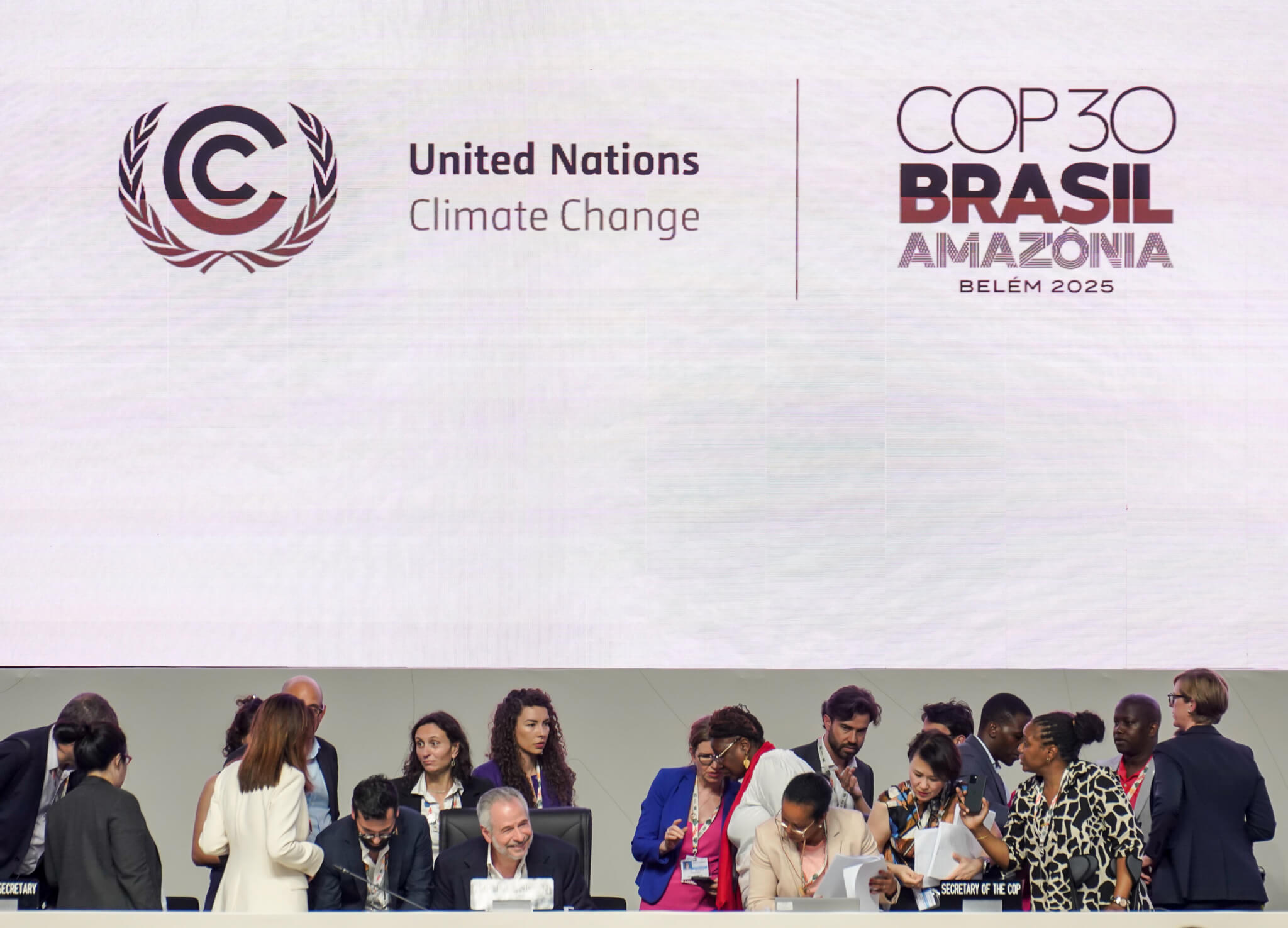
The World Climate Leaders Summit on November 6–7, 2025, served to set the tone for COP30. The message from leaders in Belém was clear: the Paris Agreement still is alive; through enhanced international cooperation, countries must work to show that multilateralism can effectively address the world’s common challenges. Several world leaders spoke at the summit and made important announcements:
During the High Level Segment, Parties highlighted Article 6 carbon markets as a relevant aspect of climate finance. Norway’s Minister of Climate and Environment proposed to nearly double spending to up to U.S. $1.5 billion to purchase up to 15 million international carbon credits to meet its 2030 climate target. Singapore committed to two million tons of carbon dioxide equivalent credits from high-integrity, nature-based solutions and to making progress on developing transition credits.
Throughout COP30, 40 countries submitted NDCs 3.0, bringing the total to 120. This included 16 members of the G20. [As of publication, 134 countries have submitted their latest NDCs.122“NDC 3.0,” UNFCCC, accessed January 20, 2026, https://unfccc.int/ndc-3.0.]

Considerations for the Progress Assessment of NAPs at COP30
https://www.c2es.org/wp-content/uploads/2025/11/Progress-Assessment-of-NAPs-at-COP30.pdf
Considerations & Recommendations for the UAE Just Transition Work Programme
https://www.c2es.org/wp-content/uploads/2025/11/UAE-Just-Transition-Work-Programme-COP30.pdf
Delivering on the Targets and Signals from the First Global Stocktake
https://www.c2es.org/wp-content/uploads/2024/10/20250729-C2ES-GST-Factsheet.pdf
Enhancing Action & Cooperation for the Transition Away from Fossil Fuels
https://www.c2es.org/wp-content/uploads/2024/10/Transition-Away-from-Fossil-Fuels-discussion.pdf
Enhancing Action & Cooperation for Halting & Reversing Deforestation
https://www.c2es.org/wp-content/uploads/2024/10/Halting-and-Reversing-Deforestation-by-2030-Discussion-Paper.pdf
Negotiations on the Global Stocktake: State of Play and KeyConsiderations
https://www.c2es.org/wp-content/uploads/2025/09/20250912-C2ES-Negotiations-on-the-Global-Stocktake-v.2.pdf
The Future of Article 2.1(c) Discussions: Issues and Options
https://www.c2es.org/wp-content/uploads/2025/05/Future-of-Article-2.1c-Discussions.pdf
Issues and Options: Centering Adaptation Finance at COP30
https://www.c2es.org/wp-content/uploads/2025/10/Centering-Adaptation-Finance-at-COP30.pdf
Issues and Options to Develop Modalities for the Baku Adaptation Roadmap
https://www.c2es.org/wp-content/uploads/2025/04/C2ES-Baku-Adaptation-Roadmap-Submission.pdf
Considerations for Selecting Indicators for the UAE Framework for Global Climate Resilience
https://www.c2es.org/wp-content/uploads/2025/05/20250502-C2ES-GGA-indicators-principles-v5.2.pdf
Considerations for the Progress Assessment of National Adaptation Plansat COP30
https://www.c2es.org/wp-content/uploads/2025/11/Progress-Assessment-of-NAPs-at-COP30.pdf
The 2024 Review of the Warsaw International Mechanism: Considerationsfor COP30
https://www.c2es.org/document/the-2024-review-of-the-warsaw-international-mechanism-considerations-for-cop30/
Harnessing the Opportunities of the Facilitative Multilateral Consideration of Progress (FMCP) for Ambition
https://www.c2es.org/wp-content/uploads/2025/08/20250812-C2ES-Harnessing-the-FMCP.pdf
The Enhanced Transparency Framework (Discussion Paper)
https://www.c2es.org/wp-content/uploads/2025/04/20250403-C2ES-ETF-State-of-Play-v2.3.pdf
A Vision for the 2025-2030 Action Agenda
https://www.c2es.org/wp-content/uploads/2025/09/C2ES-Vision-for-the-Action-Agenda.pdf
10 Years of the Paris Agreement: Progress Toward Achieving Key Goals
https://www.c2es.org/wp-content/uploads/2025/11/C2ES-Paris-Agreement-Progress.pdf
https://www.c2es.org/supporting-the-paris-agreement/c2es-cop30/