Achieving net-zero emissions will require large-scale change across all sectors of the economy, and efforts to drive this transition are intensifying. Over the past several years, through the Climate Innovation 2050 initiative, the Center for Climate and Energy Solutions (C2ES) has engaged closely with leading companies across diverse sectors to examine challenges and solutions to decarbonizing the U.S. economy by 2050. As we lay out in Getting to Zero: A U.S. Climate Agenda, reaching net zero will require large-scale change, but it will also require us to address a number of discrete and urgent challenges.1Elliot Diringer et al., Getting to Zero: A U.S. Climate Agenda (Washington, DC: Center for Climate and Energy Solutions, 2019), https://www.c2es.org/document/getting-to-zero-a-u-s-climate-agenda/ To inform policymakers considering these near- and long-term questions, C2ES launched a series of “Closer Look” briefs to investigate important facets of the decarbonization challenge, focusing on key technologies, critical policy instruments, and cross-sectoral challenges. These briefs explore policy implications and outline key steps needed to reach net zero by mid-century.
Accumulation: A buildup of hydrogen gas that has migrated into a reservoir and become trapped there over time.
Iron oxidation: A chemical reaction in which ferrous iron (Fe²⁺) loses electrons and becomes ferric iron (Fe³⁺). In certain water–rock reactions, the released electrons help convert hydrogen derived from water into hydrogen gas.
Migration pathway: The route that hydrogen gas takes as it moves through faults, fractures, or permeable rock layers in the subsurface.
Permeability: A measure of how easily fluids or gases can flow through a rock; high permeability means that fluids and gases can move through it easily.
Porosity: The amount of empty space, or pore space, within a rock that can hold gases or fluids.
Prospectivity: The likelihood that an area contains the geologic conditions needed for a potentially recoverable resource. Prospectivity indicates where further exploration may be warranted; it does not confirm that a resource exists.
Radiolysis: A chemical process in which radiation released by naturally occurring radioactive elements breaks apart water molecules, producing hydrogen gas.
Recoverable resource: The portion of an accumulation estimated to be extractable using existing (or reasonably foreseeable) technology at a cost that makes economic sense.
Reservoir (geologic): An underground rock layer that has enough open space (porosity) to store hydrogen and is permeable enough to allow the hydrogen to be extracted.
Seal (geologic): A layer of dense, impermeable rock that sits above a reservoir and prevents hydrogen gas from escaping upward.
Suture zone: A boundary where sections of Earth’s crust have collided and joined together; these zones can act as pathways for gas to migrate upward from deep sources.
Ultramafic rock: A type of rock that is very low in silica and rich in iron and magnesium; a key source rock for hydrogen generation through iron oxidation.
From petroleum refining to fertilizer production, hydrogen is a foundational input for some of the most important industrial sectors in the United States. Global demand for hydrogen has reached 100 million metric tons per year, which is almost entirely supplied by carbon-intensive methods. 2International Energy Agency, Global Hydrogen Review 2026 (Paris: International Energy Agency, 2026), https://www.iea.org/reports/global-hydrogenreview- 2026. Expanding access to cleaner, cost-competitive hydrogen sources is an economic and strategic endeavor that could strengthen the U.S. production base while opening new markets in aviation, maritime shipping, long-haul trucking, and other sectors.
Subsurface hydrogen gas is a prospective resource. While most subsurface hydrogen is too deep, too diffuse, or otherwise inaccessible for commercial production, certain natural accumulations or engineered systems may offer a scalable source of low-carbon hydrogen. Promising geologies span much of the United States, extending from the Great Lakes to Texas, and covering parts of the Appalachians and the Coast Ranges in the west up to Alaska. While the resource is highly uncertain, its potential scale, early cost estimates, and overlap with U.S. strengths in geoscience, drilling, and subsurface engineering make it a high-reward opportunity worth validating.
This report examines the origins, resource potential, extraction pathways, costs, challenges, and policy needs associated with subsurface hydrogen. It focuses on two broad pathways: exploration for naturally accumulated hydrogen and stimulated production designed to induce or accelerate hydrogen generation underground. Natural hydrogen exploration seeks reservoirs where hydrogen has been generated, migrated, accumulated, and trapped over geologic time. Stimulated production attempts to create hydrogen in place by altering subsurface conditions.
The evidence base remains preliminary. Global accumulation estimates suggest very large potential resources, but the recoverable portion is unknown. Cost estimates are similarly uncertain, although early modeling suggests a potential for competitive hydrogen prices. Subsurface hydrogen may become a significant low-carbon energy resource, a niche opportunity, or prove less commercially viable than early estimates suggest. However, the investment needed to test that question is modest relative to the potential reward, and the resulting data, methods, and field experience would retain value across adjacent subsurface resource sectors. For that reason, policymakers should act now to expedite the assessment of subsurface hydrogen with coordinated research, better data, and regulatory clarity. Targeted federal actions include:
Most hydrogen produced today is made through steam methane reforming (SMR), a natural gas-based process involving the unabated release of greenhouse gases. In the United States, where nearly all hydrogen is produced through SMR, each kilogram of hydrogen results in an estimated 10–12 kilograms of carbon dioxide. With domestic production of about 10 million tons of hydrogen in 2019, this implies annual emissions of about 100 million tons of carbon dioxide.3U.S. Department of Energy, U.S. National Clean Hydrogen Strategy and Roadmap (Washington, DC: U.S. Department of Energy, 2023), https://www. hydrogen.energy.gov/docs/hydrogenprogramlibraries/pdfs/us-national-cleanhydrogen- strategy-roadmap.pdf.
Clean hydrogen production pathways, including electrolysis and SMR paired with carbon capture, can significantly reduce the emissions associated with hydrogen production. However, these pathways have faced persistent cost premiums and other barriers that limit market demand and slow the growth of new applications that depend on clean hydrogen.4International Energy Agency, Global Hydrogen Review 2026.
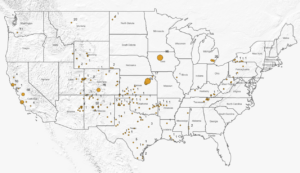
A growing body of research is interrogating a so-far unproven option for clean hydrogen production: the extraction of hydrogen gas from underground resources. While hydrogen has been detected across the United States, often incidentally, no economically recoverable resource has yet been demonstrated (Figure 1). Researchers are now developing a better understanding of hydrogen generation, migration, and accumulation, while advances in adjacent technologies are creating new possibilities for exploration and production. These developments suggest that subsurface hydrogen could expand the portfolio of clean hydrogen production pathways and potentially become a cost-competitive energy resource.
Figure 1: Known Occurrences Of Subsurface Hydrogen In The Continental United States
In this report, subsurface hydrogen refers to free hydrogen gas (H2) occurring naturally or produced within geological formations beneath Earth’s surface. Other forms of naturally occurring hydrogen (e.g., trapped in mineral inclusions or dissolved in groundwater) are not commercial prospects and therefore are excluded in this report.5Aliaksei Patonia et al., Natural (Geologic) Hydrogen and Its Potential Role in a Net-Zero Carbon Future: Is All That Glitters Gold?, OIES Paper ET38 (Oxford: Oxford Institute for Energy Studies, 2024), https://www.oxfordenergy.org/wpcms/wpcontent/ uploads/2024/09/ET38-Natural-geologic-hydrogen-and-its-potential-rolein- a-net-zero-carbon-future.pdf. This report examines subsurface hydrogen across five key areas: (1) the geologic origins of subsurface hydrogen, (2) resource scale, (3) production techniques and their challenges, (4) attributes, and (5) public policy approaches that can expedite understanding and potential exploitation of subsurface hydrogen resources.
Subsurface hydrogen has existed since Earth’s formation; it is actively produced and consumed through dynamic natural processes. The three sources believed to be the primary origins of subsurface hydrogen include iron oxidation, radiolysis, and degassing from deep sources in the lower crust or upper mantle.
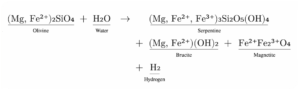
One of the primary ways subsurface hydrogen forms is through chemical reactions between water and iron-rich rocks. When water contacts ferrous iron under the right conditions, hydrogen splits from the water molecules as a free gas while other minerals are formed. Box 1 describes the process in greater detail.
Mantle-derived “ultramafic” rocks, especially olivine-rich formations, are the primary targets for water-rock reactions because they are rich in Fe²⁺. In the United States, relevant geologies include exposed ultramafic belts in the Appalachians and across the West (e.g., Coast Ranges and Sierra Nevada foothills), as well as buried mantle-derived rocks such as the Midcontinent Rift (covering parts of Kansas, Nebraska, Iowa, Minnesota, Wisconsin, and Michigan), Southern Oklahoma Aulacogen (Texas and Oklahoma), and Reelfoot Rift (Arkansas, Missouri, Tennessee, and southern Illinois).6Sarah E. Gelman, Jane S. Hearon, and Geoffrey S. Ellis, Prospectivity Mapping for Geologic Hydrogen, version 1.2, U.S. Geological Survey Professional Paper 1900 (Reston, VA: U.S. Geological Survey, 2025), https://doi.org/10.3133/ pp1900. Magnetite-rich banded iron formations, which are indicative of past oxidation and may also contribute to new hydrogen generation, are especially relevant in parts of Minnesota, Michigan, and Wisconsin.7Ugo Geymond et al., “Reassessing the Role of Magnetite during Natural Hydrogen Generation,” Frontiers in Earth Science 11 (2023): 1169356, https://doi. org/10.3389/feart.2023.1169356.
Although hydrogen occurrences associated with water-rock reactions have been documented, no large-scale, commercially recoverable underground accumulation has yet been demonstrated.8Berit Erlach et al., Geological Hydrogen—An Overlooked Energy Source?, Discussion Paper, Energy Systems of the Future (ESYS) (acatech—National Academy of Science and Engineering, German National Academy of Sciences Leopoldina, and Union of the German Academies of Sciences and Humanities, 2026), https://doi. org/10.48669/esys_2026-1. Commercial relevance therefore depends not only on source rocks and reaction conditions, but also on migration pathways, reservoirs, seals, and preservation conditions that prevent hydrogen from escaping or being consumed by natural processes (see section: Natural Hydrogen Exploration).
Radiolysis is a chemical process in which naturally occurring radioactive decay splits water molecules and produces hydrogen gas. The reaction occurs as follows. Radioactive elements such as uranium, thorium, and potassium emit high-energy particles. When those particles interact with water in pores, fractures, or fluid inclusions in rocks, they can break water molecules apart, forming hydrogen. Unlike iron oxidation, radiolysis does not require iron-rich minerals or high-temperature water-rock reactions. It can occur wherever water and radioactive minerals coexist, including relatively low-temperature surface environments.14L.-H. Lin et al., “The Yield and Isotopic Composition of Radiolytic H2, a Potential Energy Source for the Deep Subsurface Biosphere,” Geochimica et Cosmochimica Acta 69 (2005): 893–903, https://doi.org/10.1016/j.gca.2004.07.032; Barbara Sherwood Lollar et al., “The Contribution of the Precambrian Continental Lithosphere to Global H2 Production,” Nature 516 (2014): 379–82, https://doi. org/10.1038/nature14017.
Radiolytic hydrogen is most commonly associated with with continental rocks containing radioactive elements, including granites and granitoids enriched in uranium and thorium. These settings are widely distributed and produce hydrogen over long periods. The process, however, is slow and diffuse, so meaningful accumulation requires millions of years of isolation and preservation.15L.-H. Lin et al., “The Yield and Isotopic Composition of Radiolytic H2, a Potential Energy Source for the Deep Subsurface Biosphere.” Potential settings for radiolytic hydrogen occur across much of the central United States, which is underlain by the continent’s ancient, geologically stable core.16Sarah E. Gelman, Jane S. Hearon, and Geoffrey S. Ellis, Prospectivity Mapping for Geologic Hydrogen. Geochemical indicators—like helium-4 from uranium and thorium decay and argon-40 from potassium decay—can help identify radiolytic systems. However, co-occurrence of hydrogen with helium or argon does not by itself demonstrate a recoverable resource.17Barbara Sherwood Lollar et al., “The Contribution of the Precambrian Continental Lithosphere to Global H2 Production”; Viacheslav Zgonnik, “The Occurrence and Geoscience of Natural Hydrogen: A Comprehensive Review,” Earth-Science Reviews 203 (2020): 103140, https://doi.org/10.1016/j. earscirev.2020.103140. As with iron oxidation through water-rock reactions, commercial relevance depends on whether hydrogen can migrate, concentrate, and remain trapped beneath an effective seal rather than recombining, diffusing, or being consumed.18Sarah E. Gelman, Jane S. Hearon, and Geoffrey S. Ellis, Prospectivity Mapping for Geologic Hydrogen.
Hydrogen may also originate from deep crustal or mantle sources and migrate upward through faults, fractures, and other permeable pathways. The underlying source mechanisms remain under study and may include residual primordial hydrogen, mantle water-rock reactions, and high-temperature equilibrium processes that stabilize hydrogen under reducing conditions. Regardless of origin, the defining characteristic of this system is vertical migration from deep crustal or mantle environments toward the surface.19Viacheslav Zgonnik, “The Occurrence and Geoscience of Natural Hydrogen: A Comprehensive Review”; Mengwei Liu et al., “Geologic Hydrogen: From Natural Occurrences to Anthropogenic Generation: A Review of Fundamentals, Potential, Challenges and Prospects,” Earth-Science Reviews 274 (2026): 105338, https:// doi.org/10.1016/j.earscirev.2025.105338; Xiao Yang et al., “Molecular Hydrogen in Mantle Minerals,” Geochemical Perspectives Letters 2 (2016): 160–68, https://doi. org/10.7185/geochemlet.1616.
Potential observations of this source have been inferred from geochemical signatures and structural context. Exploration interest is highest where deepcrustal faults or suture zones acting as migration pathways intersect with reservoirs and seals capable of trapping gas.20Oliver Jackson et al., “Natural Hydrogen: Sources, Systems and Exploration Plays,” Geoenergy 2, no. 1 (2024): geoenergy2024-002, https://doi.org/10.1144/ geoenergy2024-002; Mengwei Liu et al., “Geologic Hydrogen: From Natural Occurrences to Anthropogenic Generation: A Review of Fundamentals, Potential, Challenges and Prospects”; Geoffrey S. Ellis and Sarah E. Gelman, “Model Predictions of Global Geologic Hydrogen Resources,” Science Advances 10, no. 50 (December 13, 2024): eado0955, https://doi.org/10.1126/sciadv.ado0955.Ancient sedimentary basins— also known as cratonic basins—that host major fault systems may be more favorable than highly permeable or tectonically active settings that promote seepage rather than accumulation.21Viacheslav Zgonnik, “The Occurrence and Geoscience of Natural Hydrogen: A Comprehensive Review”; Oliver Jackson et al., “Natural Hydrogen: Sources, Systems and Exploration Plays”; Mengwei Liu et al., “Geologic Hydrogen: From Natural Occurrences to Anthropogenic Generation: A Review of Fundamentals, Potential, Challenges and Prospects.” In the United States, potential settings include western regions associated with high heat flow (e.g., associated with geothermal fluids) and suture zones concentrated in the western and central interior of the country.22Sarah E. Gelman, Jane S. Hearon, and Geoffrey S. Ellis, Prospectivity Mapping for Geologic Hydrogen.
The volume of subsurface hydrogen that is recoverable for commercial purposes depends on two highly uncertain variables: how much subsurface hydrogen exists, and how much, if any, can be extracted economically. While significant scientific and commercial milestones must be met before recoverable volumes are meaningfully understood, a growing body of research has begun to estimate how much hydrogen might be stored in the subsurface (global accumulation), how much new hydrogen is produced (global generation) or reaches the surface per year (flux), and how much hydrogen is produced from case studies of known sites where estimates are inferred from well tests, simulations, or volumetric analogies.23Geoffrey S. Ellis and Sarah E. Gelman, “Model Predictions of Global Geologic Hydrogen Resources.”
Ellis and Gelman provide an initial frame of reference for the total volume of hydrogen that may exist in subsurface accumulations. Using their mass-balance model, they estimate a most probable value of 5.6 trillion tons. Although the recoverable portion remains unknown, the authors note that two percent of this amount would contain roughly twice the energy of Earth’s proven natural gas reserves.24Dieter Franke et al., “The Relationship between Natural Hydrogen Flow Rates and Production Viability.” Their model is most sensitive to how long hydrogen persists in reservoirs before being consumed (primarily by microorganisms), followed by annual generation rate and trapping efficiency (Table 1). The influence of these inputs is instructive in understanding hydrogen’s expected subsurface dynamics.

Table 1: Relative Influence Of Inputs On Modeled Accumulation Estimates
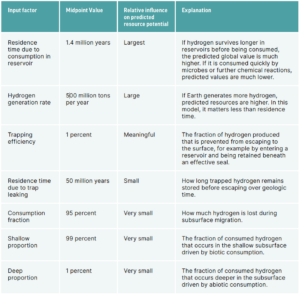
Input factors are variables used to calculate modeled hydrogen accumulation. Midpoint values represent the study’s selected central or median input values used in the model calculations, not necessarily the numerical midpoint of the minimum and maximum inputs used. Relative influence is based on C2ES’s interpretation of the study’s weighted-value analysis. Adapted from Table 1 in Geoffrey S. Ellis and Sarah E. Gelman, “Model Predictions of Global Geologic Hydrogen Resources.”25K. A. Aquino et al., “High Hydrogen Outgassing from an Ophiolite-Hosted Seep in Zambales, Philippines,” International Journal of Hydrogen Energy 105 (2025): 360–66, https://doi.org/10.1016/j.ijhydene.2025.01.251.
Hydrogen flux is sometimes used as a proxy for the maximum viable accumulation rate, but it cannot be used to determine stored volumes without assumptions on trapping, losses, and residence time (Table 1).26Dieter Franke et al., “The Relationship between Natural Hydrogen Flow Rates and Production Viability,” Scientific Reports 16 (2026): 3036, https://doi.org/10.1038/ s41598-026-36749-y.
Ellis and Gelman estimate most probable values for the amount of hydrogen which migrates from the subsurface into the atmosphere each year (24 million tons) and the amount of newly generated hydrogen which successfully migrates into subsurface reservoirs each year (5 million tons).27Geoffrey S. Ellis and Sarah E. Gelman, “Model Predictions of Global Geologic Hydrogen Resources.”Compared with current global hydrogen demand of roughly 100 million tons per year, these figures suggest that economically relevant production will likely depend more on finding sizable accumulations or engineering much faster reaction rates than relying on natural generation alone. Flux estimates compiled and harmonized by Franke et al. underscore this point further, with significantly lower rates from other studies and scopes of analysis.28Dieter Franke et al., “The Relationship between Natural Hydrogen Flow Rates and Production Viability.”
Known occurrences of subsurface hydrogen around the world demonstrate that these hydrogen systems exist, but they have not yet demonstrated significant commercial-scale potential.
Modeled and measured flow rates from 26 sites compiled from the literature by Franke et al. show that the highest flow rate cited, stemming from a continuous seep in the Philippines, releases an estimated 808 tons of hydrogen per year.29Ibid. While this is roughly the amount of hydrogen a large ammonia plant would use in about two days, natural surface outgassing should not be conflated with the size or producibility of potential subsurface accumulations.30K. A. Aquino et al., “High Hydrogen Outgassing from an Ophiolite-Hosted Seep in Zambales, Philippines,” International Journal of Hydrogen Energy 105 (2025): 360–66, https://doi.org/10.1016/j.ijhydene.2025.01.251.
Considering that most known sites were discovered accidentally, a central question is whether dedicated exploration can find higher-flow, higher-concentration accumulations that accidental discovery has missed.
Successful production of subsurface hydrogen on a commercial scale will depend on project-specific combinations of flow rate, gas composition, location, end use, and any potential co-products. To date, no significant commercial recoveries have been publicly demonstrated.
Representations from subsurface hydrogen developers generally describe future production goals as tens of thousands of tons per year on a given site. While today’s SMR plants can produce well over 100,000 tons of hydrogen per year with 99.9 percent purity, minimum viable production levels are ultimately specific to individual projects and offtaker requirements.31U.S. Department of Energy, National Energy Technology Laboratory, Comparison of Commercial, State-of-the-Art, Fossil-Based Hydrogen Production Technologies, DOE/NETL-2022/3241 (National Energy Technology Laboratory, 2022), 2, 51, https://www.osti.gov/servlets/purl/1862910/. If a hydrogen offtaker requires high purity, as would be the case for most established applications, separating hydrogen from low concentration gas streams will add significant capital and energy costs. However, prospective revenue from co-production of helium from the gas stream and critical minerals from produced water could provide subsurface hydrogen projects with an opportunity to overcome some of those costs.32Shaowen Mao et al., “Geologic Hydrogen: A Review of Resource Potential, Subsurface Dynamics, Exploration, Production, Transportation, and Research Opportunities,” Energy & Environmental Science 18 (2025): 9991–10035, https://doi. org/10.1039/D5EE02910D; Jon Gluyas et al., “Exploring for Hydrogen, Helium and Lithium: Is It as Easy as 1, 2, 3?,” Energy Geoscience Conference Series 1 (2024), https://doi.org/10.1144/egc1-2024-13.
Demand for reliable, cost-effective energy produced near the point of use could create early markets for subsurface hydrogen. The United States Air Force Office of Energy Assurance, for example, has partnered with industry to evaluate whether locally sourced subsurface hydrogen could support onbase power generation and help meet a congressional mandate for 99.9 percent energy availability at critical military sites by 2030.33Air Force Office of Energy Assurance, “Initial Partners Selected in Air Force Geologic Hydrogen Energy Resilience Initiative,” news release, Air Force Civil Engineer Center, May 29, 2026, https://www.afcec.af.mil/News/Article-Display/ Article/4504180/initial-partners-selected-in-air-force-geologic-hydrogen-energyresilience- init/. Remote mines present another potential market. Many depend on diesel transported over long distances, and some are located in formations that may also be suitable for subsurface hydrogen production. Where favorable geology coincides with mine-site demand, local hydrogen production could reduce fuel costs and improve energy resilience.34Estibalitz Ukar, “Can Geologic Hydrogen Be a Game-Changer for Mining?,” Open Access Government, no. 51 (July 2026): 370–71, https://doi.org/10.56367/OAG- 051-12343; Canada Nickel Company Inc., “GeoRedox and Canada Nickel Launch First-of-Its-Kind Geologic Hydrogen Program at Crawford Nickel Project in Timmins, Ontario,” news release, PR Newswire, May 20, 2026, https://www.prnewswire.com/ news-releases/georedox-and-canada-nickel-launch-first-of-its-kind-geologichydrogen- program-at-crawford-nickel-project-in-timmins-ontario-302776376. html; Barbara Sherwood Lollar and Oliver Warr, “Decadal Record of Continental H2 Reservoirs Reveals Potential for Subsurface Microbial Life and Natural H2 Exploration,” Proceedings of the National Academy of Sciences 123, no. 21 (2026): e2603895123, https://doi.org/10.1073/pnas.2603895123.
Today, researchers and technology developers are piloting a range of approaches in the pursuit of subsurface hydrogen. These approaches fall into two high-level categories: natural hydrogen exploration and stimulated production (Figure 3).
Figure 3: Production Approaches For Subsurface Hydrogen
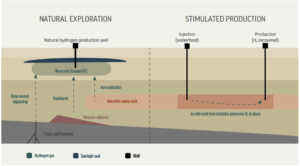
Natural hydrogen exploration is motivated by the possibility that hydrogen has been generated, migrated, concentrated, and trapped in underground reservoirs that remain undiscovered. The central uncertainty is not whether hydrogen exists in the subsurface, but whether producible accumulations can be found and developed for economically viable uses.
Over a century of oil and gas exploration provides a general framework for discovery, in which progressively narrower assessments of opportunities, such as basin, play, lead, and prospect, are used to locate potential resources based on what is known about the hydrocarbon formation.35Estibalitz Ukar, “Can Geologic Hydrogen Be a Game-Changer for Mining?,” Open Access Government, no. 51 (July 2026): 370–71, https://doi.org/10.56367/OAG- 051-12343; Canada Nickel Company Inc., “GeoRedox and Canada Nickel Launch First-of-Its-Kind Geologic Hydrogen Program at Crawford Nickel Project in Timmins, Ontario,” news release, PR Newswire, May 20, 2026, https://www.prnewswire.com/ news-releases/georedox-and-canada-nickel-launch-first-of-its-kind-geologichydrogen- program-at-crawford-nickel-project-in-timmins-ontario-302776376. html; Barbara Sherwood Lollar and Oliver Warr, “Decadal Record of Continental H2 Reservoirs Reveals Potential for Subsurface Microbial Life and Natural H2 Exploration,” Proceedings of the National Academy of Sciences 123, no. 21 (2026): e2603895123, https://doi.org/10.1073/pnas.2603895123.
For subsurface hydrogen, a “play” is a class of settings that share common geologic conditions such as the hydrogen generation mechanism, migration pathways, suitable reservoir rocks, effective seals, and conditions that allow hydrogen to accumulate rather than escape, get consumed, or react into other compounds. A “prospect” is a more localized target where those conditions appear to coincide and can be tested with geologic, geophysical, and geochemical data.
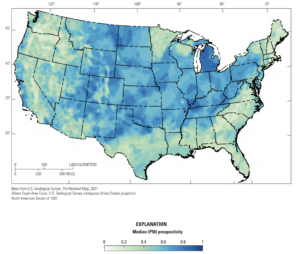
A USGS hydrogen prospectivity (play-level) map released in 2025 was based on a continental-scale study to identify regions of interest for more detailed assessment. The map evaluates three primary geologic components: whether source rocks are present for iron oxidation, radiolysis, or deep-seated degassing; whether reservoir rocks have sufficient porosity to store hydrogen; and whether seal rocks are present to avoid the loss of subsurface hydrogen. Locations rated highest for chance of sufficiency (a measure of how viable a given system is for hydrogen production) were generally those where iron and radiolytic rock sources coincide (Figure 4).36Sarah E. Gelman, Jane S. Hearon, and Geoffrey S. Ellis, Prospectivity Mapping for Geologic Hydrogen. It is a play-level screen, not a resource estimate or drill-target map, and does not seek to estimate volumes, depths, specific traps, consumption rates, or migration outside the model’s sedimentary-basin framework.37Ibid. Although some higher-resolution gravity, magnetic, seismic, and geochemical data exist, limited and uneven spatial coverage prevented their use at the continental scale. Broader coverage is needed for more detailed regional and prospect-scale assessment.
Figure 4: Continental Chance Of Sufficiency
Exploration for subsurface hydrogen faces several known challenges, including a nascent understanding of subsurface hydrogen systems, fragmented geologic data, pilot funding constraints, and conventional commercial barriers related to production, distribution, and storage.
More research is needed to develop and refine exploration tools that identify where hydrogen may form, migrate, accumulate, leak, or be consumed. Existing geochemical and geophysical datasets may be useful, but researchers are still learning to apply them to hydrogen systems and translate them into prospective drilling targets.
Data availability and access pose a major dual challenge. Relevant datasets are often spread across federal and state agencies, universities, and private companies. A stepwise search for critical data may require sourcing information from many places. An exploration company may need to combine USGS data, state geologic maps, local geochemistry records, university core samples, and privately held seismic data to evaluate a single prospect. Where seismic data are unavailable, new collection can be expensive. This fragmented data environment adds time, uncertainty, and cost to exploration. Some of the highest-value data are collected by private firms and remain proprietary.
Natural hydrogen exploration also lacks the proven commercial track record that supports oil and gas investment. Several theories help explain why large hydrogen reservoirs, if they exist, have not already been discovered—and commercially utilized—during hydrocarbon exploration. Oil and gas exploration has often focused on settings less favorable for hydrogen, and petroleum source rocks may act as hydrogen sinks because migrating hydrogen can be incorporated into organic matter and hydrocarbon products during petroleum-forming reactions.38U.S. Geological Survey, “The Potential for Geologic Hydrogen for Next- Generation Energy,” April 13, 2023, https://www.usgs.gov/news/featured-story/ potential-geologic-hydrogen-next-generation-energy. Historically, the analytical instruments used in petroleum exploration were not designed to detect hydrogen, and past analyses may have missed or misclassified it.39Viacheslav Zgonnik, “The Occurrence and Geoscience of Natural Hydrogen: A Comprehensive Review.”
Private capital may become harder to secure if early exploratory drilling does not validate producible accumulations, or if success is defined only by large accumulations rather than project-specific commercial uses. Some experts worry that prospecting could outpace the scientific understanding needed to guide it, echoing lessons from geothermal energy, where early unsuccessful projects chilled investment before the resource base and development methods were better understood.40Emily Pope, Drilling Down: What It Will Take to Harness the Potential of Next- Generation Geothermal (Washington, DC: Center for Climate and Energy Solutions, April 2026), https://www.c2es.org/wp-content/uploads/2026/04/drilling-down-onnext- gen-geothermal-technology.pdf.
Even if hydrogen is discovered, transportation and storage may limit commercial value. Natural accumulations cannot be sited selectively near demand centers or infrastructure. Because hydrogen is small, diffusive, and costly to move, remote reservoirs could face significant delivered-cost penalties. Storage and distribution easily amplify the delivered cost of hydrogen from the cost of production.41Roxana T. Shafiee and Daniel P. Schrag, “Carbon Abatement Costs of Green Hydrogen Across End-Use Sectors,” Joule 8, no. 9 (December 18, 2024): 1–9, https:// doi.org/10.1016/j.joule.2024.09.003.
Stimulated production seeks to create hydrogen in place by altering subsurface conditions. Like natural hydrogen exploration, the early stages of stimulated production development have yet to demonstrate commercially relevant results. If successful, stimulated production could allow operators to influence reaction conditions in known geologies. Its potential repeatability and siting flexibility— meaning it could be developed closer to infrastructure and demand—would be additional assets but remain unproven. The heterogeneity of reactive formations may require site-specific stimulation methods and further field testing is needed to determine where it can work reliably.
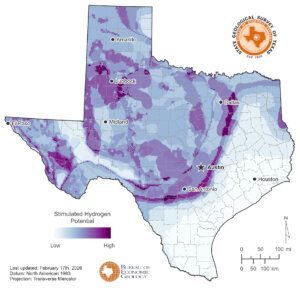
Most stimulated concepts seek to induce or accelerate water-rock reactions in iron-rich formations. Execution is complex but the premise is simple: expose suitable rocks to water under favorable temperature, pressure, flow, and chemical conditions, then recover the generated hydrogen through production wells. As Figure 5 illustrates for Texas, prospective areas can be screened by identifying where suitable rocks occur at depths and temperatures favorable for induced water-rock reactions. Compared with natural low-temperature reactions which may alter only about one percent of rock volume per 10,000 years, economically viable stimulated systems may need to accelerate reactions 10,000 to 100,000 times faster.42Alexis S. Templeton et al., “Low-Temperature Hydrogen Production and Consumption in Partially-Hydrated Peridotites in Oman: Implications for Stimulated Geological Hydrogen Production,” Frontiers in Geochemistry 2 (2024): 1366268, https://doi.org/10.3389/fgeoc.2024.1366268; NatH2investing, “Stimulated Hydrogen Changes Everything for Natural Hydrogen – Dr. Alexis Templeton Interview,” YouTube video, October 30, 2025, https://www.youtube.com/ watch?v=NIoqrc2WQLE&t=2640s.
Figure 5: Stimulated Hydrogen Potential In Texas
Different techniques to induce hydrogen production are being designed and tested by companies, universities, and public research entities. As many approaches are proprietary and overlapping, this report groups them into three broad categories: mechanical or electrical stimulation to create reactive surface area and flow paths, heat stimulation to bring formations into favorable temperature ranges, and water or steam circulation to sustain water-rock reactions and recover generated hydrogen.
Mechanical and electrical stimulation techniques seek to fracture or weaken iron-rich rock so water can reach more reactive mineral surfaces. This technique is most commonly compared with enhanced geothermal systems and, in some respects, hydraulic fracturing. However, stimulated hydrogen approaches may require smaller fracture networks that maximize water-rock contact while avoiding large fractures that channel fluids too quickly from injection to production wells, limiting the reaction with the surrounding rock. High-voltage electric currents or pulses are being tested to create these microfracture networks and may be paired with water injection to facilitate hydrogen-generating reactions.43Alexis S. Templeton et al., “Low-Temperature Hydrogen Production and Consumption in Partially-Hydrated Peridotites in Oman: Implications for Stimulated Geological Hydrogen Production.”
Heat stimulation seeks to accelerate water-rock reactions that would otherwise occur over tens of thousands of years by raising iron-rich formations into the temperature range most favorable for hydrogen-producing reactions. The introduced heat could be delivered through technologies such as heater wells, which are already used today for oil recovery. Although laboratory experiments indicate that hydrogen generation can begin immediately after favorable conditions are reached, the time needed to heat the formation and recover the hydrogen through a production well remains uncertain and has not yet been established through field demonstrations.44Thomas M. McCollom et al., “The Effect of pH on Rates of Reaction and Hydrogen Generation during Serpentinization,” Philosophical Transactions of the Royal Society A: Mathematical, Physical and Engineering Sciences 378 (2020): 20180428, https://doi.org/10.1098/rsta.2018.0428; Alexis S. Templeton et al., “Low-Temperature Hydrogen Production and Consumption in Partially-Hydrated Peridotites in Oman: Implications for Stimulated Geological Hydrogen Production.”
Water and steam circulation approaches bring reactive fluids into contact with rocks containing ferrous iron. In this method, water serves both as a reactant and as a transport medium that can help move generated hydrogen toward a production well.45Qingwang Yuan et al., “Stimulated Geologic Hydrogen: From Mechanistic Control to Engineered Rock Transformation,” Energy & Environmental Science 19, no. 10 (2026): 3100–3133, https://doi.org/10.1039/D6EE01230B. The engineering objective is to improve contact between water and reactive minerals while managing flow paths, temperature, pressure, fluid chemistry, and rock permeability.46Aliaksei Patonia, Stimulated Geologic Hydrogen Production: State of Play, Challenges, and Key Questions to Ask, Energy Insight 169 (Oxford: Oxford Institute for Energy Studies, September 2025), https://www.oxfordenergy.org/wpcms/wpcontent/ uploads/2025/09/Insight-169-Stimulated-Geologic-Hydrogen-Production. pdf. Catalysts may offer another means of accelerating hydrogen-generating reactions in iron-rich rocks. Laboratory studies suggest that nickel, aluminum, palladium, and spinel-bearing minerals introduced with water or occurring naturally may promote mineral dissolution and iron oxidation, potentially favoring reaction pathways that generate more hydrogen.47Qingwang Yuan et al., “Stimulated Geologic Hydrogen: From Mechanistic Control to Engineered Rock Transformation.” Developers are also investigating the injection of carbon dioxide (e.g., dissolved in water). Dissolved carbon dioxide can acidify water and accelerate mineral dissolution, while carbonate formation releases heat and may create reaction-induced fractures that increase permeability.48Florian Osselin et al., “Orange Hydrogen Is the New Green,” Nature Geoscience 15 (2022): 765–69, https://doi.org/10.1038/s41561-022-01043-9; Lizhi Huang et al., “Generating H2 during the CO2 Sequestration in Basalt Formations,” Geomechanics and Geophysics for Geo-Energy and Geo-Resources 11 (2025): 4, https://doi.org/10.1007/s40948-024-00921-3; Conghao Yi, Catherine A. Peters, and David R. Cole, “Geologic H2 Generation with Simultaneous CO2 Mineralization: A Dual Strategy for Energy Decarbonization,” International Journal of Hydrogen Energy 247 (2026): 155861, https://doi.org/10.1016/j.ijhydene.2026.155861. These effects are not uniformly beneficial. Carbon dioxide can inhibit hydrogen generation or react with hydrogen to form methane, and carbonate precipitation can coat reactive surfaces or obstruct fluid pathways.49Qingwang Yuan et al., “Stimulated Geologic Hydrogen: From Mechanistic Control to Engineered Rock Transformation.” Further research is therefore needed to determine under what conditions and practices the benefits of carbon mineralization outweigh the competing reactions.
Characterizing mineralogy at the intended reaction depth can be a significant challenge, presenting uncertainty for both the potential generation rate and generated hydrogen volume. Surface samples may not represent rocks one to two kilometers below ground, core samples provide information only for discrete intervals along individual boreholes, and mineralogy can vary over distances of just a few meters. No established geophysical tool can yet map the relevant mineralogy throughout the entire volume targeted for stimulation.
Another challenge beyond rock characterization is achieving adequate contact between water and iron-rich rocks with very low porosity. Ferrous iron availability is a primary limiting factor, meaning production can stall if accessible reactive iron is depleted or poorly connected to flowing water.50Robert Egert, Ghanashyam Neupane, and Wencheng Jin, “On the Viability of Stimulated Hydrogen Generation from Iron-Rich Formations,” Geoenergy Science and Engineering 256 (2026): 214130, https://doi.org/10.1016/j.geoen.2025.214130. Broader mineralogy also influences whether ferrous iron is converted into hydrogen-generating minerals (see Box 1).
Laboratory experiments have improved understanding of how temperature, pH, salinity, and other conditions influence reaction rates, but many use ideal laboratory conditions, like powdered or grain-sized olivine.51T. M. McCollom et al., “Temperature Trends for Reaction Rates, Hydrogen Generation, and Partitioning of Iron during Experimental Serpentinization of Olivine,” Geochimica et Cosmochimica Acta 181 (2016): 175–200, https://doi.org/10.1016/j. gca.2016.03.002; R. Lafay et al., “Mineral Replacement Rate of Olivine by Chrysotile and Brucite under High Alkaline Conditions,” Journal of Crystal Growth 347, no. 1 (2012): 62–72, https://doi.org/10.1016/j.jcrysgro.2012.02.040; R. Huang et al., “Effect of Fluid Salinity on Reaction Rate and Molecular Hydrogen (H2) Formation During Peridotite Serpentinization at 300°C,” Journal of Geophysical Research: Solid Earth 128, no. 3 (2023): e2022JB025218, https://doi.org/10.1029/2022JB025218. These favorable surface-area conditions do not reflect natural subsurface environments. A key field question is whether fluid circulation and removal of reaction products can overcome limited reactive surface area underground.52Qingwang Yuan et al., “Stimulated Geologic Hydrogen: From Mechanistic Control to Engineered Rock Transformation.”
A successful system must create enough permeability and damaged rock volume for water to contact reactive minerals while, in the case of separate injection and production wells, avoiding short-circuiting between the two.
Maintaining permeability may be difficult if silica-rich layers, secondary mineral precipitation, or fracture filling reduce access to fresh mineral surfaces.53Ibid. Some reactions may create additional porosity as minerals dissolve, expand, and weaken the rock, but commercial systems must manage the balance between self-propagating permeability and fracture clogging.54R. Lafay et al., “Mineral Replacement Rate of Olivine by Chrysotile and Brucite under High Alkaline Conditions.”
Hydrogen recovery and containment also pose technical and environmental challenges. Stimulated systems must balance hydrogen generation with fluid circulation, produced-water management, hydrogen separation, and losses from dissolution, migration, trapping, leakage, microbial consumption, or chemical reactions. Fugitive hydrogen emissions could erode the climate benefits of the extracted hydrogen because of its effects as an indirect greenhouse gas.55Candice Chen, Susan Solomon, and Kane Stone, “On the Chemistry of the Global Warming Potential of Hydrogen,” Frontiers in Energy Research 12 (2024): 1463450, https://doi.org/10.3389/fenrg.2024.1463450. These challenges point to the need for better modeling, sensing, stimulation methods, geochemical controls, and field validation before stimulated subsurface hydrogen can be treated as a reliable energy source.56Franciszek Jozef Hasiuk and Donald M. Conley, Exploring Geologic Hydrogen: A New Frontier for Affordable, Reliable Energy Security, SAND2025- 04723R (Albuquerque, NM: Sandia National Laboratories, April 2025), https://doi. org/10.2172/2562737.
Considering these challenges, an alternative ex situ pathway also deserves attention. This approach would accelerate water-rock reactions in crushed, iron-bearing mine tailings rather than underground. Tailings offer larger reactive surface area and can be characterized more directly than heterogeneous formations at depth, potentially reducing some geological and stimulation uncertainty. While this aboveground approach would operate outside the working definition of subsurface hydrogen, it is relevant as an adjacent technology and possible early application at mine sites.57Kanchana Kularatne et al., “Simultaneous Ex-Situ CO2 Mineral Sequestration and Hydrogen Production from Olivine-Bearing Mine Tailings,” Applied Geochemistry 95 (2018): 195–205, https://doi.org/10.1016/j.apgeochem.2018.05.020.
Induced microbial production is separate from induced water-rock reactions. It seeks to stimulate subsurface microbiomes with injected nutrients and other materials, so they produce hydrogen under favorable geologic conditions. End-of-life oil reservoirs may be attractive because they already have wells, reservoir data, surface access, and operating history (see Box 2). Key technical challenges include sustaining hydrogen production at useful rates, co-produced gas separation, and satisfying hydrogen concentration demands for specific end-use scenarios.
The primary appeal of subsurface hydrogen as a prospective resource is the potential for more cost-competitive clean hydrogen. According to the limited technoeconomic literature, subsurface hydrogen could have low production costs under favorable conditions (Figure 6). This potential is highly uncertain, as technoeconomic analyses and other cost assessments at this stage must make assumptions about flow rate, purity, and other variables that have not been validated in the field.
Figure 6: Technoeconomic Analyses Of Levelized Cost Of Hydrogen ($/kg H₂)
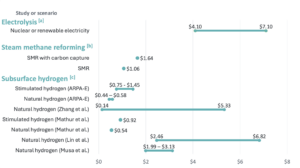
[a] Source data: U.S. Department of Energy, Pathways to Commercial Liftoff: Clean Hydrogen.58U.S. Department of Energy, Pathways to Commercial Liftoff: Clean Hydrogen, updated 2024 (Washington, DC: U.S. Department of Energy, 2024). [b] Source data: Case 1 and 2 from U.S. Department of Energy, National Energy Technology Laboratory, Comparison of Commercial, State-of-the-Art, Fossil-Based Hydrogen Production Technologies.59U.S. Department of Energy, National Energy Technology Laboratory, Comparison of Commercial, State-of-the-Art, Fossil-Based Hydrogen Production Technologies. [c] Source data: U.S. Department of Energy, “April H2IQ Hour: Geologic Hydrogen”; Kaiqiang Zhang et al., “Techno-Economic Viability of Natural Hydrogen”; Yash Mathur et al., “Techno-Economic Analysis of Natural and Stimulated Geological Hydrogen”; Ning Lin et al., “Natural Hydrogen Techno-Economics and Valuation”; Mohammed Musa et al., “Techno-Economic Assessment of Natural Hydrogen Produced from Subsurface Geologic Accumulations.”60U.S. Department of Energy, “April H2IQ Hour: Geologic Hydrogen” (webinar slides, H2IQ Hour, April 24, 2025), https://www.energy.gov/sites/default/ files/2025-05/h2iqhour-04242025.pdf; Kaiqiang Zhang et al., “Techno-Economic Viability of Natural Hydrogen,” National Science Review 12, no. 10 (2025): nwaf368, https://doi.org/10.1093/nsr/nwaf368; Yash Mathur et al., “Techno-Economic Analysis of Natural and Stimulated Geological Hydrogen,” International Journal of Hydrogen Energy 165 (2025): 150872, https://doi.org/10.1016/j.ijhydene.2025.150872; Ning Lin et al., “Natural Hydrogen Techno-Economics and Valuation,” Applied Energy 408 (2026): 127406, https://doi.org/10.1016/j.apenergy.2026.127406; Mohammed Musa et al., “Techno-Economic Assessment of Natural Hydrogen Produced from Subsurface Geologic Accumulations,” International Journal of Hydrogen Energy 93 (2024): 1283– 94, https://doi.org/10.1016/j.ijhydene.2024.11.009.
Natural hydrogen cost estimates range from roughly $0.14 to $6.82 per kilogram at the point of production. Low estimates assume high flow rates, high hydrogen concentration, long well life, and favorable U.S. drilling costs.61Yash Mathur et al., “Techno-Economic Analysis of Natural and Stimulated Geological Hydrogen.” Higher cost estimates reflect smaller production scales, field-specific conditions, or production-decline risk.62 Mohammed Musa et al., “Techno-Economic Assessment of Natural Hydrogen Produced from Subsurface Geologic Accumulations.”; Ning Lin et al., “Natural Hydrogen Techno-Economics and Valuation.” Across studies, the dominant variables are reservoir productivity, hydrogen purity, project scale, decline or recharge behavior, exploration success, and compression costs.
Stimulated hydrogen estimates are more preliminary. Mathur et al. report a base case of $0.92 per kilogram, while DOE’s preliminary design-screening analysis estimates roughly $0.75 to $1.45 per kilogram across well configurations and depths.63U.S. Department of Energy, “April H2IQ Hour: Geologic Hydrogen.” These results depend on assumptions about flow rate, hydrogen concentration, water containment, stimulation cost, source-rock productivity, restimulation frequency, and recovery efficiency. Field studies underscore this challenge, as pilot-scale systems may need orders-of-magnitude improvements over natural background generation rates to become commercially meaningful.64Alexis S. Templeton et al., “Low-Temperature Hydrogen Production and Consumption in Partially-Hydrated Peridotites in Oman: Implications for Stimulated Geological Hydrogen Production.”
The largest uncertainty across the reviewed cost estimates is a lack of validated, real-world cost and performance data. Absent these data, modeled estimates should serve as preliminary indications for the specific high-purity, high-flow cases they evaluate rather than representative of every potential commercial project. The cost of delivered hydrogen could also be significantly higher than these modeled values. Transportation costs are not reflected in Figure 6 and can add significantly to the cost of hydrogen; the mode of transport, delivery distance, and infrastructure availability are also key factors. Additionally, a lack of flexibility to co-locate with hydrogen offtakers could represent a significant and limiting disadvantage for the cost of delivered subsurface hydrogen.
The primary limitation of today’s legacy SMR systems is their high emissions intensity of about 10–12 kg CO2e/kg H2. Producing lower-emitting hydrogen is critical to unlocking new markets that will require clean hydrogen (e.g., sustainable aviation and marine fuels) and improving existing products’ trade competitiveness and sustainability. The prospective value of subsurface hydrogen as a competitive alternative to other hydrogen pathways is highly dependent on lifecycle greenhouse gas emissions.
The lifecycle emissions of subsurface hydrogen production techniques are an underdeveloped area of study. Brandt’s 2023 prospective lifecycle assessment of natural hydrogen extraction estimated baseline emissions of about 0.37 kg CO2e/kg H2, primarily from fugitive emissions and embodied emissions from steel and cement used in drilling and well construction.65Adam R. Brandt, “Greenhouse Gas Intensity of Natural Hydrogen Produced from Subsurface Geologic Accumulations,” Joule 7 (August 16, 2023): 1818–31, https://doi.org/10.1016/j.joule.2023.07.001. That result suggests potentially lower emissions not just compared to SMR, but of any production method (Figure 7).
Figure 7: Hydrogen Production Lifecycle Emissions (CO₂e/kg H₂)
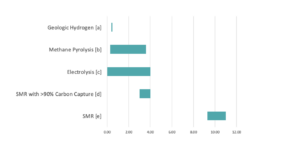
[a] Production and purification of naturally accumulated hydrogen by Adam R. Brandt, “Greenhouse Gas Intensity of Natural Hydrogen Produced from Subsurface Geologic Accumulations.”66Adam R. Brandt, “Greenhouse Gas Intensity of Natural Hydrogen Produced from Subsurface Geologic Accumulations.” [b],[c],[d],[e] Adapted from DOE Pathways to Commercial Liftoff 2024. Values for (c) based on different renewable energy and grid electricity mixes and assume no more than 20 percent grid power.67U.S. Department of Energy, Pathways to Commercial Liftoff: Clean Hydrogen.
Subsurface hydrogen’s emissions and broader sustainability profile should become clearer as future studies incorporate technologies and methods that advance from the lab to the field. Stimulated production methods, fugitive emissions risks, and water consumption profiles are key factors to evaluate as more data become available.
Subsurface hydrogen production is highly uncertain at this stage. However, the relatively modest investments needed to validate the resource potential, together with the cross-sector benefits those investments would provide for critical minerals and geothermal development, more than justify near-term policy support.
Federal innovation policy should shoulder early risks that private markets cannot, build the knowledge base needed for later investment, and align policy support with real commercialization timelines. Today, subsurface hydrogen sits in the “Research & Development” and “Prototyping & Demonstration” stages of the technology innovation process, where the most effective policies mitigate science, engineering, and financing risks with sustained resources and intentional knowledge management.68Diandra Angiello et al., C2ES Innovation Policy Matrix: A Framework to Accelerate US Technology Leadership (Arlington, VA: Center for Climate and Energy Solutions, January 2026), https://www.c2es.org/wp-content/uploads/2026/01/c2esinnovation- policy-matrix-a-framework-to-accelerate-us-technology-leadership.pdf.
Figure 8: Key Risks Across The Innovation Process

Congress should authorize and fund a dedicated subsurface hydrogen research, development, and demonstration program at the U.S. Department of Energy. Multi-year appropriations should be sufficient to support competitive awards, national laboratory research, university and state geological survey partnerships, and pre-commercial field validation while maintaining a focused, limited-term federal role.
The program’s structure should prioritize effective knowledge exchange used in similar programs (Box 3). Program authorization should direct DOE to designate a program lead, identify participating agencies, convene regular interagency coordination meetings, establish an expert advisory panel, and report publicly on program progress and future research needs. Program implementation should be coordinated with the USGS, national laboratories, state geological surveys, universities, industry, Tribal and state governments, and international partners.
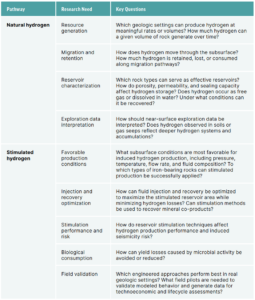
Immediate research needs should be informed by recent investigations into the challenges, uncertainties, and scientific gaps of subsurface hydrogen, including reviews funded by DOE and the National Energy Technology Laboratory (NETL), and work related to the International Energy Agency (IEA) Hydrogen Technology Collaboration Programme Task 49. Table 2 summarizes several research focus areas based on this work that a dedicated subsurface hydrogen research, development, and demonstration program could address.
The program should build on early learnings within the USGS, Advanced Research Projects Agency-Energy (ARPA-E), the United States Air Force Office of Energy Assurance, and the national labs to pair laboratory and modeling work with field validation. This is an important activity to mitigate engineering and financing risks at the prototyping and demonstration phase of the technology innovation process. Expected priorities would include public-private field projects in diverse geologic settings, including resource characterization programs for natural hydrogen and field pilots for stimulated hydrogen production where concepts are technically ready. These projects should be structured to build in part on the early research under ARPA-E, which in 2024 awarded $20 million in funding across 16 projects to advance stimulated hydrogen technologies.71U.S. Department of Energy, Advanced Research Projects Agency–Energy, “U.S. Department of Energy Announces $20 Million to 16 Projects Spearheading Exploration of Geologic Hydrogen,” news release, February 8, 2024, https:// arpa-e.energy.gov/news-and-events/news-and-insights/us-department-energyannounces- 20-million-16-projects-spearheading-exploration-geologic-hydrogen. Data on drilling, coring, reservoir behavior, stimulation approaches, production rates, hydrogen losses, separation needs, and monitoring methods can feed back into research priorities to help determine which concepts warrant further investment.
To maximize the public value of federal support, Congress should require competitive, merit-based awards and the publication of nonproprietary data, methods, and results. The program should preserve appropriate protections for confidential business information, but federally funded field data, environmental monitoring results, resource assessment methods, and lessons from unsuccessful pilots should be made available where possible. Strong knowledge management is especially important for subsurface hydrogen, where the highest-value outcome of early RD&D may be learning which concepts do not work, and where cost barriers for companies to obtain the most consequential data (e.g., well logs) underscore the importance of sharing relevant data obtained with the assistance of public funds.
Table 2: Priority Research And Questions
As demand for minerals and other subsurface resources has grown sharply, much of the United States still lacks modern geologic, geophysical, and geochemical data detailed enough to characterize domestic resource potential. That information gap raises exploration risk for private investors, limits communities’ ability to assess local impacts, and limits the information that policymakers have at their disposal to make energy, economic, and national security decisions regarding the U.S. resource base. Systematic geologic data collection and processing address this knowledge gap. As pre-competitive public infrastructure, the availability of these data would lower the cost of subsurface hydrogen resource development, support permitting and land-use decisions, and create durable value across multiple sectors including mineral development, groundwater management, infrastructure siting, and emerging subsurface energy resources. Public investments in pre-competitive geologic mapping by the USGS and state geological surveys have produced measurable economic and societal benefits. A 2025 study by the American Geosciences Institute found that geological mapping returns seven to ten times its cost, underscoring the economic and strategic value of public investment.72R. C. Berg and J. E. Faulds, eds., Economic Analysis of the Costs and Benefits of Geological Mapping in the United States of America from 1994 to 2019 (American Geosciences Institute, 2025), https://doi.org/10.62322/wra5.gs9v.
Congress should expand existing data acquisition efforts, like the Earth Mapping Resources Initiative (Earth MRI), to include geologic data relevant to subsurface hydrogen resource assessments. Congress should also expand the base of publicly available subsurface data by conditioning access to some federal resources on the eventual release of data generated by supported projects.
The USGS launched Earth MRI in 2019 to modernize U.S. surface and subsurface mapping with the collection of geologic, geophysical, geochemical, and topographic data relevant for critical mineral resource assessments.73U.S. Geological Survey, “Earth Mapping Resources Initiative (Earth MRI): About,” accessed May 5, 2026, https://www.usgs.gov/special-topics/earth-mri/ about. In 2021, the Infrastructure Investment and Jobs Act codified the initiative and authorized $320 million in funding for the period of FY22–26.74Infrastructure Investment and Jobs Act, Pub. L. No. 117-58, § 40201, 135 Stat. 429, 923–25 (2021). Since its formation, national coverage of publicly accessible, high-resolution magnetic and radiometric geophysical surveys has nearly quadrupled to support a marked increase in critical mineral claims.75Beneath the Surface: Earth MRI and America’s Resource Potential, Before the U.S. House Committee on Natural Resources, Subcommittee on Energy and Mineral Resources, 119th Cong. (June 25, 2026) (statement of Colin Williams, Mineral Resources Program Coordinator, U.S. Geological Survey), https://docs.house.gov/ meetings/II/II06/20260625/119386/HHRG-119-II06-Wstate-WilliamsC-20260625. pdf.
Earth MRI’s airborne magnetic and radiometric surveys can already provide valuable information on prospective ferrous iron and radiolytic source rock systems for subsurface hydrogen. Drill core samples can supplement these data. Earth MRI has already characterized thousands of submitted drill core samples for critical minerals. In the near term, a congressional expansion of Earth MRI to include subsurface hydrogen resources would permit the USGS to expand its analysis of core samples to include hydrogen source minerals like olivine. A broader scope of work may also place a greater emphasis on gravity data collection to further help resolve subsurface hydrogen basins and source rocks.
Beyond the Earth MRI program, Congress should also prioritize the public availability of well log and seismic data by conditioning access to some public resources on their eventual release.76Well logs are records of physical measurements made at different depths within a borehole that provide information on subsurface geology and reservoir properties, including rock type, formation thickness, porosity, permeability, fluid composition and saturation, electrical properties, radioactivity, acoustic properties, and temperature; A. E. Mussett and M. A. Khan, “Well Logging and Other Subsurface Geophysics,” in Looking into the Earth: An Introduction to Geological Geophysics (New York: Cambridge University Press, 2000), 285–305. These data are often expensive and proprietary in the private sector domain. Obtaining seismic data can be a significant financial barrier and their availability would provide critical insights into faults, fracture systems, basin architecture, and migration pathways relevant to subsurface hydrogen systems. Well log data, which according to researchers and subsurface hydrogen developers can cost over $1 million per well, are important for ground-truthing reservoir and seal characterization. Congress can help preserve and disseminate these data while protecting legitimate proprietary information with time-bound data release schedules for projects making use of new federal leases, grants, or loan guarantees. Importantly, these data would also support critical mineral exploration and improve characterization of heat flow, faults, fractures, reservoirs, and fluid pathways for enhanced geothermal development.77U.S. Department of Energy, Office of Energy Efficiency and Renewable Energy, Geothermal Technologies Office, Geothermal Technologies Office Multi-Year Program Plan, Fiscal Years 2022–2026 (Washington, DC: U.S. Department of Energy, 2022), https://www.energy.gov/sites/default/files/2022-02/GTO%20Multi-Year%20 Program%20Plan%20FY%202022-2026.pdf.
The United States has a large inventory of geologic information, but much of it remains difficult to use because it is embedded in scanned maps, reports, and other legacy formats. The challenge is not only data availability, but also the lack of interoperable, analysis-ready datasets that can be combined across geologic, geophysical, and geochemical domains. Congress should ensure that public agencies are equipped to take advantage of modern data science, artificial intelligence (AI), and machine learning tools to convert legacy information into usable digital datasets, identify patterns across large and complex geologic records, and develop new analytical tools that support resource assessment, hazard planning, and responsible subsurface development.
Critical Mineral Assessments with AI Support (CriticalMAAS) was a project developed by the USGS in collaboration with the Defense Advanced Research Projects Agency (DARPA). The 18-month pilot used AI and machine learning tools to accelerate parts of the resource assessment workflow. Before ending in January 2025, CriticalMAAS tested software for automated map georeferencing, feature extraction, data collation, and conversion of raw or legacy geologic information into more usable derivative products.78U.S. Geological Survey, “Collaborative Workshop Spotlights Machine Hydrogen Underground: The Prospects and Policy of Subsurface Hydrogen Learning to Accelerate USGS Critical Mineral Assessments,” January 15, 2025, https://www.usgs.gov/news/featured-story/collaborative-workshop-spotlightsmachine- learning-accelerate-usgs-critical. CriticalMAAS was successful as a proof of concept. To fully apply AI to USGS mineral assessments, additional resources are required to improve machine-learning models, scale map-processing pipelines, and develop human–machine interfaces that allow expert feedback and human-in-the-loop workflows.79Margaret A. Goldman et al., “Extracting Data from Maps: Lessons Learned from the Artificial Intelligence for Critical Mineral Assessment Competition,” Applied Computing and Geosciences 27 (2025): 100274, https://doi.org/10.1016/j. acags.2025.100274.
Congress should provide sustained funding for a CriticalMAAS 2.0 with the goal of broadening its assessments to subsurface hydrogen, geothermal, and other resources beyond critical minerals, and developing more predictive modeling with the integration of 3D subsurface data.
High-quality prospectivity analysis for subsurface hydrogen depends on the integration of source rock data, geochemistry, gravity and magnetic data, seismic data, sediment thickness, and other regional datasets. The lack of high-resolution national datasets is a limitation in the USGS continent-wide subsurface hydrogen prospectivity mapping; the integration of regional-level gravity and magnetic datasets could significantly improve this work. As no single dataset can confirm a hydrogen system, the federal government should also support integrated interpretation tools to improve public prospectivity analysis. Continuing and making available CriticalMAAS-style software tools, in collaboration with DOE and the national laboratories, could improve public prospectivity analysis and support modeling, validation, and data-integration workflows for hydrogen, geothermal, and critical mineral applications. This is the kind of foundational data infrastructure the federal government is well positioned to provide, especially where benefits extend across multiple subsurface resource sectors.
While state governments can be proactive by clarifying regulatory authorities, permitting, and property rights in the context of subsurface hydrogen, Congress has an important role to play in clarifying federal authorities and permitting expectations. Congress should provide the Secretary of the Interior the statutory authority to issue federal subsurface hydrogen leases.80Leasing of federal lands for oil, natural gas, and coal exists under the framework of the Mineral Leasing Act of 1920. The Geothermal Steam Act of 1970 serves a similar purpose for geothermal projects on federal land. Mineral Leasing Act of 1920, Pub. L. No. 66-146, 41 Stat. 437 (1920) (codified as amended at 30 U.S.C. §§ 181–287); Geothermal Steam Act of 1970, Pub. L. No. 91-581, 84 Stat. 1566 (1970) (codified as amended at 30 U.S.C. §§ 1001–1028). To expedite exploratory and testing activities, the Department of the Interior can develop new National Environmental Policy Act categorical exclusions modeled on existing exclusions for oil, natural gas, and geothermal energy.
Subsurface hydrogen does not yet fit neatly into a single federal or state permitting regime. Natural hydrogen exploration may be governed largely by state drilling and well-construction rules, with federal review where projects involve federal lands, federal permits, or federal funding. Stimulated hydrogen projects may face more complex review if water, additives, or other fluids trigger underground injection control requirements.
State treatment of subsurface hydrogen is inconsistent. Nebraska is home to one of the first U.S. wells drilled specifically to explore for natural hydrogen. Operationally, the state has treated natural hydrogen as an oil-and-gas well permitting issue regulated by the Nebraska Oil and Gas Conservation Commission in the absence of explicit rules and regulations referencing hydrogen.81Nebraska Department of Environment and Energy, Title 122, Department of Environment and Energy, Nebraska Administrative Code, effective April 2, 2002; EFI Foundation, Exploring the Future of Geologic Hydrogen: Defining the Path Ahead (Washington, DC: EFI Foundation, June 2025), https://efifoundation.org/wp-content/ uploads/sites/3/2025/10/EFI-Foundation-Report-Geologic-H2-Workshop.pdf. Other states have recently updated rules specifically to accommodate natural hydrogen. In 2024, Iowa updated its state codes on oil, gas, and other minerals to broaden the definition of “gas” to include naturally occurring hydrogen, and in 2026 passed a law updating shared subsurface rights to accommodate the same.82Iowa General Assembly, Senate File 2490, 91st Gen. Assemb., Reg. Sess. (Iowa 2026), approved June 1, 2026; Iowa Code § 458A.2(7) (2026). Michigan (Box 4) is currently examining regulatory readiness by evaluating existing authorities for exploration, production, transportation, storage, and leasing of state-owned subsurface rights.
Policymakers should clarify federal subsurface hydrogen leasing and permitting expectations and, as states begin to evaluate their own rules, seek to align federal and state standards for groundwater protection, well integrity, seismicity monitoring, waste handling, financial assurance, plugging, abandonment, and closure.83EFI Foundation, Exploring the Future of Geologic Hydrogen: Defining the Path Ahead
Subsurface hydrogen is at an early stage of scientific understanding and commercial development. It could ultimately contribute to decarbonization, while advances in subsurface characterization could also benefit related industries. However, both natural and stimulated hydrogen must meet critical milestones before they can be considered commercially viable sources of low-carbon hydrogen. Natural hydrogen exploration must still demonstrate that producible accumulations can be found to support project-specific uses at a competitive delivered cost. Stimulated production must show that known hydrogen-generating reactions can be accelerated and controlled at reservoir scale. Both pathways face significant uncertainty.
Nevertheless, the potential reward justifies near-term public action. The United States has relevant strengths in subsurface science, drilling, geologic data, national laboratories, and industrial hydrogen markets to maximize return on this investment. Targeted investment in coordinated research, improved data infrastructure, and clear regulatory pathways could help determine whether subsurface hydrogen is a scalable low-carbon energy resource. These are no-regrets investments: even if subsurface hydrogen proves less commercially viable than early estimates suggest, the resulting data, methods, and field experience would have durable value for critical minerals, enhanced geothermal development, and other subsurface energy systems.