Publication
Assessing the Mandate for Review of the Transparency Modalities, Procedures, and Guidelines
The Paris Agreement’s transparency regime is fully operational. The modalities, […]

By Eda Kosma and Kaveh Guilanpour
The transparency rules of the Paris Agreement rarely attract much attention, but they hold outsized importance for implementation.
By 2028, countries are supposed to review these crucial transparency rules for country climate reporting—called the modalities, procedures, and guidelines or MPGs. Before countries can start to tackle such a technical process, they first need to agree—ideally at COP31 in November—on the review timeline and when to actually start it.
Though 2028 feels distant, Parties face competing priorities with the second global stocktake (GST2) set to conclude that same year and they might benefit by front-loading the MPG review well ahead of its deadline at COP33.
Transparency is the proof of implementation
The Paris Agreement is based on a bargain: countries get to set their own climate targets—or nationally determined contributions (NDCs)—and, in return, they agree to regularly report their progress to prove their efforts.
NDCs are only plans on paper until implemented. Increasingly ambitious targets are empty rhetoric if there is no evidence of increasing action.
Biennial transparency reports (BTRs) are the proof of these plans being implemented, with the true measure of progress being a time series analysis of these country climate reports.
Unpacking the MPG review mandate
The requirements for country-level climate reporting are laid out in the MPGs—in effect, the Paris Agreement’s transparency rules. The MPGs set out how countries communicate NDC progress through BTRs, how technical experts assess BTRs, and how countries discuss their national climate progress with each other.
Parties finalized negotiations on the core of the MPGs at COP24, and later agreed the standardized tables for reporting at COP26.
Even when drafting the transparency rules, Parties realized that the MPGs were never meant to be static. Built into decision 18/CMA.1 is a mandate to undertake the first review and update of the MPGs “no later than 2028” based on Parties’ experience in reporting, independent expert review, and Party-to-Party discussion.
This makes COP33 the effective deadline for the MPG review.
But a major issue remains: there is no start date outlining when the review should begin or how it should proceed.
Heads Up – 2028 will be a busy year for the UNFCCC
In 2028, COP33 will also serve as the final negotiation for the outcome of GST2.
With the GST2 technical assessment and consideration of outputs ongoing through 2027 and early 2028, Party capacity to engage in another technical process will likely already be strained.
If Parties are serious about the MPG review, they will likely need to frontload the technical work well before COP33 to make sure they have the capacity to consider the review carefully before the political phase of GST2 begins in earnest.
Time is of the essence for a deeply technical review
2028 may sound far away, but after COP31, Parties would have only four formal negotiating sessions to:
The MPGs are dense and need specialized expert input. Updated MPG reporting guidance would need to account for—or at the very least not contradict—new outcomes agreed since 2018, such as COP30’s indicators for the global goal on adaptation, and COP29’s New Collective Quantified Goal on climate finance and reporting rules for Article 6 carbon markets. Also, there is relevant work already underway that could be included; new voluntary guidelines for enhancing loss and damage reporting in BTRs are due to be finalized by 2027.
The MPG review could also represent an opportunity to institute changes that could make the transparency system more useful to a wider audience, rather than only compliance reporting.
Could we have simplified country climate reports, more granular information on in-country investment opportunities, or multilateral reviews that deliver actionable, aggregate information on NDC progress to feed into the ambition-raising cycle?
Without proactive planning, a review could suffer from a rushed technical process. This might make late-stage political intervention necessary, which could displace technical nuance.
The cost of not agreeing the MPG Review at COP33
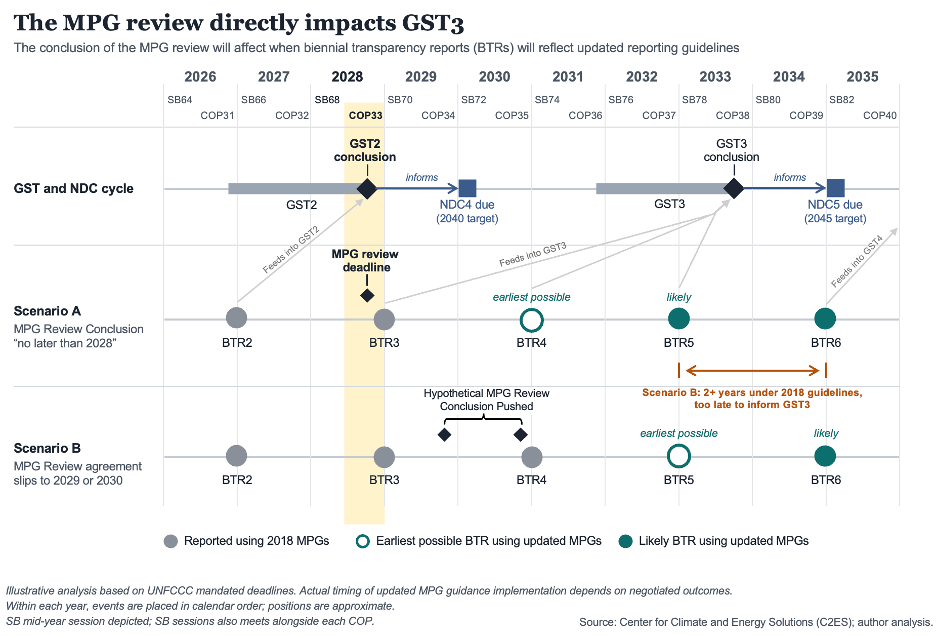
Timing is critical. If Parties can update the text of the MPGs by 2028, realistically, they might be able to update the corresponding reporting tables in the following year or two. This means Parties could likely transition to the updated MPGs by 2032, the last reporting year available to shape GST3 and inform NDC5s for 2045.
If Parties do not finalize the review by 2028, the transparency system would not fully reflect the latest Paris architecture—including the GGA indicators, NCQG, and Article 6 reporting—until the mid-2030s at the earliest. It would not inform GST3 nor inform NDC5s, which effectively means the outcome of the review would not be incorporated into the overarching ambition cycle until GST4 in 2038. Such a delay would give credence to criticism that the multilateral system is too slow to respond to the climate crisis.
This has happened before. Parties negotiated the MPGs for so long that they did not leave enough time to transition reporting to BTR1s to inform the first GST.
Suggested priority transparency outcomes for COP31
The clock is already ticking toward 2028. But Parties at COP31 can determine the first steps toward a robust outcome on the MPGs.