
Worldwide, industrial heat makes up two-thirds of industrial energy demand and almost one-fifth of total energy consumption. However, only 12 percent of this demand is met using renewable energy. To address this, C2ES helps convene the Renewable Thermal Collaborative (RTC), a coalition of companies, institutions, and governments committed to scaling up renewable heating and cooling.
The RTC’s goal is to create a community of corporate buyers, establish policy support for the deployment of renewable thermal technologies, and put the United States on the path to reduce industrial sector thermal-related emissions 30 percent by 2030 and full sector decarbonization by 2050.
The RTC’s vision
- Educate all parties about the need for innovation in commercial and industrial thermal energy use
- Identify technology, market, and policy barriers to scaling renewable thermal technology adoption
- Implement solutions to enable the delivery of cost-competitive renewable thermal energy
- Improve the marketplace and financing for renewable thermal technologies
- Develop a long-term vision for scaling up renewable thermal technologies in the United States and globally
About the Renewable Thermal Collaborative
Since its founding in 2017, the RTC has built a growing membership of large energy buyers representing more than $6 trillion in market capitalization, some of whom have successfully invested in renewable thermal solutions with significant emissions and cost savings. RTC members represent a wide range of industrial sub-sectors, including leaders in the food and beverage, pharmaceutical, consumer goods, paper, healthcare, higher education, state government, building materials, and automotive sectors. The RTC also includes solutions providers, including renewable thermal technology developers, project financiers, and consultants, that work across an array of renewable thermal solutions, such as green hydrogen, solar thermal, geothermal, and electrification (e.g., industrial heat pumps) of industrial processes. These experts provide important institutional support for the RTC’s work to advance renewable thermal solutions for large customers.
As large thermal energy users, RTC members work together to meet the growing necessity for cleaner heating and cooling solutions — sustainably, economically, and at scale. The collaborative advocates for policies that support the deployment of renewable thermal solutions and helps members understand the problems in the market, learn from each other, and overcome barriers to renewable heating and cooling.
C2ES contributes to the strategic direction of the RTC and leads the Thermal Energy Storage (TES) workstream, which focuses on strengthening policy support for TES and ensuring TES technologies can access low-cost renewable electricity to produce and store heat for later use. C2ES also directs the coalition’s state and federal policy work, which includes building awareness and consensus among policymakers on the urgency of decarbonizing thermal energy, analysis of renewable thermal funding opportunities, and advocating for policies that accelerate renewable thermal deployment. Additionally, C2ES contributes to the knowledge base of the RTC, performing technology and sector assessments.
C2ES Publications
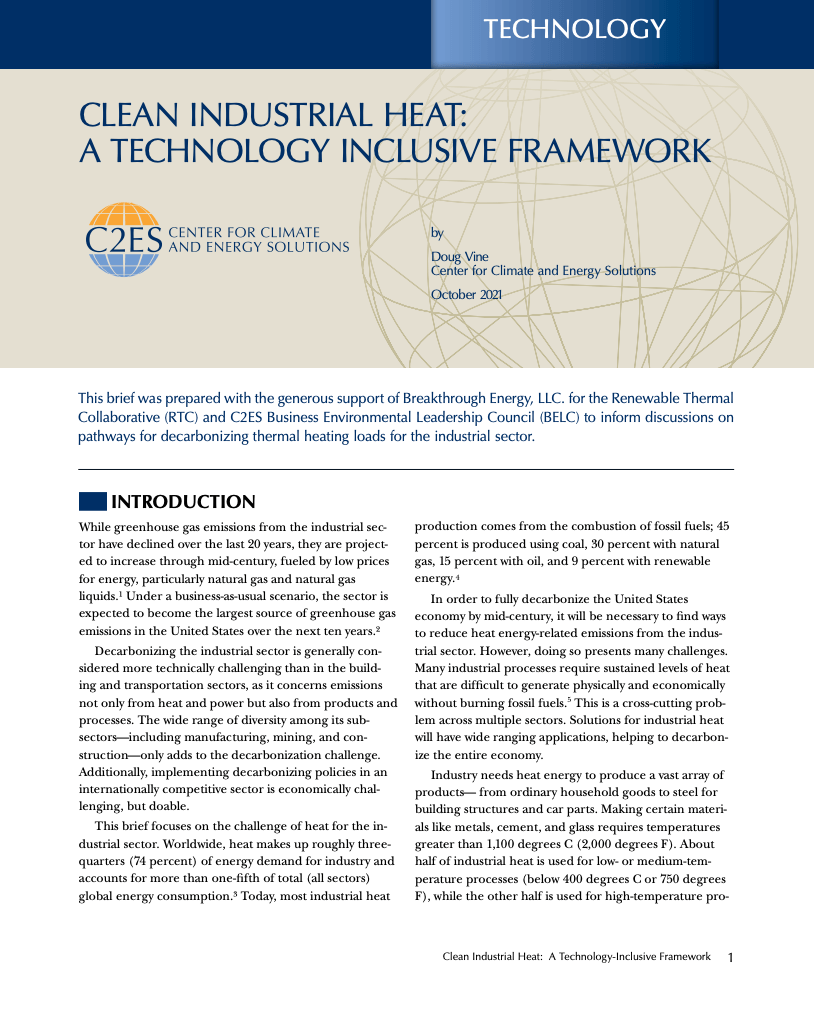
Clean Industrial Heat: A Technology Inclusive Framework
A look at the challenge of heat for the industrial sector. Today, most industrial heat production comes from the combustion of fossil fuels; 45 percent is produced using coal, 30 percent with natural gas, 15 percent with oil, and 9 percent with renewable energy.
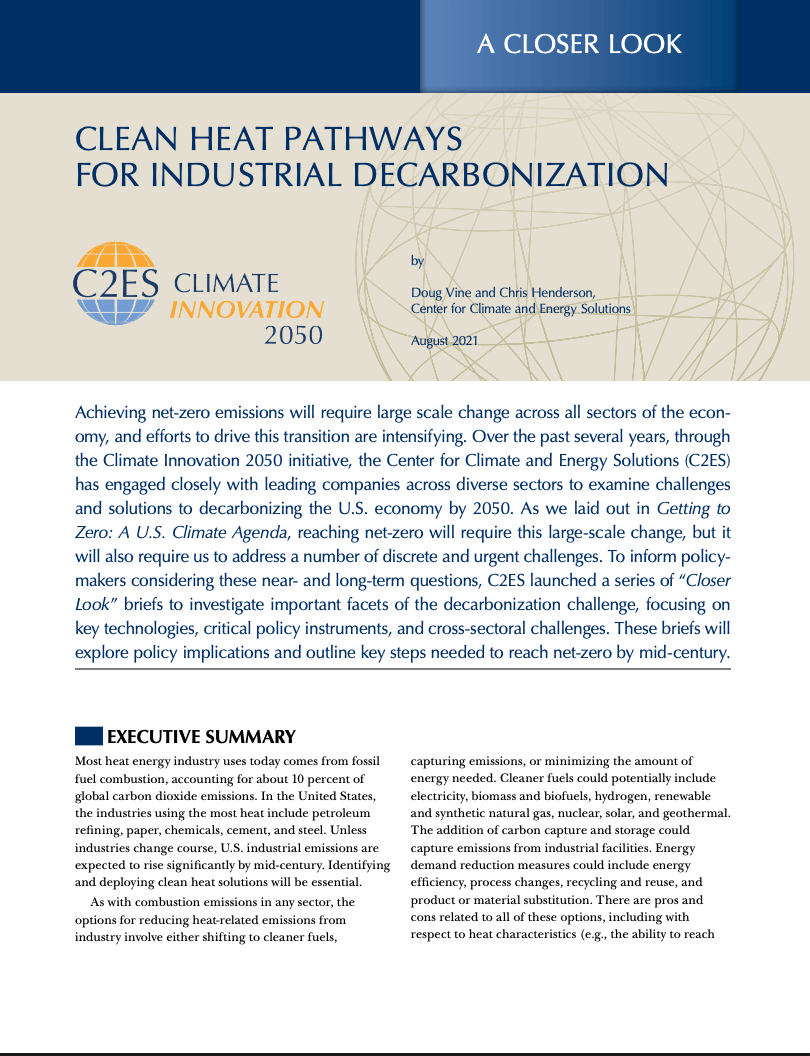
Clean Heat Pathways for Industrial Decarbonization
An overview of the current status of industrial heat in a range of sectors with key criteria for evaluating or characterizing clean heat technologies and the challenges and opportunities clean heat technology options present. The brief concludes with recommendations for a suite of policies that can provide a pathway to reducing emissions from industrial heat.
Additional RTC Publications
The Renewable Thermal Vision: Finding a Path Forward for Decarbonizing Thermal Energy in the U.S. Industrial Sector.
Thermal Batteries: Opportunities to Accelerate Decarbonization of Industrial Heat: An analysis of the potential benefits of and barriers to the use of electricity-powered thermal batteries to decarbonize nearly all industrial heat demand. This report finds that thermal batteries can be cost-competitive in much of the U.S. even today and provides modeling to demonstrate the highest-potential use cases, which heavily depend on how the industrial facility is sourcing renewable electricity and access to wholesale power prices.
Utility Engagement Playbook for Industrial Customers: A look at the barriers to industrial electrification within the context of the utility sector, solutions to those barriers and the potential implementation pathways for those solutions. This report helps companies understand utility issues that affect electrification projects, inform conversations with their utility partners, and outline potential regulatory and legislative advocacy strategies.
Chemical Sector Assessment: An analysis of decarbonization opportunities within the U.S. chemical industry. This report offers an overview of three key chemical production processes, an evaluation of technology readiness and emissions abatement potential of decarbonization solutions, and recommendations for chemical companies to reduce thermal emissions.
Community Benefits Handbook: A comprehensive guide to help companies and organizations navigate community collaboration and equity-focused project planning. This resource helps companies understand the strategic importance of proactive community partnerships in de-risking project development, learn how to conduct community impact assessments, develop stakeholder engagement strategies, and create community benefit plans that deliver tangible economic, environmental, and social value.