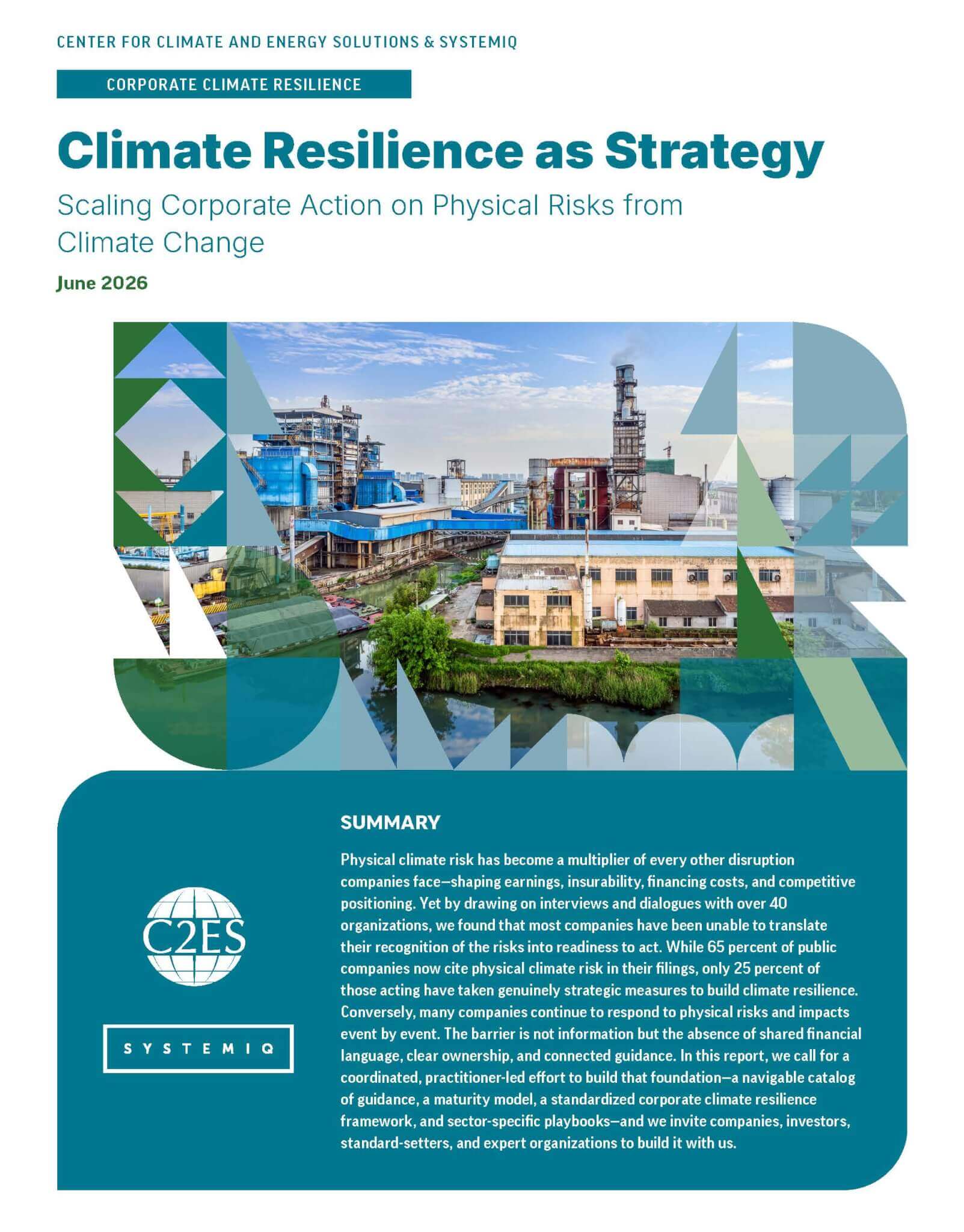
"Climate Resilience as Strategy" is a joint white paper co-authored by Systemiq and the Center for Climate and Energy Solutions (C2ES), examining where companies stand on physical climate resilience today and what it will take to move from risk awareness to scaled action.
Synthesized from desktop research, practitioner interviews, and C2ES’s 2025 dialogue series.
1. Corporate resilience efforts remain underdeveloped relative to risk
Most companies now acknowledge growing physical risk and have begun strengthening business continuity. But maturity still lags exposure. Many adaptation plans push implementation far into the future — and only 25% of corporate adaptation measures are genuinely strategic in nature.
2. Companies lack the tools to treat resilience as a strategic discipline
A key gap is valuation — the ability to quantify avoided losses in ways finance teams trust. Without this, resilience falls down the priority list against nearer-term initiatives. The mismatch between capital planning cycles and multi-decade physical risk trajectories compounds the problem.
3. The guidance landscape has foundations, but critical gaps remain
Guidance is expanding quickly, and strongest on risk assessment and disclosure. But it remains fragmented and uneven on the elements that convert insight into action: valuing resilience, building financeable pipelines of interventions, and enabling ecosystem collaboration.

What needs to happen next
C2ES and Systemiq see four interlocking priorities for moving corporate resilience from awareness to scaled action. Progress on each will reinforce the others.
Make the guidance landscape navigable
The ecosystem of standards, frameworks, and tools is expanding but remains fragmented. Companies need a coherent map of what exists, where guidance is strongest, and how to connect risk assessment to strategic action. A navigator tool would reduce duplication and help practitioners find what they need when they need it. Our cataloguing of existing guidance below is a first step. More work and additions from others as new resources are developed will be needed to make it practical and usable
Establish a shared baseline for what good looks like
Without a common reference point, companies cannot benchmark their progress or build credibility with boards and investors. A widely adopted self-assessment framework, co-developed with practitioners and refined through use, gives companies a structured way to understand where they stand and what to prioritize. A prototype is available here.
Establish a broadly accepted holistic corporate climate resilience framework
No single standard or framework provides end-to-end support for companies seeking to build resilience to physical climate risk. Companies must piece together multiple frameworks, tools, and analyses and often encounter gaps in guidance that stall progress. A broadly accepted, standardized corporate climate resilience framework that coalesces existing resources and fills in any gaps will help companies take coordinated, enterprise-wide action from risk assessment to implementation to decision-useful disclosures to their key stakeholders.
Develop sector-specific pathways to action
Generic guidance leaves companies uncertain about where to start. Sector pathways, co-developed with industry associations and leading practitioners, translate broad principles into concrete priorities for specific risk profiles, asset types, and value chain structures. They also create the conditions for coordinated action beyond the fence line.
Physical climate risk has moved from tail risk to systemic threat — compounding geopolitical, supply chain, and operational disruptions in ways that demand strategic action, not just awareness. This paper examines where companies stand on climate resilience today and what it will take to move from risk assessment to scaled, competitive advantage.
Climate Resilience Resource Landscape
Search our database of current guidance, tools, and market analyses on corporate climate resilience. These resources come from a wide range of organizations and include guidance on risk assessment, governance, valuation of risk and resilience efforts, disclosure, and other topics. The database will be updated as new resources are published. Please contact Tessa Ida (idet[at]c2es.org) if you would like to request the addition of a publicly available resource to this database.
Join the Webinar
From Recognition to Readiness: Building Corporate Climate Resilience at Scale
Join C2ES and Systemiq on June 30th at 11:00am ET to hear key findings and recommendations from this report, gain insights from the companies leading the way on climate resilience, and explore what the path forward looks like for companies ready to move from recognition to readiness.
The Resilience Agenda — Sets out seven strategic priorities for European leaders on meeting Europe’s security, climate, and competitiveness challenges together. Published by Systemiq with the University of Oxford and Clingendael Institute (Feb 2026).