Innovation Program

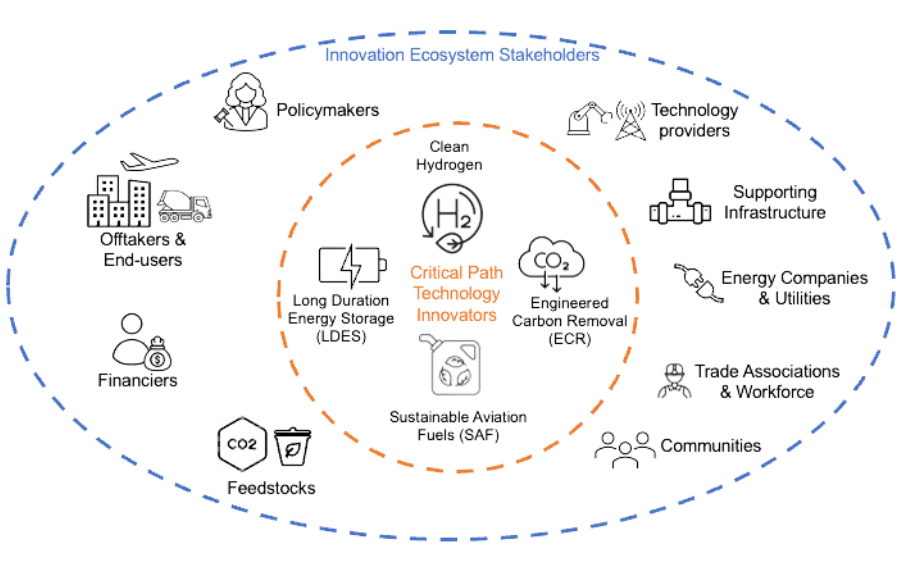
The C2ES Innovation Program focuses on four critical-path technologies: engineered carbon removal, sustainable aviation fuel, and clean hydrogen, and long duration energy storage. These working groups provide a regular venue where stakeholders across the innovation ecosystem can convene to discuss the technical, market, and policy solutions needed to rapidly scale these technologies.

The Challenge

Meeting our long-term climate goals will require the large-scale deployment of a multitude of new, innovative technologies and low- and zero-carbon fuels across every sector of the economy. First- of-a-kind technologies must navigate commercialization in an increasingly complex environment, one shaped by policy uncertainty, macroeconomic headwinds, and rising electricity demand. Effectively supporting innovators during this pivotal moment requires a system-wide approach between corporate incumbents, financiers, innovators, and communities that builds durable support for critical technologies, while simultaneously growing the investor and market confidence necessary for scale-up.

To meet these challenges, the Center for Climate and Energy Solutions (C2ES) established the Innovation Program, which seeks to foster a U.S. innovation ecosystem that reliably supports leadership in commercializing critical clean technologies, strengthens U.S. competitiveness, and enables global decarbonization. By convening companies who are driving investments across the value chain to commercialize new clean technologies, we aim to identify barriers in the innovation ecosystem, advocate for pragmatic solutions, and support market development.
Our Approach

Innovation Program Structure

For 2026, the Innovation Program is focused on five major topics which will be explored through technology working group convenings and concurrent research efforts:

  1. Cross-cutting innovation sessions: Recognizing that many innovators are navigating shared challenges around market volatility, project development, and policy uncertainty, we plan to offer quarterly convenings that will bring together the full network of the Innovation Program, with a goal of running three workshops in 2026. Our goal is to enable information exchange across technology verticals, facilitate connections, and align on a shared set of recommendations for how to lower the administrative and financial burden of partnering with the federal government on innovative projects.
  2. Engineered Carbon Removal: Initial work on this topic is focused on systems-level issues and policy development (e.g., infrastructure, market drivers, industry standardization) that will support commercialization of a range of carbon removal pathways (e.g., direct air capture, biomass with carbon removal and storage/bioenergy with carbon capture and storage, enhanced rock weathering, biochar, and marine-based carbon dioxide removal).
  3. Sustainable Aviation Fuel: Initial work on this topic is focused on an assessment of feedstock dynamics and potential contributions of emerging hydrogen production pathways for synthetic fuels (e.g., e-fuels) and constructive policy and industry opportunities that can help accelerate their development and contribution to volumetric SAF targets.
  4. Clean Hydrogen: Initial work on this topic is focused on the development and policy opportunities for emerging production pathways, including geologic hydrogen and methane pyrolysis, and identifying context-optimized production and demand opportunities to help enable clean hydrogen production at scale.
  5. Clean Firm: Initial work on this topic is focused on shared commercialization bottlenecks and policy needs (e.g., financing, market misalignment, and permitting and interconnection delays) for a broad range of clean firm and storage technologies (e.g., advanced nuclear, next-generation geothermal, long-duration energy storage) that will represent new clean firm capacity additions.

Key Working Group Priorities:

  • Research and Analysis: Includes, but is not limited to, analysis on market potential, cost- competitiveness, technological development, and cross-cutting constraints to project development and commercialization.
  • Federal Innovation Policy: Includes technology-specific policies and appropriations requests as well as cross-cutting recommendations on how to improve federal support of innovation.
  • Non-policy Market Development: Intended to capture non-policy work, including supporting use of market development mechanisms by both demand and supply actors.
  • Education and Amplification: Includes education and advocacy efforts to help grow awareness and build durable bipartisan support for emerging technologies.

Each topic area and associated working group will take its own approach towards achieving shared outcomes, likely exploring one or two activities within any given year. In addition to our technology- specific efforts, the Innovation Program also encompasses C2ES’s broader work on innovation, including work like the C2ES Innovation Policy Matrix.


The Technology Innovation Ecosystem

The innovation ecosystem spans the entire technology value chain. Each working group includes both demand and supply-side perspectives, as well as other key stakeholders.

Publications

C2ES Innovation Policy Matrix A Framework to Accelerate US Technology Leadership

This paper introduces the Center for Climate and Energy Solutions’ (C2ES) Innovation Policy Matrix, a user-friendly, nonpartisan, and technology-neutral tool designed to help policymakers assess and craft effective innovation policy. Explore our factsheets covering each critical-path technology below.

Working Groups

Engineered Carbon Removal

Engineered carbon removal (ECR) is a necessary complement to industrial decarbonization and the transition to clean energy. The ECR working group is focused on both direct air capture (DAC) and biomass carbon removal & storage (BiCRS).  

ECR Working Group

Long Duration Energy Storage

Long duration energy storage (LDES) is essential for enabling the widespread adoption of renewable energy sources such as solar and wind. This working group is focused primarily on mechanical and electrochemical LDES with a duration of dispatch greater than ten hours. 

LDES Working Group

Clean Hydrogen

Hydrogen is a versatile zero-emissions energy carrier with significant potential to decarbonize multiple economic sectors. This working group focuses on near term opportunities to grow the market for clean hydrogen among existing and prospective use cases.  

Clean Hydrogen Working Group

Sustainable Aviation Fuel

Sustainable aviation fuel (SAF) is projected to play a crucial role in decarbonizing the aviation industry. Recognizing the diversity of the SAF industry, this working group is open to all SAF pathways. 

SAF Working Group