Cross-sector leaders for climate-ready communities
Cross-sector leaders for climate-ready communities
Despite strong local leadership and innovation, resilience efforts remain fragmented and increasingly underfunded as disasters grow more frequent and costly, outpacing state and federal budget resources. The Climate Resilient Communities Accelerator (Accelerator) supports community and business leaders by creating space for coordination and then activating an expanding pool of public- and private-sector partners around shared hazards and high-impact resiliency strategies.
Learn more about regional Accelerators launched by C2ES since 2023:
By 2030, C2ES’s vision for the Accelerator is to help catalyze a national shift where climate resilience is mainstreamed across communities and businesses, demonstrated by measurable risk reduction, stable insurability and creditworthiness, stronger policy frameworks, empowered local leadership, and coordinated action that protects vulnerable regions across the U.S. that are collectively home to more than 20 million people.
Building off existing efforts across each region, the Accelerator provides two years of flexible support and focused convenings to organize, align, and equip diverse local leaders around a shared vision for resilience.
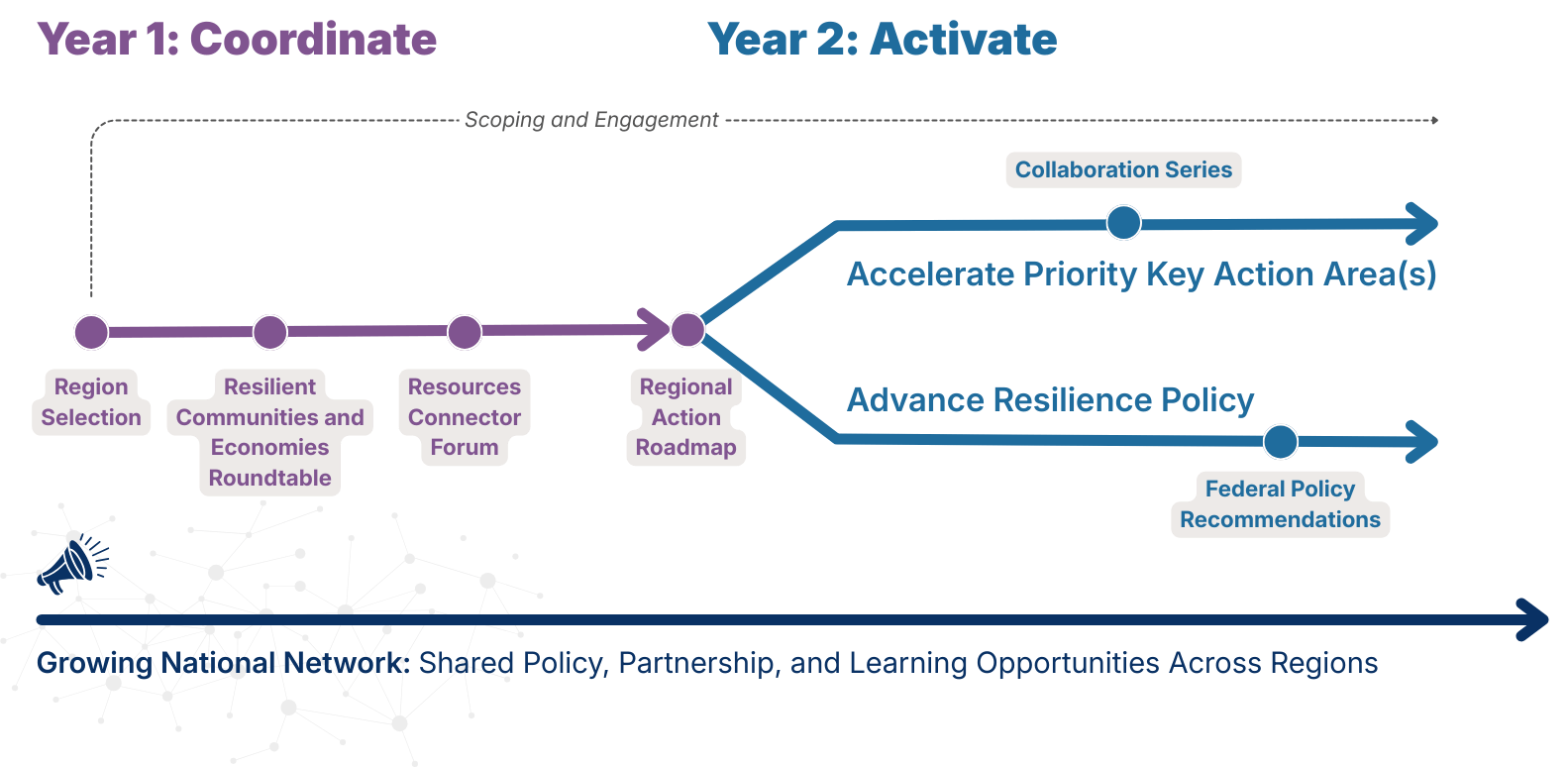 In Year 1, cohort members select 2-3 focus hazards and co-create a Regional Action Roadmap of priority resiliency strategies that are high-impact, multi-hazard, and leverage the strengths of both public and private sectors. In Year 2, the cohort starts implementing one or more priority strategies, supporting new public-private partnerships and identifying policy priorities for more systemic change. After the initial two-year regional effort, the regional cohort joins a growing national network as the initiative expands to new regions across the United States, with C2ES continuing to engage them in policy, partnerships, and learning opportunities.
C2ES is excited to announce the release of the Regional Action Roadmap for Extreme Heat and Wildfire Smoke: From the South-Central Puget Sound Climate Resilient Communities Accelerator, a collaborative guide designed to strengthen resilience to extreme heat and wildfire smoke across the South-Central Puget Sound Region. The Roadmap was developed through C2ES's Climate Resilient Communities Accelerator—a multi-year initiative to brings together government, Tribes, businesses, and community organizations to advance equitable, high-impact strategies for a safer, healthier future. The Roadmap outlines six key action areas, actionable steps, and resources to help local leaders accelerate climate resilience efforts. Explore the full Roadmap and join us in driving regional action toward a more resilient South-Central Puget Sound.

Each regional Accelerator begins with two years of focused convenings and flexible support, after which cohort members join a growing national network as the initiative expands to new regions across the United States.
The first year focuses on engaging and learning from a cohort of local leaders from across diverse organizations, selecting local climate hazards, and co-creating a Regional Action Roadmap. C2ES kicks off the first year with a 2-part series of in-person convenings: the Climate Resilient Economies Roundtable uncovers innovative and scalable local strategies, followed by a curated Resources Connector Forum to align public and private resources to advance identified strategies across the region.
The second year advances one or more priority strategies across the region and elevates local voices to federal policy priorities and national forums.
C2ES invites representatives with decision-making authority from public and private sectors and aligned non-profit and community organizations across the region to coordinate and accelerate existing efforts and develop new, actionable commitments. These leaders will represent their organizations in strategic convenings alongside resilience practitioners, technical experts, government agency staff, and community representatives.
C2ES seeks to support and engage a regional cohort of organizations and individuals who are open to new ideas, solutions, and collaboration. Participating organizations are highly encouraged to consider and define tangible opportunities to enhance their own approaches and commitments and explore ways to support and complement other resilience efforts in the region.
In the first year, C2ES staff host scoping calls and two full-day in-person convenings to coordinate local leaders and identify priority strategies. Second-year convenings are designed to drive on-the-ground progress toward implementing a priority strategy and advance public policy for lasting, systemic change. In years three and beyond, C2ES continues to connect the cohort with new resources, partnerships, and policy opportunities.
Participation is flexible, and engagement can vary based on capacity and interest, ranging from providing input on the Accelerator’s focus during a scoping call to attending all in-person convenings, presenting on organizational efforts, and providing input on resilience policy priorities.
C2ES staff plan and facilitate the in-person convenings, lead the development of program deliverables, and provide flexible support for projects or partnerships that emerge from the Accelerator. C2ES engages the cohort at several points outside of the meetings to understand organizational goals, share relevant information, and gather insights and feedback to support productive convenings.
After each two-year regional effort of the Accelerator, success means communities, businesses, and public leaders are more organized, resourced, and acting together: co-creating a roadmap, launching high-impact resilience projects, strengthening critical infrastructure, and amplifying community voices to measurably reduce impacts and costs. In the longer term, success means that communities and local economies across each region, and beyond, are thriving and more resilient to the impacts of climate hazards and extreme weather.
Climate disasters and extreme weather impacts are escalating nationwide, with the first half of 2025 marking the costliest period on record for disasters. In 2024, the U.S. experienced 27 billion-dollar disasters (explore the U.S. Billion-Dollar Weather and Climate Disasters), and it is now understood that every $1 invested in preparedness saves $33 in avoided costs. Yet, public-sector resources remain limited, and communities and businesses, which depend on the same infrastructure and natural systems, need new avenues to collaborate and make an impact.