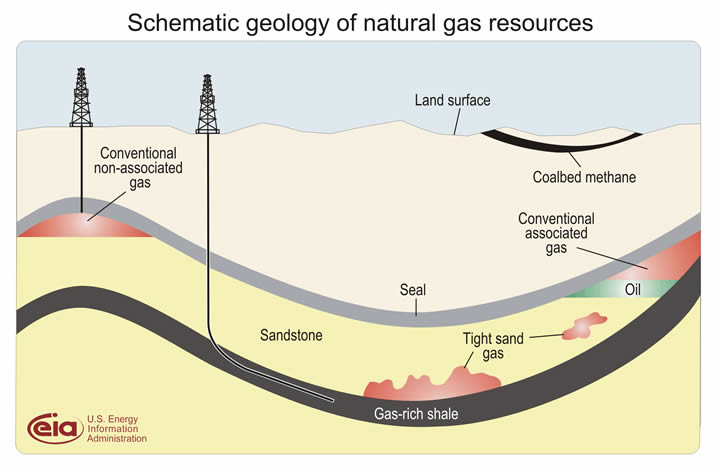
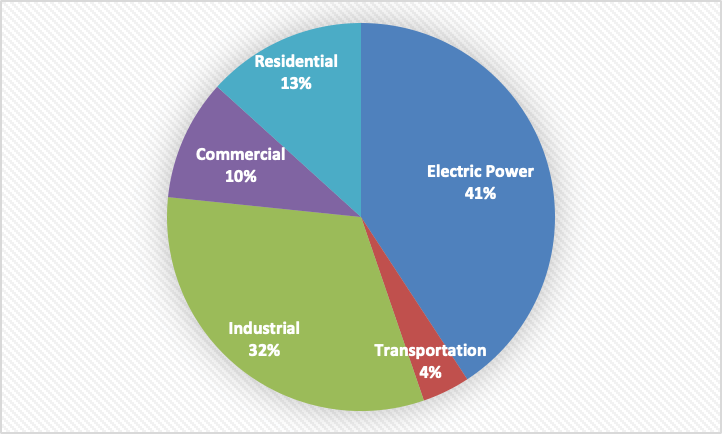
Constituting 25 percent of total U.S. energy consumption, natural gas is important in almost every economic sector, used to produce heat and electricity, and as a feedstock in manufacturing (see Figure 1).[11] [1] Natural gas is composed primarily of methane (CH4) – a very potent greenhouse gas. During various steps of natural gas extraction, transportation, and processing, methane is released to the atmosphere. These “fugitive” emissions can represent an opportunity to reduce greenhouse gas emissions, maximizing the potential climate benefits of using natural gas.
Recently, natural gas reserves have dramatically expanded because of technological advances allowing access to unconventional sources in shale formations, coal beds, and sandstone formations. For background information on natural gas not covered in this factsheet, including supply, demand, and pricing see C2ES Natural Gas Overview [2].
Figure 1: U.S. Natural Gas Consumption by Economic Sector (2011)
Source: Energy Information Administration, U.S. Department of Energy 2012.[12]
In the last few years, the outlook for U.S. natural gas supply has changed dramatically, with predictions no longer showing the United States becoming increasingly reliant on natural gas imports (particularly imports of liquefied natural gas, or LNG); rather, technological advances in seismic imaging, horizontal directional drilling and hydraulic fracturing over the past 30 years have led to dramatically increasing economically recoverable North American shale gas. Because of this increase, the United States is expected to become a net exporter of natural gas in 2022.[13] Shale gas has been the primary source of U.S. natural gas growth since 2000, increasing from 2 percent to approximately 22 percent of the natural gas supply in 2011.[14] Shale gas is expected to grow fourfold by 2035, making up nearly 50 percent of total U.S. natural gas production.[15]
In 2012, U.S. natural gas consumption averaged 69.8 billion cubic feet per day (Bcf/d), a 4.8 percent increase (3.2 Bcf/d) from 2011 (see Figure 2).[16] Growth in natural gas consumption is expected in all sectors except the residential sector, with the most dramatic increase in transportation (an estimated 5.9 percent increase, though it is starting from a low baseline).[17]
Figure 2: Projected Total Natural Gas Consumption (2012-2035)
Source: EIA Annual Energy Outlook. 2012. Total Energy Supply, Disposition, and Price Summary.[18]
Natural gas has a wide range of applications in all economic sectors.
Electric Power: Natural gas can provide baseload, intermediate, and peak demand electricity. The electric power sector is using an increasing percentage of natural gas, over 31 percent in 2011, up from 17percent in 1990.[19] Natural gas-fired electric power plants are expected to continue to increase in importance – accounting for 37 percent of 23.5 GW of electric power generation planned for 2012 and 60 percent of capacity additions between 2010 and 2035 (for more, see C2ES resource Natural Gas in the U.S. Electric Power Sector [5]).[20]
Figure 3: Combined Cycle Power Plant
Source: Global-Greenhouse-Warming.com, 2010.
Industrial Sector. Natural gas can be used in a diverse array of industrial sector applications, including heating and cooling, electricity generation, food processing, and as a feedstock in chemical products, plastics and fertilizers (see C2ES resource Natural Gas in the Industrial Sector [9]).[32] In 2011, natural gas accounted for 58 percent of industrial electricity generation produced onsite, up from 51percent in 2005.[33] That year, the industrial sector consumed 6.91 quadrillion Btus of natural gas with 72 percent (4.98 quadrillion Btus) in heat and power operations.[34] Industrial sector usage resulted in the release of 433 million metric tons of CO2 that same year.[35]
o Other efficiency measures: Measures such as preventive maintenance and advanced steam systems process controls can lead to more efficient energy use and thus lower emissions.[38]
Natural Gas Industry Operations. Natural gas systems involve the production, processing, transmitting, and distributing as well as the storage of the resource.
Transportation: Natural Gas Vehicles (NGV): Natural gas can be compressed (CNG) or converted into liquid (LNG) fuel for use in place of conventional fuels in modified engines, or in fuel cell vehicles. Globally, there are more than 15 million NGVs; almost three quarters in just five countries (Pakistan, Argentina, Brazil, Iran, and India).[44] In 2010, compressed natural gas (CNG) and liquid natural gas (LNG) vehicles comprised about 0.05 percent (about 120,000 vehicles) of the U.S. vehicle stock (for more, see C2ES Natural Gas in the Transportation Sector [11])[45] – over 45 percent of which were medium- or heavy-duty vehicles.[46] Gas to liquid technology (GTL) is another fuel technology that converts natural gas into diesel or gasoline, able to be utilized in the existing fleet and fuel distribution infrastructure. Finally, electricity can be produced using natural gas that can in turn power electric vehicles.
Residential and Commercial: Natural gas has extensive residential and commercial applications. As a fuel source consumed onsite, natural gas provides an option to increase fuel efficiency in buildings while decreasing emissions when compared with centrally produced electricity.
Among fossil fuels, natural gas is the least carbon intensive and burns efficiently with fewer air pollutants (including particulates, nitrogen oxides, sulfur dioxide, lead, and mercury).[53] Combustion of natural gas emits approximately half as much carbon dioxide (CO2) as traditional coal and 33 percent less than oil.[54] As described natural gas heavy-duty vehicles could achieve a nearly 29 percent reduction when compared to diesel vehicles, depending on natural gas leakage rates.[55] While natural gas still produces significant emissions, when it displaces more carbon-intensive fuels like coal and oil, it can lower greenhouse gas emissions.
Natural gas emissions consist primarily of methane (CH4), which is a greenhouse gas about 21 times more powerful in terms of its heat-trapping ability than CO2 over a 100 year time frame.[56] Methane is emitted through venting and fugitive releases during the processing, transporting, and storage of natural gas.[57] Currently, venting and fugitive emissions from natural gas systems are around 3 percent of total U.S. greenhouse gas emissions. However, to fully realize the benefits of increased natural gas usage these fugitive emissions must be addressed. Fortunately, there are technologies that can help reduce emissions from oil and natural gas systems. Some analyses suggest these technology-based investment options for reducing greenhouse gas emissions have short payback times, depending on the price of natural gas.[58]
The role natural gas plays in overall greenhouse gas emission reductions depends on the extent to which natural gas is used to fulfill energy needs, the efficiency of the technology used, and the effectiveness of efforts to limit emissions. First, increasing direct use of natural gas in residential, commercial, and industrial sectors can reduce greenhouse gas emissions because of increased efficiency inherent in natural gas transmission and distribution when compared to electricity. A full fuel cycle assessment of the emissions impacts from all stages of fossil fuel production, processing, and end-use more accurately assesses its true climate impacts (see C2ES resource Natural Gas in the Commercial Buildings [16]). Also, fuel switching from coal to natural gas in large power plants creates an opportunity for emissions reductions. Additionally, though no commercial-scale projects have been developed, natural gas power generation with carbon capture and storage (CCS) could provide further opportunity to diminish emissions (see C2ES Climate Techbook: CCS [8] and C2ES resource Natural Gas in the U.S. Power Sector [5]). Interest in building the world’s first commercial-scale natural-gas fired CCS power plant has grown in recent years. Notably, CO2 captured from natural gas processing or power generation can be used in enhanced oil recovery (CO2-EOR) and stored underground (see C2ES Enhanced Oil Recovery Overview [17]).
However, inexpensive natural gas has the potential to outcompete renewables and nuclear projects, potentially hurting emission mitigation efforts.[59] Nuclear becomes less tenable because of its higher upfront capital costs when compared to natural gas (see Table 1).[60] Using natural gas in combination with renewables could provide lower emissions and a more flexible energy production system compared to centralized provision based on a single fuel source such as coal or nuclear power.
Price volatility is an important component of natural gas history, but it is unclear if this will remain so in the future (see Figure 4). Historically, natural gas cost fluctuations were due to regulatory changes, weather patterns, and large market trends (see C2ES resource U.S. Natural Gas: Overview of Markets and Uses [18]). However, the market is expected to remain more stable in future years because of increased supply due to development of shale gas resources, advanced reserve identification and extraction techniques, and storage capabilities.[61]
Figure 4. U.S. Natural Gas Monthly Average Wellhead Prices (USD/mcf)
Source: U.S. Energy Information Agency, 2012.[62]
In the U.S. electric power sector, public utility commissions are approving natural gas power production based on fuel source economics, increasing deployment of natural gas electricity production. The degree of fuel switching is also dependent on cost differences in utilizing existing natural gas power plants compared with coal plants. For new construction, natural gas power plants can be built on a levelized cost basis for much less than competing fuel sources, including coal, nuclear, and renewable resources (see Table 1). When compared to traditional coal power production, new natural gas power plants provide a lower cost option to provide electricity with reduced carbon emissions.
Table 1. Levelized Comparisons of New Power Plants Entering Service in 2017
2010 USD($/MWh) | Levelized Capital Cost | Total System Levelized Cost |
Coal |
| |
Conventional Coal | $64.9 | $97.7 |
Advanced Coal (IGCC) | $74.1 | $110.9 |
Natural Gas |
| |
Conventional Natural Gas (NGCC) | $17.2 | $66.1 |
Advanced Combined Cycle | $17.5 | $63.1 |
Wind | $82.5 | $96.0 |
Nuclear | $87.5 | $111.4 |
Source: Annual Energy Information Administration of the Department of Energy. 2012.[63]
Due to the range of applications, the natural gas policy landscape is diverse and addresses extraction, distribution, energy production, and end use consumption. The recent boom in shale gas extraction in areas of the country unaccustomed to this manner of industrial development has caused concerns in some communities and some calls for policy action. As part of this development, and particularly related to hydraulic fracturing, the U.S. Department of Energy’s Secretary of Energy Advisory Board (SEAB) recently released recommendations for improving operational safety and reducing potential environmental impacts in drilling operations.[64]
One area of policy attention is water quality impacts of shale gas development. The Environmental Protection Agency (EPA) is undertaking a study on the effects of hydraulic fracturing on drinking water, to be completed in 2014.[65] The Energy Policy Act of 2005 amended the Safe Drinking Water Act (1974) to exempt underground injection of fluids for hydraulic fracturing related to oil, gas, and geothermal production from regulation by the Environmental Protection Agency.[66] This lack of regulation has led to some concerns that water resources are not effectively protected from hydraulic fracturing activities.
Currently, 15 states have requirements for chemical disclosure in fracturing operations (see C2ES resource Hydraulic Fracturing Chemical Disclosure Map [20]). Though requirements can vary widely, they generally outline what must be disclosed, identify the monitoring authority, set disclosure deadlines, and outline trade secret protections.[67] Regulations are changing quickly as states respond to new market conditions, recoverable gas resources, and potential environmental impacts. At the federal level, legislation has been put before Congress to promote transparency, particularly concerning the chemicals used in fracking operations.[68]
EPA, using its authority under the Clean Air Act (CAA), promulgated New Source Performance Standards [21] (NSPS) and National Emissions Standards for Hazardous Air Pollutants (NESHAP) for the oil and gas production sector in 2012. The NSPS requires facilities, including hydraulically-fractured wells to reduce emissions to a certain level that is achievable using the best system of pollution control, taking other factors into consideration, like cost.[69] Under the NESHAP program, the Agency sets technology-based standards for reducing certain hazardous air pollutants emissions using maximum achievable control technology. The regulations directly target the emission of volatile organic compounds, sulfur dioxide, and air toxics, but have the co-benefit of reducing emissions of methane by 95 percent.[70]
Also in 2012, EPA proposed a court-mandated NSPS to regulate greenhouse gas emissions from newly-constructed power plants. The rules would require that all new power plants meet the emission rates of highly efficient NGCC power plants. Therefore, NGCC power plants would comfortably meet the new standards, favoring new natural gas electricity generation in the future. Coal power plants can only meet the standard using CCS technologies. With an estimated 14 GW of coal generation being retired by 2015 because of other regulations and market forces, natural gas has an opportunity to capture an expanded percentage of power markets.[71] EPA is also required to set additional NSPS rules for greenhouse gas emissions from existing power plants, expected in the next few years. Additional pollution regulations impacting the power sector are found here [22].
Finally, proposals for a Federal Clean Energy Standard (CES) have been before Congress in recent years (see C2ES resource Clean Energy Standard [23]). A CES would act similarly to state-level renewable portfolio standards (RPS) – which mandate a certain percentage of renewable-sourced electricity – by allowing credits for renewables as well as “clean” energy. “Clean” energy encompasses various technologies, such as NGCC and CHP, which create significantly less CO2 than traditional coal-fired power plants.[72] Currently, some states have policies that operate similarly to a CES in that they allow for some compliance through clean non-renewable energy resources (for more, see C2ES report Clean Energy Standards: State and Federal Options and Policy Implications [24].
Natural Gas in the Industrial Sector [29]
Oil and Natural Gas Air Pollution Standards [30]
U.S. Natural Gas Overview of Markets and Uses [18]
Natural Gas Use in the Transportation Sector [11]
Natural Gas in the U.S. Electric Power Sector [5]
The Looming Natural Gas Transition in the United States [31]
Natural Gas Infrastructure [32]
Natural Gas in the Residential Sector [15]
Natural Gas in Commercial Buildings [14]
Distributed Generation and Emerging Technologies [7]
State Maps
Congressional Research Service (CRS)
U.S. Department of Energy
U.S. Energy Information Administration (EIA)
U.S. Environmental Protection Agency (EPA)
U.S. Department of the Interior, Bureau of Land Management
National Energy Technology Laboratory
Global CCS Institute
ICF International
Air Products [57]
ALCOA [58]
ALSTOM [59]
AREVA [60]
Bayer [61]
BP [62]
Cummins [63]
DTE Energy [65]
Duke Energy [66]
Entergy [67]
Exelon [68]
National Grid [70]
NRG [71]
NextEra Energy [72]
PG&E Corporation [73]
PNM Resources [74]
Royal Dutch/Shell [75]
[1] U.S. Energy Information Administration (EIA), Annual Energy Outlook (AEO): Total Energy Supply, Disposition, and Price Summary Table (2012), http://www.eia.gov/oiaf/aeo/tablebrowser/#release=AEO2012&subject=8-AEO2012&table=1-AEO2012®ion=0-0&cases=ref2012-d020112c
[2] EIA, International Energy Outlook 2009, see Table A2. (2009), http://www.eia.doe.gov/oiaf/ieo. [76]
[3] EIA AEO, Electricity Supple, Disposition, Prices and Emissions Table (2012), http://www.eia.gov/oiaf/aeo/tablebrowser/#release=AEO2012&subject=6-AEO2012&table=8-AEO2012®ion=0-0&cases=ref2012-d020112c.
[4] Out of 5,481 million metric tons. EIA, Annual Energy Review (AER): Total Energy Emissions (2012), http://www.eia.gov/totalenergy/data/annual/showtext.cfm?t=ptb1101.
[5] Alvarez, R., Pacala, S, Winebrake, J., Chameides, W., Hamburg, S. Greater focus needed of methane leakage from natural gas infrastructure (2012), http://www.pnas.org/content/early/2012/04/02/1202407109.full.pdf+html [77]
[6] California Air Resources Board (CARB), Low Carbon Fuel Standard Fuel Pathways Analysis, http://www.arb.ca.gov/fuels/lcfs/workgroups/workgroups.htm#pathways [78]; U.S. Department of Energy (DOE) Energy Efficiency and Renewable Energy (EERE), Fuel Economy.gov – Natural Gas, http://www.fueleconomy.gov/feg/bifueltech.shtml [79]
[7] C2ES, Natural Gas in the U.S. Electric Power Sector (Electric Power Sector) (2012), http://www.c2es.org/publications/us-natural-gas-electric-power-sector.
[8] Ibid.
[9] EIA AEO, 2013, http://www.eia.gov/forecasts/aeo/er/index.cfm [80]; EIA AEO, 2012, http://www.eia.gov/forecasts/archive/aeo12/index.cfm [81]
[10] C2ES, Electric Power Sector, 2012; EPA, FACT SHEET: Proposed Carbon Pollution Standard for New Power Plants (2012), http://epa.gov/carbonpollutionstandard/pdfs/20120327factsheet.pdf
[11] Ibid.
[12] EIA AEO, Total Energy Supply, Disposition, and Price Summary Table (2012), http://www.eia.gov/forecasts/aeo/er/pdf/tbla1.pdf
[13] EIA AEO, Natural Gas Supply, Disposition, and Prices, Reference Case Table (2012) http://www.eia.gov/oiaf/aeo/tablebrowser/#release=AEO2012&subject=8-AEO2012&table=13-AEO2012®ion=0-0&cases=ref2012-d020112c.
[14] Ibid.
[15] C2ES, U.S. Natural Gas Overview of Markets and Uses (Markets and Uses) (2012), http://www.c2es.org/docUploads/natural-gas-markets-use.pdf
[16] EIA, Short-term Energy Outlook: September 2012 (2012), http://www.eia.gov/forecasts/steo/archives/sep12.pdf.
[17] EIA AEO, 2012.
[18] Ibid.
[19] Or, 7.6 MMCF in 2011. AER, Total Energy, (2012), http://www.eia.gov/totalenergy/data/annual/index.cfm#naturalgas.
[20] Planned in 2012 additions were 20 percent wind, 18 percent coal, 12 percent solar, 5 percent nuclear, and 8 percent other sources, including hydro, geothermal and biomass. C2ES, Electric Power Sector, 2012.
[21] EIA AEO, Levelized Cost of New Generation Resources (2012), http://www.eia.gov/forecasts/aeo/pdf/electricity_generation.pdf.
[22] For a more detailed explanation, see DOE’s “How Gas Turbine Power Plants Work.” http://www.fossil.energy.gov/programs/powersystems/turbines/turbines_howitworks.html.
[23] EIA, Average Tested Heat Rates by Prime Mover and Energy Source, 2007 – 2011, http://www.eia.gov/electricity/annual/html/epa_08_02.html
[24] For a more detailed explanation, see EGL’s Gas-Fired Combined Cycle Power Plants: How Do They Work? http://www.egl.ch/int/ch/en/about/Publications/Unternehmensbroschueren.-ContentLeft-0017-ContentLeftdownloadlist-l1227699492261-File.File.FileRef.pdf/Gas_Fired_Combined_Cycle_Power_PlantEN.pdf.
[25] A new natural gas combined cycle power plant is estimated to emit roughly 42-44 percent as much CO2 per unit of net electricity generation compared to a new pulverized coal power plant. National Energy Technology Laboratory (NETL), Cost and Performance Baseline for Fossil Energy Plants, Volume 1: Bituminous Coal and Natural Gas to Electricity Final Report, see Exhibit ES-2 (2007), http://www.netl.doe.gov/energy-analyses/baseline_studies.html
[26] Comparison based on heat rates assumed in EIA’s Assumptions to the Annual Energy Outlook (2009), Table 8.2, and EPA’s National Electric Energy Data System (NEEDS [82]) 2006 database. http://www.eia.doe.gov/oiaf/aeo/assumption/index.html
[27] GE Energy, “FlexEfficiency* 50 Combined Cycle Power Plant.” (2012), http://www.ge-energy.com/products_and_services/products/gas_turbines_heavy_duty/flexefficiency_50_combined_cycle_power_plant.jsp.
[28] ICF International, Integrating Renewable Electric Power Generators and the Natural Gas Infrastructure, (2011), http://www.icfi.com/insights/white-papers/2011/integrating-variable-renewable-electric-power-generators-natural-gas-infrastructure
[29] This contributed to 64 percent increase in natural gas net generation, from 601 thousand GWhs in 2000 to 988 thousand GWhs in 2010. EIA, Electric Power Annual 2010 Data Tables (2011), http://www.eia.gov/electricity/annual/html/epa_04_01.html.
[30] C2ES, Electric Power Sector, 2012.
[31] IEA 2008, p.256.
[32] C2ES, Natural Gas in the Industrial Sector (Industrial Sector) (2012), http://www.c2es.org/docUploads/natural-gas-industrial-sector.pdf
[33] EIA, “Industrial onsite generation increasingly relies on natural gas.” Today in Energy - October 26 (2012), http://www.eia.gov/todayinenergy/detail.cfm?id=8550.
[34] EIA AEO, Industrial Sector Key Indicators and Consumption (2012), http://www.eia.gov/oiaf/aeo/tablebrowser/#release=AEO2012&subject=2-AEO2012&table=6-AEO2012®ion=0-0&cases=ref2012-d020112c.
[35] EIA AEO, Energy-Related Carbon Dioxide Emissions by Sector and Source, US. (2012), http://www.eia.gov/oiaf/aeo/tablebrowser/#release=AEO2012&subject=1-AEO2012&table=17-AEO2012®ion=1-0&cases=ref2012-d020112c.
[36] MIT Energy Initiative, The Future of Natural Gas: An Interdisciplinary MIT Study (2011), http://mitei.mit.edu/system/files/NaturalGas_Chapter5_Demand.pdf.
[37] C2ES, Industrial Sector, 2012.
[38] McKinsey & Company, Reducing U.S. Greenhouse gas Emissions: How Much at What Cost? (2007), http://www.mckinsey.com/clientservice/ccsi/pdf/US_greenhouse [83] gas_final_report.pdf
[39] IEA, Energy Technology Perspectives 2008: Scenarios and Strategies to 2050 (2008), http://www.iea.org/techno/etp/etp_2008_exec_sum_english.pdf
[40] For detail on oil and gas operations emissions see Table 1 in Bluestein, 2008.
[41] DOE National Energy Technology Laboratory (NETL), Carbon Sequestration Through Enhanced Oil Recovery (2008), http://www.netl.doe.gov/publications/factsheets/program/Prog053.pdf
[42] Global CCS Institute 2012, The Global Status of CCS: 2012, http://cdn.globalccsinstitute.com/sites/default/files/publications/47936/global-status-ccs-2012.pdf
[43] IEA 2008.
[44] International Association for Natural Gas Vehicles (IANGV) Natural Gas Vehicle Statistics (2008), http://www.iangv.org/current-ngv-stats.
[45] DOE-EERE, Table 6.1 Estimates of Alternative Fuel Vehicles in Use,” Transportation Energy Data Book (2012), http://cta.ornl.gov/data/index.shtml.
[46] EIA, Renewable and Alternative Fuels: Alternative Fuel Vehicle Data, Yearly Estimates for 2010. (2012), http://www.eia.gov/renewable/afv/users.cfm?fs=a&ufueltype=cng%2clng&weightclass=ld&uyear=2010.
[47] C2ES, Natural Gas Use in the Transportation Sector (2012), http://www.c2es.org/publications/natural-gas-use-transportation-sector.
[48] DOE, Alternative Fuels Data Center (AFDC) (2012), http://www.afdc.energy.gov/fuels/natural_gas_basics.html.
[49] DOE, AFDC: Hydrogen Fuel Cell Vehicles (2012), http://www.afdc.energy.gov/vehicles/fuel_cell.html
[50] GREET modeling incorporates full life cycle emissions from well (natural gas recovery) to wheel (vehicle fuel combustion) and includes fugitive and fuel distribution emissions. CARB, Lifecycle Analysis Workgroup (LCA) Fuel Pathways, http://www.arb.ca.gov/fuels/lcfs/workgroups/workgroups.htm#pathways
[51] Alvarez, et al., 2012.
[52] C2ES, Transportation Sector, 2012.
[53] C2ES, Markets and Uses, 2012.
[54] Environmental Protection Agency, Draft Inventory of U.S. Greenhouse Gas Emissions and Sinks: 1990-2011. 2013. Chapter 3 and Annex 2. Available at: http://www.epa.gov/climatechange/ghgemissions/usinventoryreport.html
[55] CARB, Detailed GREET Pathway Modeling for North American Compressed Natural Gas (2009), http://www.arb.ca.gov/fuels/lcfs/022709lcfs_cng.pdf; [84] CARB, Detailed GREET Pathway Modeling for North American and Remote Liquid Natural Gas (2009), http://www.arb.ca.gov/fuels/lcfs/092309lcfs_lng.pdf.
[56] Carbon dioxide equivalent is a metric used to compare the amounts and effects of different greenhouse gases. It is determined by multiplying the emissions of a gas (by mass) by the gas’s global warming potential (GWP), an index representing the combined effect of the length of time a given greenhouse gas remains in the atmosphere and its relative effectiveness in absorbing outgoing infrared radiation. CO2 is the standard used to determine the GWPs of other gases. CO2 has been assigned a 100-year GWP of 1 (i.e., the warming effect over a 100-year time frame relative to other gases). Methane (CH4) has a 100-year GWP of 21.
[57] Other sources of methane emissions include enteric fermentation, landfills, coal mines, and manure management. For more information on methane emission sources, see EPA, Methane: Sources and Emissions, http://epa.gov/climatechange/ghgemissions/gases/ch4.html [85].
[58] See the EPA Natural Gas STAR program’s estimates of payback periods for Recommended Technologies and Practices. http://www.epa.gov/gasstar/tools/recommended.html.
[59] Massachusetts Institute of Technology (MIT), Future of Nuclear Power (2009), http://web.mit.edu/nuclearpower/pdf/nuclearpower-update2009.pdf
[60] MIT, 2009. EIA estimates Natural Gas-fired levelized system costs to be $66.1 per MWh and nuclear levelized system costs to be $111.4 per MWh, (2012), http://www.eia.gov/forecasts/aeo/pdf/electricity_generation.pdf.
[61] EIA AEO, 2012.
[62] EIA, U.S. Natural Gas Wellhead Price, http://www.eia.gov/dnav/ng/hist/n9190us3m.htm
[63] The assumed discount rate is 10 percent. EIA AEO, Levelized Cost of New Generation Resources (2012), http://www.eia.gov/forecasts/aeo/pdf/electricity_generation.pdf.
[64] These would be implemented be the Department of Energy (DOE), EPA, and the Department of the Interior (DOI , C2ES, U.S. Natural Gas Overview of Markets and Uses (2012), http://www.c2es.org/docUploads/natural-gas-markets-use.pdf
[65] EPA, Study of Hydraulic Fracturing and Its Potential Impact on Drinking Water Resources (2012), http://www.epa.gov/hfstudy/
[66] See Title III, Subtitle C, Sec. 322 of the Energy Policy Act of 2005.
[67] Ibid.
[68] The Fracturing Responsibility and Awareness of Chemicals (FRAC) Act, presented before the 111th and 112th Congresses, would have granted EPA the authority to regulate hydraulic fracturing under the Clean Water Act, Murrill, B., Vann, A. “Hydraulic Fracturing: Chemical Disclosure Requirements.” Congressional Research Service (2012), http://www.fas.org/sgp/crs/misc/R42461.pdf.
[69] The NSPS regulates emissions of volatile organic compound from oil and gas production and processing facilities, including gas wells (including hydraulically fractured wells), compressors, pneumatic controllers, storage vessels, and leaking components at onshore natural gas processing plants.
[70] Environmental Protection Agency. “Methane Related[70] C2ES, Electric Power Sector, 2012.
Gas Sector: New Source Performance Standards and National Emission Standards for Hazardous Air Pollutants Reviews,” Proposed Rule”. August 23, 2011. Available at: http://s398369137.onlinehome.us/files/Regulation.gov/PublicSubmission/2011%2F12%2F19%2FEPA%2FFile%2FEPA-HQ-OAR-2010-0505-4460-55.pdf
[71] C2ES, Electric Power Sector, 2012.
[72] C2ES, Electric Power Sector, 2012.
[73] C2ES, Industrial Sector, 2012.
[74] As an example of misaligned incentives, if a firm allocates energy costs across departments as an overhead cost, no department will realize the full benefit of its investments in energy efficiency thus reducing the incentive of any individual department to pursue energy efficiency.
[75] Census Bureau, 2010 Census Data, U.S. Census Bureau, U.S. Department of Commerce (2010).
Links:
[1] https://stratforgloenv.serverdata.net/IS/Shared%20Documents/TechBook/Factsheet%20Sources/Natural%20Gas/NaturalGas.docx#_edn11
[2] http://www.c2es.org/technology-solutions/natural-gas
[3] http://www.c2es.org/docUploads/nat-gas-techbook-1.png
[4] http://www.c2es.org/docUploads/nat-gas-techbook-2.png
[5] http://www.c2es.org/publications/us-natural-gas-electric-power-sector
[6] http://www.c2es.org/docUploads/nat-gas-techbook-3.png
[7] http://www.c2es.org/publications/distributed-generation-emerging-technologies
[8] http://www.c2es.org/technology/factsheet/CCS
[9] http://www.c2es.org/docUploads/natural-gas-industrial-sector.pdf
[10] http://www.c2es.org/initiatives/eor
[11] http://www.c2es.org/publications/natural-gas-use-transportation-sector
[12] http://www.c2es.org/technology/overview/buildings
[13] http://www.c2es.org/technology/factsheet/ResidentialBuildingEnd-Use
[14] http://www.c2es.org/publications/natural-gas-commercial-biuldings
[15] http://www.c2es.org/publications/natural-gas-residential-sector
[16] http://www.c2es.org/publications/natural-gas-commercial-buildingshttp%3A/www.c2es.org/publications/natural-gas-commercial-buildings
[17] http://www.c2es.org/initiatives/eor/overview
[18] http://www.c2es.org/publications/natural-gas-markets-use-overview
[19] http://www.c2es.org/docUploads/nat-gas-techbook-4.png
[20] http://www.c2es.org/us-states-regions/policy-maps/hydraulic-fracturing-chemical-disclosure-map
[21] http://www.c2es.org/federal/executive/epa/ghg-standards-for-new-power-plants
[22] http://www.c2es.org/federal/executive/epa
[23] http://www.c2es.org/federal/congress/112/summary-bingaman-clean-energy-standard-act-2012
[24] http://www.c2es.org/docUploads/Clean-Energy-Standards-State-and-Federal-Policy-Options-and-Implications.pdf
[25] http://www.pewclimate.org/technology/factsheet/ccs
[26] http://www.c2es.org/us-states-regions/policy-maps/decoupling/detailhttp%3A/www.pewclimate.org/what_s_being_done/in_the_states/decoupling_detail
[27] http://www.energystar.gov/
[28] http://www1.eere.energy.gov/industry/saveenergynow/index.html
[29] http://www.c2es.org/publications/natural-gas-industrial-sector
[30] http://www.c2es.org/federal/executive/epa/oil-natural-gas-air-pollution-standards
[31] http://www.c2es.org/publications/looming-natural-gas-transition-united-states
[32] http://www.c2es.org/publications/natural-gas-infrastructure
[33] http://www.c2es.org/us-states-regions/policy-maps/appliance-energy-efficiency
[34] http://www.c2es.org/us-states-regions/policy-maps/commercial-building-energy-codes
[35] http://www.c2es.org/us-states-regions/policy-maps/decoupling
[36] http://www.c2es.org/us-states-regions/policy-maps/residential-building-energy-codes
[37] http://assets.opencrs.com/rpts/R41027_20100119.pdf
[38] http://www.fas.org/sgp/crs/misc/R41543.pdf
[39] http://assets.opencrs.com/rpts/R42074_20111104.pdf
[40] http://www.afdc.energy.gov/afdc/vehicles/emissions_natural_gas.html
[41] http://www1.eere.energy.gov/buildings/appliance_standards/index.html
[42] http://www.fossil.energy.gov/programs/oilgas/publications/naturalgas_general/ShaleGasPrimer_Online_4-2009.pdf
[43] http://www.fossil.energy.gov/programs/oilgas/
[44] ftp://ftp.eia.doe.gov/natgas/usshaleplays.pdf
[45] http://www.eia.doe.gov/oil_gas/natural_gas/info_glance/natural_gas.html
[46] http://www.epa.gov/cleanenergy/energy-and-you/affect/natural-gas.html
[47] http://www.epa.gov/gasstar/
[48] http://www.epa.gov/climatechange/EPAactivities/economics/nonco2mitigation.html
[49] http://www.epa.gov/ogwdw000/uic/wells_hydrofrac.html
[50] http://www.epa.gov/methanetomarkets/index.htm
[51] http://www.blm.gov/wo/st/en/prog/energy/oil_and_gas.html
[52] http://www.netl.doe.gov/energy-analyses/pubs/NGCC_LCA_Report_093010.pdf
[53] http://www.netl.doe.gov/energy-analyses/pubs/NG-GHG-LCI.pdf
[54] http://cdn.globalccsinstitute.com/sites/default/files/publications/47936/global-status-ccs-2012.pdf
[55] http://www.icfi.com/insights/white-papers/2011/integrating-variable-renewable-electric-power-generators-natural-gas-infrastructure
[56] http://www.ingaa.org/cms/31/7306/7628/7833.aspx
[57] http://www.c2es.org/business/belc/members/air-products
[58] http://www.c2es.org/business/belc/members/alcoa
[59] http://www.c2es.org/business/belc/members/alstom
[60] http://www.c2es.org/business/belc/members/areva
[61] http://www.c2es.org/business/belc/members/bayer
[62] http://www.c2es.org/business/belc/members/bp
[63] http://www.c2es.org/business/belc/members/cummins
[64] http://www.c2es.org/business/belc/members/dow-chemical-companyhttp%3A/oilandgas.dow.com
[65] http://www.c2es.org/business/belc/members/dte-energyhttp%3A/www.dtepipeline.com
[66] http://www.c2es.org/business/belc/members/duke-energyhttp%3A/www.duke-energy.com/ohio/natural-gas.asp
[67] http://www.c2es.org/business/belc/members/entergyhttp%3A/www.entergy.com
[68] http://www.c2es.org/business/belc/members/exelonhttp%3A/www.exeloncorp.com/ourcompanies/powergen/fossil/fossil_generating_stations
[69] http://www.opg.com/power/fossil/
[70] http://www.c2es.org/business/belc/members/nationa_grid
[71] http://www.c2es.org/business/belc/members/nrg-energy
[72] http://www.c2es.org/business/belc/members/nextera-energy
[73] http://www.c2es.org/business/belc/members/pacific-gas-electrichttp%3A/www.pge.com/pipeline/about
[74] http://www.c2es.org/business/belc/members/pnm-resourceshttp%3A/www.pnmresources.com
[75] http://www.c2es.org/business/belc/members/shellhttp%3A/www.shell.com/home/content/innovation/meeting_demand/getting_more/lng/lng.html
[76] http://www.eia.doe.gov/oiaf/ieo.
[77] http://www.pnas.org/content/early/2012/04/02/1202407109.full.pdf+html
[78] http://www.arb.ca.gov/fuels/lcfs/workgroups/workgroups.htm#pathways
[79] http://www.fueleconomy.gov/feg/bifueltech.shtml
[80] http://www.eia.gov/forecasts/aeo/er/index.cfm
[81] http://www.eia.gov/forecasts/archive/aeo12/index.cfm
[82] http://www.epa.gov/airmarkt/progsregs/epa-ipm/index.html
[83] http://www.mckinsey.com/clientservice/ccsi/pdf/US_greenhouse
[84] http://www.arb.ca.gov/fuels/lcfs/022709lcfs_cng.pdf;
[85] http://epa.gov/climatechange/ghgemissions/gases/ch4.html