Publication
Microgrid Momentum: Building Efficient, Resilient Power
Microgrids are not a traditional or typical infrastructure investment for […]

Microgrids provide a tiny fraction of U.S. electricity. At the start of 2023, the United States had 692 microgrids installed, with a total capacity of nearly 4.4 gigawatts. More than 212 of those with a capacity of more than 419 MW has come online in the last four years. Most microgrid projects are in Alaska, California, Georgia, Maryland, New York, Oklahoma, and Texas.
Microgrids are attractive to many large U.S. companies committed to working on their own and in partnership with governments to transition to a sustainable low-carbon economy. For example, NRG Energy, one of the country’s largest independent power producers, has turned its Princeton, New Jersey, headquarters into a fully-islandable microgrid demonstration project laboratory from which the company can test ideas for real-world applications. NRG is also collaborating with grid operator PJM to explore ways that microgrids can help enhance macrogrid operations.
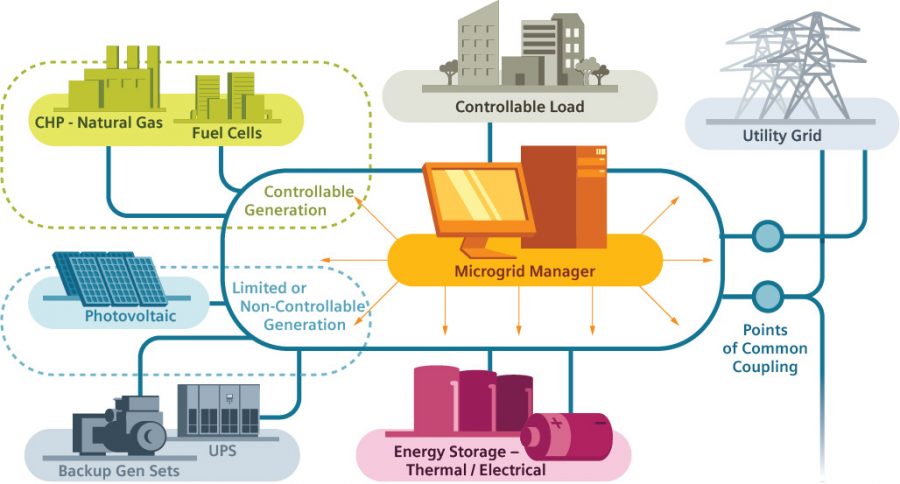
Microgrids have several benefits to the environment, to utility operators, and to customers.
Microgrids can help deploy more zero-emissions energy sources, make use of waste heat, reduce energy lost through transmission lines, help manage power supply and demand, and improve grid resilience to extreme weather.
Financial and legal hurdles stand in the way of accelerating microgrid deployment.
Microgrids tend to integrate multiple energy technologies and unique circumstances into a single project, making them complicated and challenging for investors. Each project can comprise different electric generation types and sizes, serve a unique load, be situated in a unique geography and market, and be subject to unique weather variability and regulations. In addition, while tax credits and preferential tax treatment exist for some of these technologies, they differ by technology, region, and ability of a developer to access. For example, solar and fuel cell technologies are eligible for a federal investment tax credit, but a municipality that does not have a federal tax obligation might not be able to use that credit. With so many variables, each microgrid project may require its own customized financial solution.
Virtually all states lack even a legal definition of a microgrid, and regulatory and legal challenges can differ between and within states. Microgrids face three types of legal hurdles: (1) laws that prohibit or limit specific activities; (2) laws that increase the cost of doing business; and (3) uncertainty, including the risk that new law will be implemented to regulate microgrids and impose restrictions or costs not anticipated at the time of development or construction. Laws also can grant rights and clearly delineate obligations, facilitating development and financing, and making the project more attractive to potential customers.
A number of potential solutions can encourage more microgrid deployment.