

In late October, C2ES joined the Just Transition Finance Lab, Chronos Sustainability and the TPI Global Climate Transition Centre (TPI Centre) to co-host a half-day investor workshop on the just transition at the London School of Economics. The workshop – attended by asset owners, asset managers and investor networks – examined what the just transition means for investors, how it can be integrated into investment strategies and stewardship, and what stands in the way of further action.
What is the Just Transition?
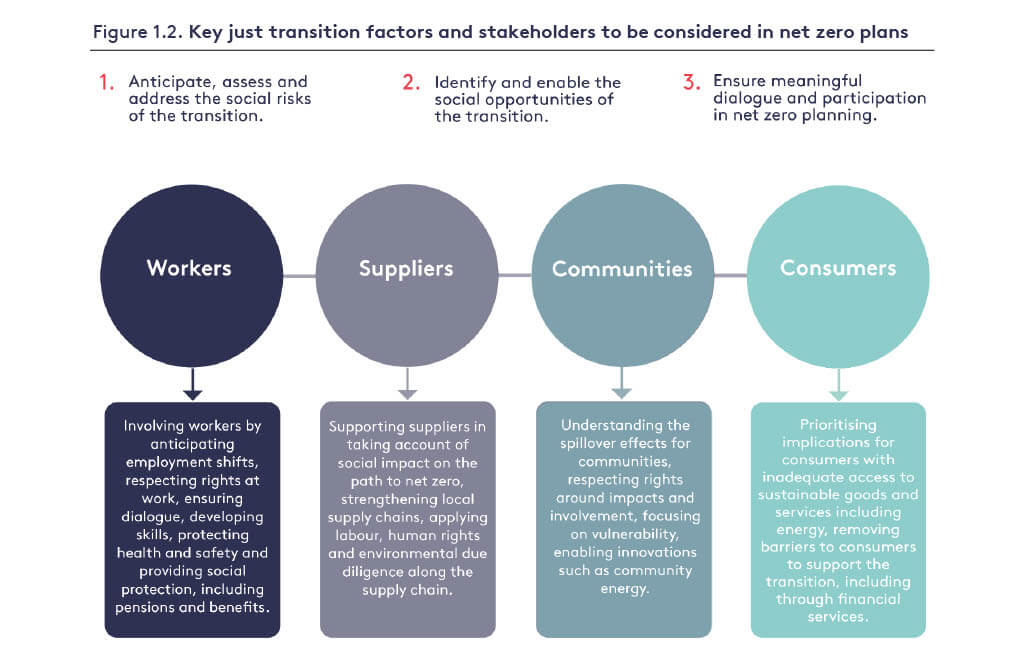
The just transition is about making the shift to a net-zero economy fair and inclusive. It aims to maximize the benefits of climate action while minimizing the negative impacts on workers and their communities. While the concept emerged from the North American trade union movement in the 1970s, it has since evolved to capture a broader set of social principles, ranging from how companies manage workforce transitions to their impacts on the communities, suppliers and consumers affected by climate action. Source: Making Transition Plans Just (Grantham Research Institute, 2022)
Reflection 1: The just transition connects environmental and social risks and opportunities
Workshop participants described the just transition as a useful way of bringing together environmental and social impacts, risks and opportunities that are otherwise often considered in silos. This is particularly important for the social dimensions of climate action, which are often difficult to identify and analyze in a consistent and replicable way.
The quality of just transition-related planning and management provides investors with useful insights into the credibility of corporate transition plans. A high quality, well thought through transition plan can help companies manage risk and support a smoother transition.
Reflection 2: Engagement on just transition is often reactive
At present, investors usually address just transition considerations in the context of broader engagement themes (such as climate, community engagement and workforce management), rather than as a stand-alone issue.
Events and controversies have often been the trigger for just transition-related engagement. This has tended to make engagement reactive rather than proactive. The investor participants in the workshop observed that a similar pattern can be seen in engagement on human rights, labor and other social topics.
Reflection 3: The boundaries of investor responsibility are contested
Responsibility for delivering a just transition is shared across governments, companies, communities and other actors, as well as asset owners and asset managers. Participants differed in how and where they felt investors could or should intervene, particularly in relation to the wider social consequences of transitioning to a clean energy economy.
The question of value chains was a further area of debate. Views varied on how far the responsibilities of companies, and of their investors, extend across the full value chain.
Reflection 4: Data and evidence gaps hold investors back
The availability of comparable data was identified as a key constraint by investors. Investors need data to prioritize engagement across their portfolios, to test the credibility of companies’ just transition claims, and to direct companies towards good practice.
A related gap concerns the business case for just transition. Meeting attendees observed that while just transition-related risks and opportunities can be financially material at company, portfolio and systemic levels, the need to build awareness in their investment teams remains challenging. Empirical evidence demonstrating the financial risks and opportunities associated with just transition would significantly strengthen the case for investor action.
Three Lessons for Investors
The discussion pointed to three broader lessons for investors seeking to act on the just transition:
- Investors need to pull in the same direction. The just transition remains a nascent topic with a range of definitions. A common understanding across the financial sector would help ensure that investors make cohesive and mutually reinforcing asks of companies.
- Better tools and evidence would strengthen proactive engagement. While some investors are beginning to engage proactively on just transition issues, their capacity to do so effectively would be strengthened by sector-specific expectations, place-based insight and a shared bank of good practice. In the workshop, participants tested these ideas using the TPI Centre’s just value chains framework and C2ES’ forthcoming just transition investor guidance resources.
- Shared learning matters. Participants highlighted the value of continued opportunities for shared learning and engagement across a community of investors, both to build capacity within investment teams and to develop the evidence base on the financial relevance of the just transition.
——
Further reading
- C2ES – Just Transition Resources
- Just Transition Finance Lab (2026) – Mainstreaming Just Transition Finance: Lessons from Emerging Best Practice
- Transition Pathway Initiative (2026) – Just Value Chains: How Corporate Decarbonisation Activities Can Impact Communities