
The business landscape around climate action has shifted dramatically. But not in the ways heated policy debates might suggest.
An in-depth analysis of consumer attitudes via a survey of 2,000 voters across the U.S. reflecting a representative range of political affiliations, ages, and incomes supports a different conclusion. It reveals something surprising for some: despite increased political polarization and a challenging regulatory environment, the business case for climate action has continued holding strong. What’s more, this research suggests that corporate retreat from environmental commitments carries more reputational and financial risk than maintaining a clear, consistent stance. And perhaps most surprisingly, even those skeptical of climate policy remain open to the business case. Across party lines, strong majorities believe that climate action is smart business and would support companies that invest in clean energy and limit climate pollution.
Here’s what executives need to know.
Voter expectations for corporate climate action haven’t changed—they’ve changed for how it’s communicated.
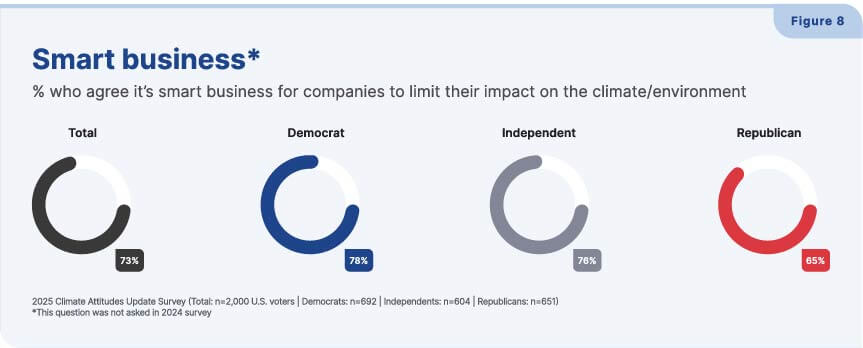
Nearly three-quarters of American voters (73%) believe it’s smart business for companies to limit their environmental impact. This isn’t a niche or partisan position—majorities across party lines, including 68% of Republicans, say companies have a responsibility to reduce their climate impacts.
But here’s what’s particularly striking: even among climate skeptical Republicans—voters who view most of a series of climate-related terms as part of a progressive agenda—64% acknowledge corporate responsibility on this issue. What’s more, 7 in 10 of these same Americans agree that climate-related considerations encourage companies to plan for the long term. These aren’t advocates; they’re pragmatists.
Ultimately, most don’t have a problem with climate action; they have a problem with the way companies have been talking about it. And when we stop leading with moral conviction and focus instead on business imperatives, like risk management, long-term strategy, and operational efficiency, skeptics become receptive.
The message Americans want to hear? We’re managing our environmental footprint because it’s smart business, not because it’s part of a political agenda.
The complexity is real, but manageable.
Successfully navigating today’s communications landscape is no easy feat. Roughly half of American voters now view assorted pro-climate corporate actions as “taking a political stand,” and that perception has grown significantly since 2024. This is the source of genuine concern for many leaders.
But here’s the critical insight: climate somehow still sits apart from traditional political issues. Which means frustrations tied to corporate climate action haven’t translated to sustained activism against companies; twice as many American voters have boycotted companies for supporting an opposing political agenda than for taking steps to reduce environmental impact. This gap is significant—and it holds true even among climate-skeptical Republicans.
In essence, Americans still distinguish between responsible environmental stewardship and overt political activism, and they’re substantially more forgiving of the former. This reinforces the importance of framing—and suggests the solution isn’t to retreat, but to communicate differently.
The real risk is appearing opportunistic.
And as an added incentive, notable percentages say they’re not only more likely to hold a more favorable opinion of companies that take pro-climate actions, but also more likely to buy from those same companies. Meanwhile, anti-climate actions appeal to far fewer.
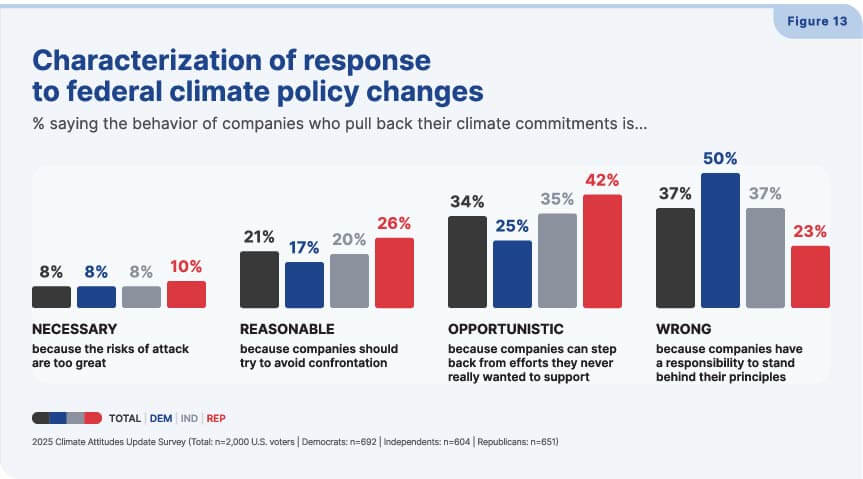
This is perhaps the most important finding for executive decision-making. When companies roll back environmental commitments, Americans don’t view this as pragmatism; they view it as opportunism. Seven in ten Americans characterize corporate retreat on climate as either “opportunistic” or “wrong.”
Even many climate-skeptical Republicans— the group that might be expected to welcome pullbacks—reject this approach: 49% call retreat “opportunistic,” even when given the option to justify it as “necessary” or “reasonable.”
This rejection reflects a sophisticated understanding across the political spectrum: Americans are watching whether companies stand behind what they say. Appearing to cave under political pressure may damage reputation far more than maintaining a consistent environmental stance.
This logic extends to how skeptics view the current state of corporate climate action. Collectively, 71% of climate-skeptical Republicans (those inclined to associate many climate terms with a progressive agenda) believe companies are doing either “too little” (31%) or “the right amount” (40%) on reducing their climate impact. Rather than calling for corporate retreat on climate, Americans are asking companies to hold the line.
And as an added incentive, notable percentages say they’re not only more likely to hold a more favorable opinion of companies that take pro-climate actions, but also more likely to buy from those same companies. Meanwhile, anti-climate actions appeal to far fewer.
Maintaining support for those actions requires clear, consistent communication rooted in business logic instead of moral appeals. In a polarized environment, corporate retreat reads as weakness and opportunism—and Americans across the political spectrum say they’re willing to punish it. Conversely, companies that maintain principled positions grounded in smart business strategy are seen as leaders worthy of customer loyalty.
For boards and executives, the greater strategic risk is appearing to abandon climate commitments under external pressure. The path to sustainable competitive advantage runs through consistency, transparency, and the courage to lead with business sense.
In late 2025, the Center for Climate and Energy Solutions (C2ES) and Potential Energy Coalition (PEC) commissioned Language Strategy firm maslansky + partners to research U.S. voter perceptions of corporate climate action and messaging.
Representing the third wave in a series of related issue and messaging research maslansky + partners has conducted dating back to 2023, this study was designed to provide an update on voter sentiment concerning specific climate approaches, policies, and terminology in the current political landscape.
The key question: Does the strategy that has consistently tested well—positioning corporate climate action around materiality rather than morality, framing it as responsible business rather than ideological commitment—still hold?
To find out, maslansky + partners surveyed 2,000 registered U.S. voters in October 2025. The sample was representative of U.S. national racial/ethnic, regional, age, gender, education, and household income demographics —and maintained the partisan balance of previous studies: consisting of 35% Democrats, 30% Independents, and 33% Republicans.
Given the nature of shifting partisan conversations around climate, the study also isolated the responses of 253 “climateskeptical Republicans”—defined as those Americans who self-identified as Republican and associated at least three of five tested climate-related terms with a “liberal” or “progressive” policy agenda, as opposed to having a “conservative” agenda or no agenda at all.
Where relevant, data from previous surveys fielded in 2024 is featured throughout to enable year-over-year comparisons. Collective results to date sit inside a body of research that now spans nearly 15,000 combined respondents across the U.S. and five additional countries.
Note: Throughout this report, we refer to the results using the terms “voters” and “Americans” interchangeably.
A majority of voters, specifically 63%, say companies should generally avoid engaging in politics. This should come as no surprise, as we’ve seen this trend across previous waves of research.
And as demonstrated in Figure 1, the sentiment holds true across not only party lines, but also key demographics—with notable percentages preferring companies avoid political action entirely. Overall, this type of data could suggest a shrinking mandate for corporate climate action.
Overall, this type of data could suggest a shrinking mandate for corporate climate action.
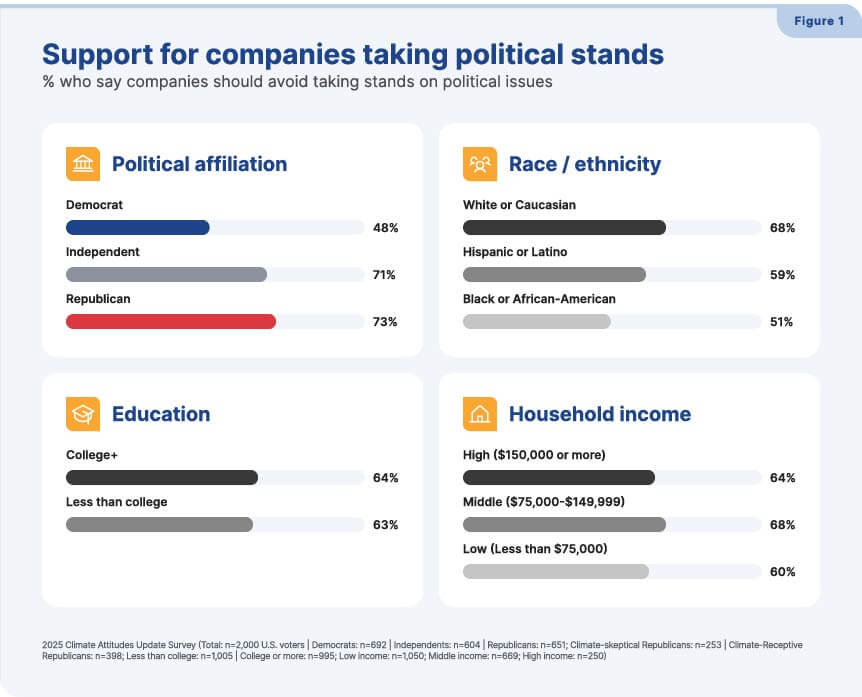
In fact, this research shows that without context, climate action increasingly comes off as political. As shown in Figure 2, more Americans now consider several climate-related corporate actions as “taking a political stand.”
Since the last time we asked these questions in 2024, an additional 8% or more feel that way about actions ranging from simply using more clean energy to announcing the phaseout of fossil fuels.
And importantly, politicization has happened across party lines—with notable upticks in percentages of Democrats, Independents, and Republicans characterizing the actions similarly (Figure 3).
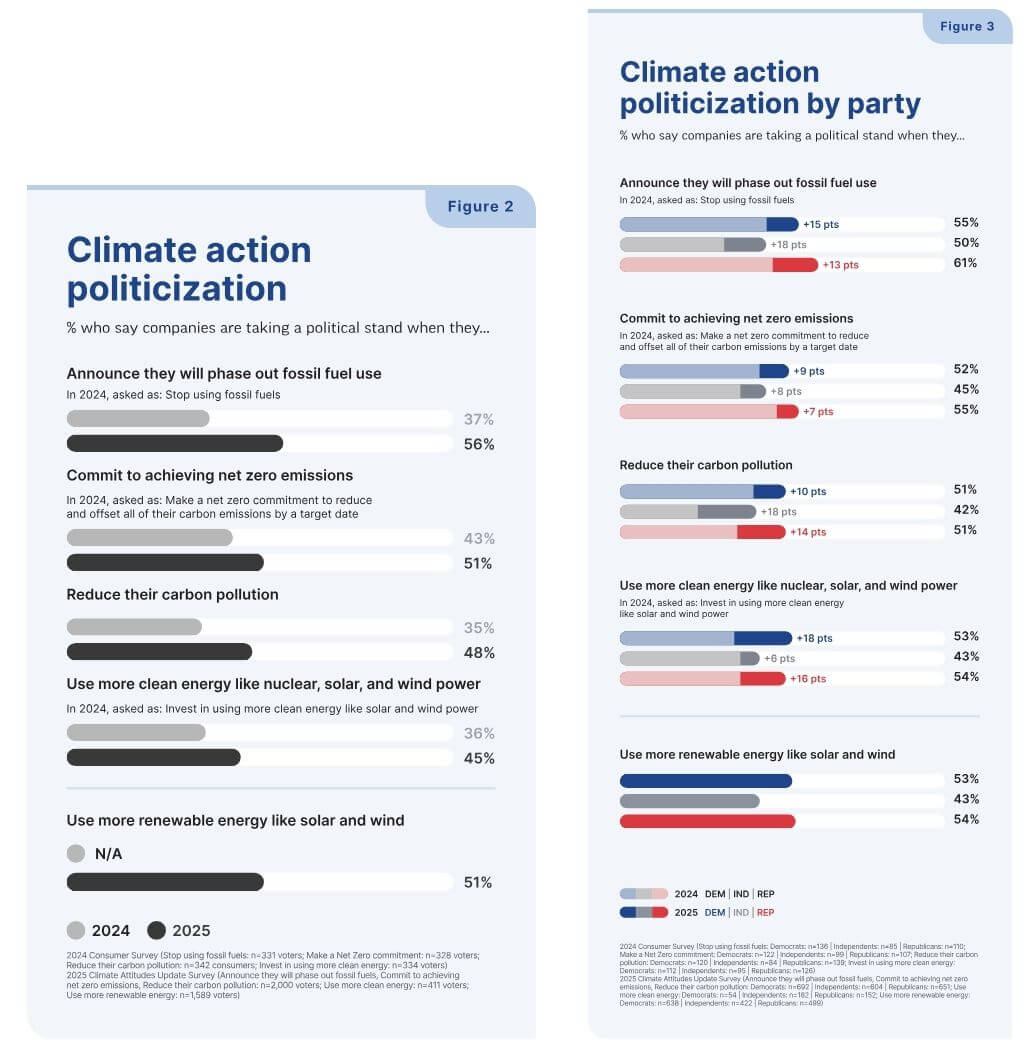
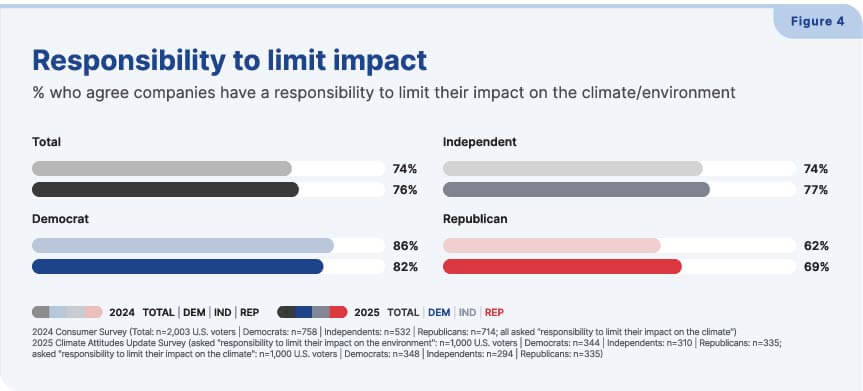
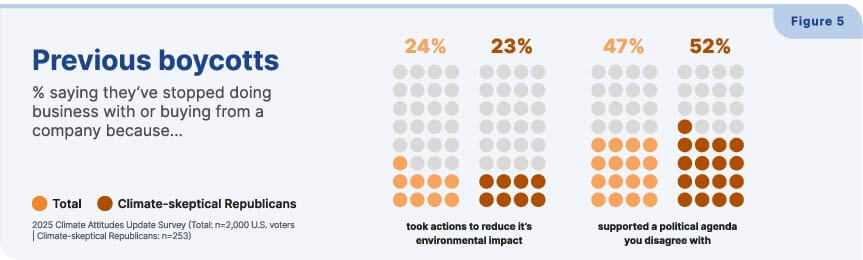
Broadly speaking, a majority of Americans across party lines believe companies have a responsibility to limit their climate impact. So while climate is certainly politically charged today, it’s not as politically charged as other issues and is therefore not grouped alongside other political issues that more strongly drive behavior. As a result, Americans are far less likely to punish companies for environmental actions versus other choices seen as pushing a political agenda.
Roughly 25% of voters say they’ve boycotted a company for taking steps to reduce its environmental impact.
Yet approximately 50% of voters claim to have done the same to a company supporting an opposing political agenda. Notably, this was also true of climate-skeptical Republicans.
The data suggests that heated debates and discourse aside, climate seems to occupy a unique position. But why?
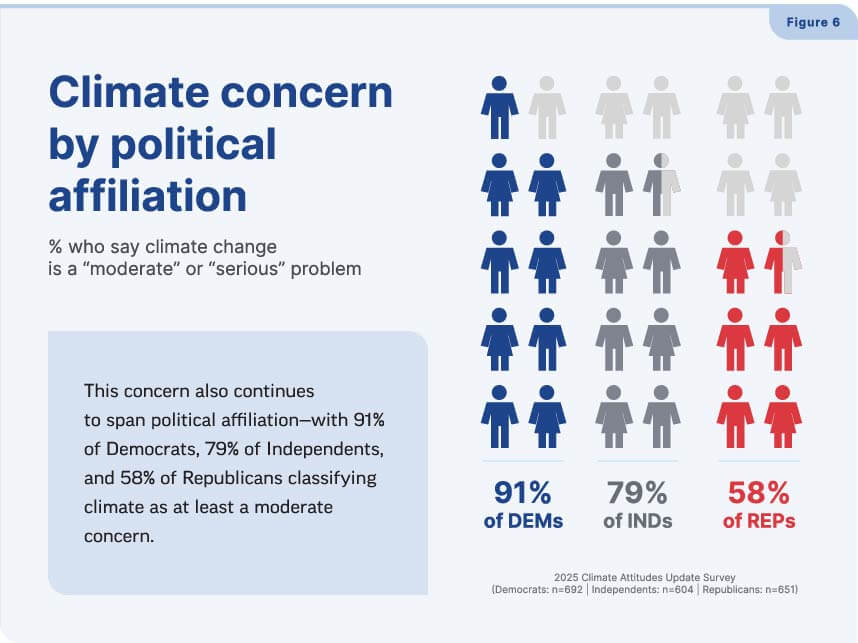
Despite recent pushback, Americans overall remain concerned about climate. Nearly eight in ten (77%) say climate change is a moderate or serious problem, up from 71% in 2024. The share calling it “serious” rose from 44% to 50% in a single year.
About 8 in 10 voters surveyed agree climate change is a “moderate” or “serious” problem.
In contrast to the polarized nature of political debates, Americans aren’t advocating a corporate climate pullback. Just 12% of voters claim companies are doing “too much” when it comes to reducing their impact on the climate.
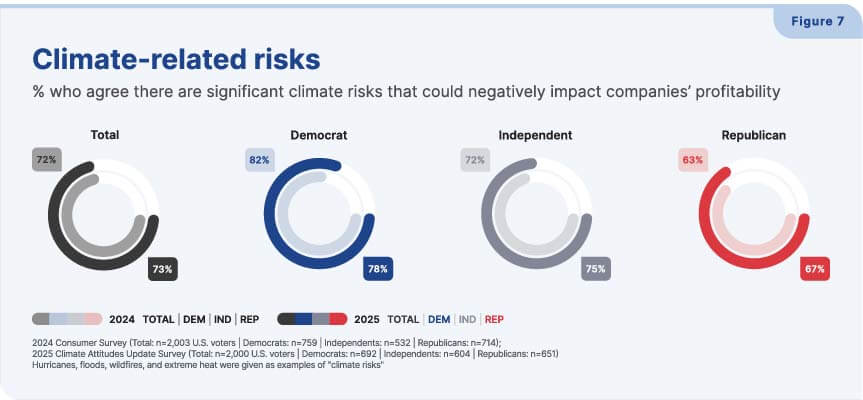
Meanwhile, roughly 7 in 10 recognize the real profitability risks posed by climate change, agree companies have a responsibility to limit their impact on climate, and consider doing so to be “smart business.” As shown in Figure 7, belief that climate risk can negatively impact companies’ ability to profit has held steady since 2024—and increased among Republicans.
Roughly 7 in 10 voters recognize the real profitability risks posed by climate change.
Amidst an increasingly politicized environment, one logical response would be to pull back from existing commitments and disengage. But the data suggests another path forward.
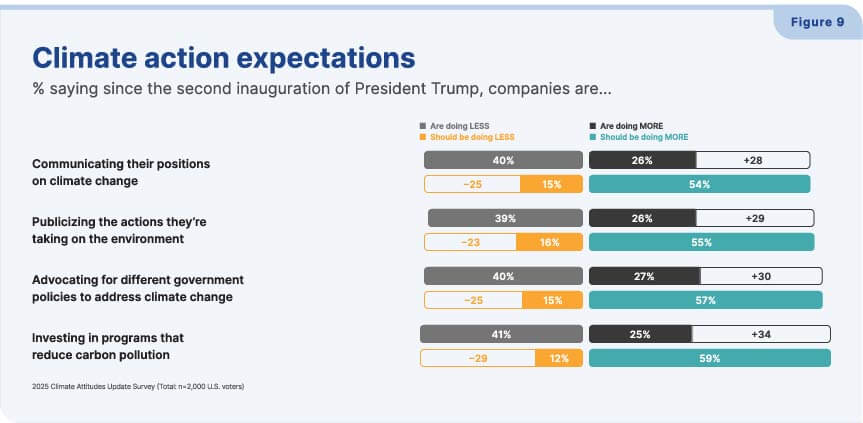
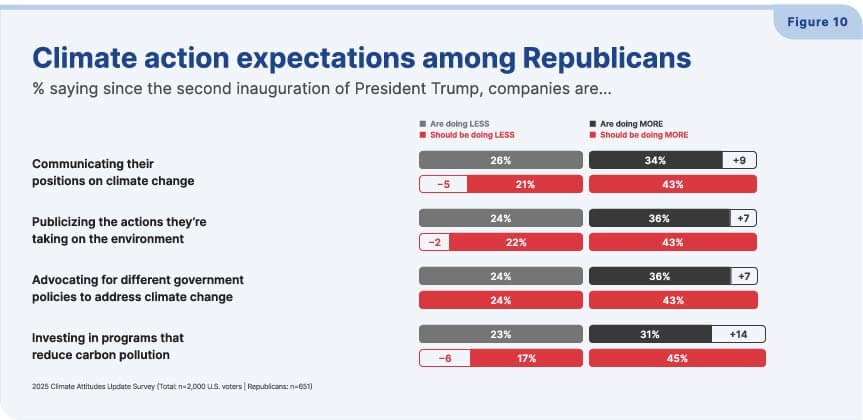
Americans want to see more – not less – climate action.
Figure 9 helps illustrate this point: revealing an expectations gap where significant percentages of Americans think companies are doing less today on a range of climate actions than they were before President Trump’s second inauguration at the same time—yet far fewer think they should be doing less. In fact, roughly twice as many think they should be doing more.
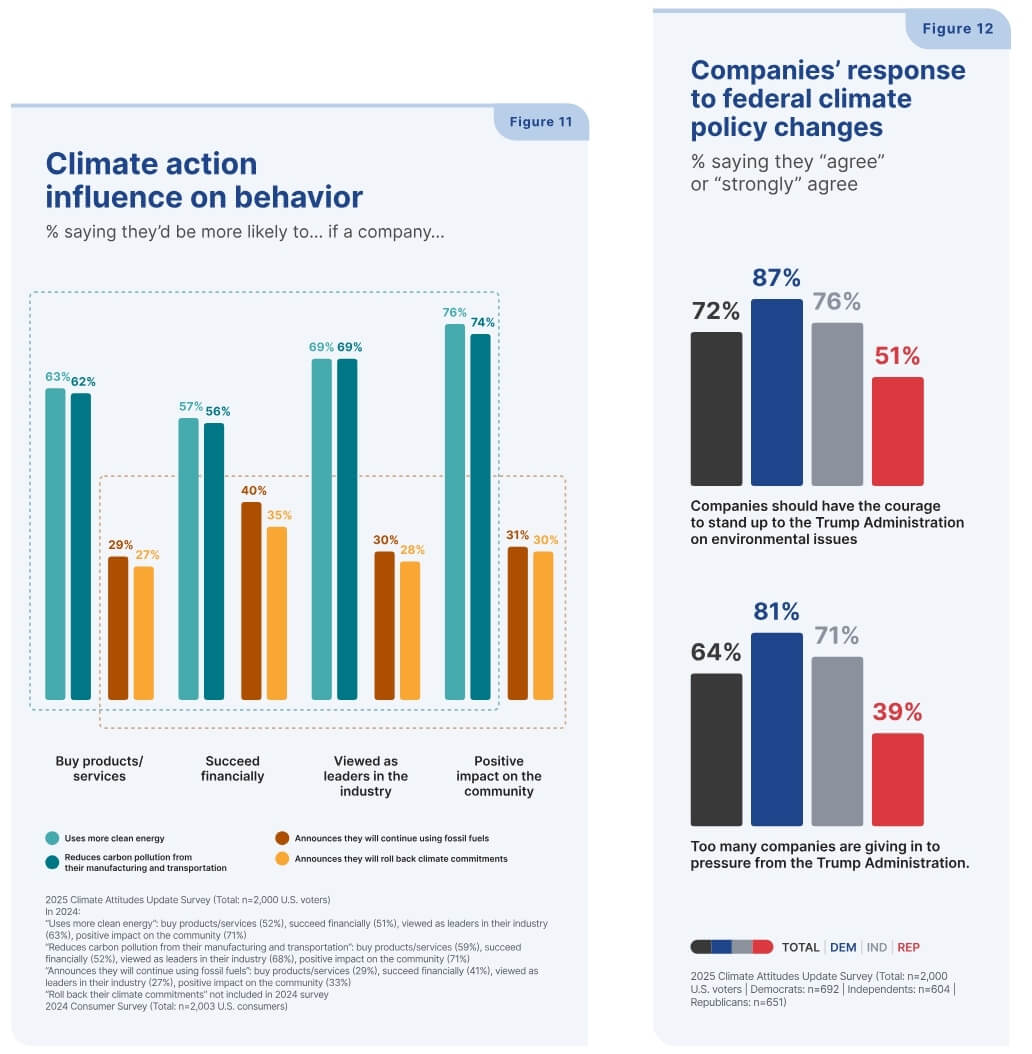
Reputational and financial rewards for climate action are holding—and in some areas, growing: 62% of voters say they’re more likely to buy from a company using clean energy, up 11 points from a company using clean or renewable energy as industry leaders.
As shown in Figure 11, comparable boosts of anti-climate corporate actions are lower.
What’s more, majorities across party lines say they want more backbone from companies. As shown in Figure 12: 87% of Democrats, 76% of Independents, and 51% of Republicans agree “companies should have the courage to stand up to the Trump Administration on environmental issues.”
When given the choice, 71% of voters critiqued pullbacks in response to pressure from the Administration as either “opportunistic” or outright “wrong.” It’s worth noting that they chose these terms over more generous assessments, like “reasonable” or “necessary.” As called out in Figure 13, this includes notable percentages across party lines.
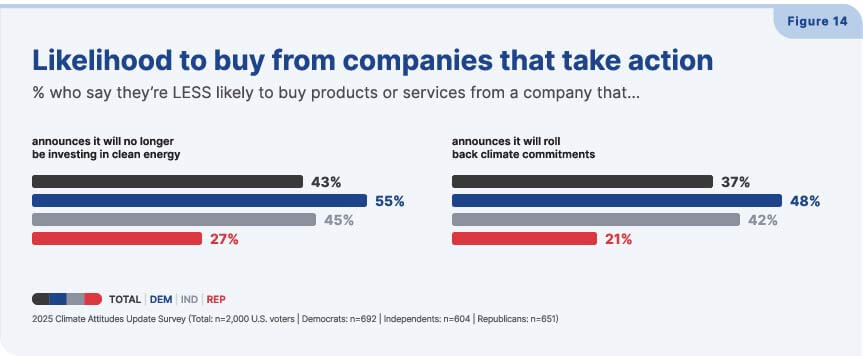
Americans also claim they’re willing to withdraw support from companies succumbing to this type of pressure. See Figure 14: notable percentages say they’re less likely to buy from or support a company that changes course by rolling back commitments or investments.
The affordability crisis is real, and it’s impacting Americans throughout the United States. This raises the stakes when it comes to Americans’ default belief that pro-climate actions lead to higher costs, at least in the near-term.
As shown in Figure 15, more than half associate sustainable products, clean energy, fleet electrification, and pollution reduction with higher prices.
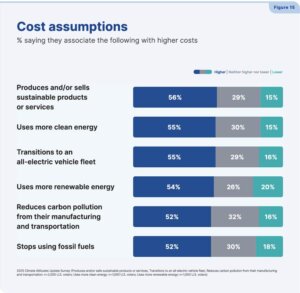
52% of voters agree that reducing environmental impact lowers long-term costs for customers, and 70% consider it a strong argument that climate action encourages long-term planning—including 71% of climate-skeptical Republicans, as shown in Figure 16.
Companies who hold the line on their climate action should expect to have a response ready that connects the dots between the short- and long-term implications for consumers’ wallets.
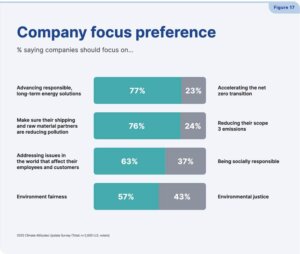
As Figure 17 shows, messages that connect climate action to everyday advantages consistently garner broader support. Americans are more receptive to language that presents environmental action as delivering practical, business benefits rather than framing it as a moral or social justice issue.
We observed similar results in previous waves of this study—as well as broader research into consumer sentiment.
Americans have not withdrawn permission for companies to act on climate. What this research makes clear is that Americans, if anything, still expect it. They acknowledge its very real implications for short- and long-term business opportunities and risks. And they recognize it as part and parcel of doing “smart business.”
Likening climate action to a moral crusade risks activating the familiar public frustration we often see in the headlines. But the more companies anchor their efforts in a responsible business frame, the less likely they are to get caught up in the surrounding politics.
In addition to sidestepping an unhelpful debate, describing climate action as responsible management positions leaders to continue leading on the relevant and material issues their businesses face.