Carbon Capture and Storage
Quick Facts
Carbon capture and storage (CCS) uses a combination of technologies to capture, transport, and store carbon dioxide (CO2) emissions in underground geologic formations.
CCS could help achieve dramatic reductions in CO2 emissions from fossil fuel-fired power plants and industrial facilities, which release significant portions of U.S. and global emissions;
CCS technologies have been deployed at several industrial facilities, and the first large-scale commercial CCS power projects are under construction. (Global Carbon Capture and Storage Institute project list)
There is a growing market for captured CO2 and its commercial applications, primarily enhanced oil recovery with carbon dioxide (CO2-EOR). Selling captured CO2 emissions provides a valuable revenue source to help overcome the high costs and financial risks of initial CCS projects.
Background
Electricity generation and industrial processes release large amounts of carbon dioxide (CO2), the primary greenhouse gas (GHG). In 2010, coal- and natural gas-fueled electricity generation accounted for approximately 80 percent and 18 percent, respectively, of CO2 emissions from the U.S. electricity sector; together, they accounted for almost 33 percent of all U.S. GHG emissions.[1] Not including its electricity use, the industrial sector’s CO2 emissions accounted for an additional 14 percent of total U.S. GHG emissions. [2] The combustion of fossil fuels accounted for approximately 82 percent of the industrial sector’s CO2 emissions, while industrial processes accounted for approximately 18 percent.[3]
Going forward, coal and natural gas will remain major sources of energy for the U.S. and global power and industrial sectors. In the United States, both coal and natural gas are in relatively abundant supply and are relatively inexpensive electricity generation sources.[4],[5] In 2011, the United States generated approximately 42 percent of its electricity from coal and 25 percent from natural gas.[6] Globally, coal and natural gas will continue to meet growing energy demand, particularly in emerging market counties, such as China and India. From 2007 to 2011, China’s total coal consumption increased by nearly 50 percent, while India’s increased by nearly 33 percent. During that same time period, China’s total natural gas consumption increased by more than 85 percent, while India’s increased by approximately 48 percent.[7]
CCS technology has the potential to yield dramatic reductions in CO2 emissions from the power and industrial sectors by capturing and storing anthropogenic CO2 in underground geological formations. Given the magnitude of CO2 emissions from coal and natural gas-fired electricity generation, the greatest potential for CCS is in the power sector. The U.S. Energy Information Administration (EIA) estimates that natural gas, when used in an efficient combined cycle plant, emits less than half as much CO2 as coal.[8] The deployment of CCS with coal generation is necessary to reduce coal’s release of global CO2 emissions relative to natural gas, but CCS also can be combined with natural gas generation to limit the impact of natural gas electricity generation on global CO2 emissions.
In the industrial sector, CO2 can be captured from a number of industrial processes, including natural gas processing; ethanol fermentation; fertilizer, industrial gas, and chemicals production; the gasification of various feedstocks; and the manufacture of cement and steel.[9]
Description
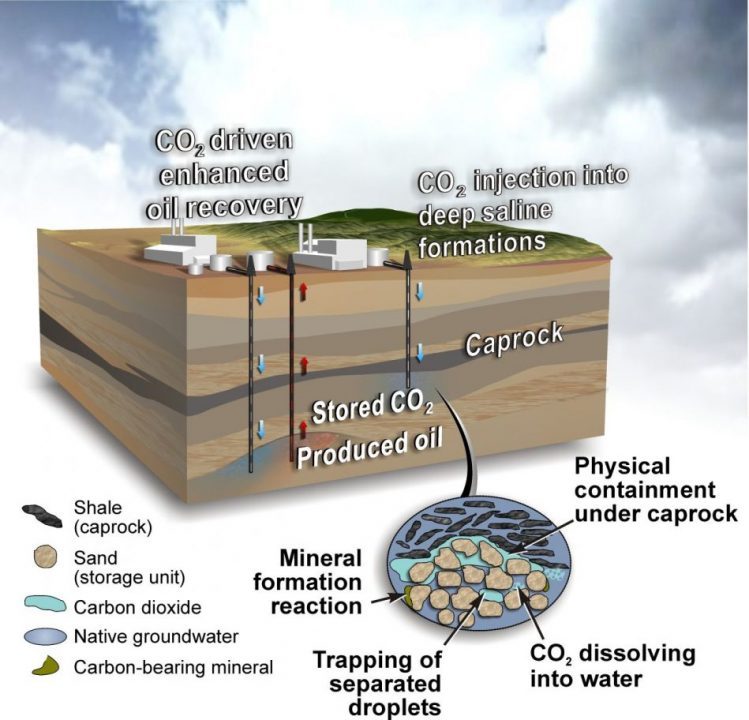
CCS uses a combination of technologies to capture the CO2 released by fossil fuel combustion or an industrial process, transport it to a suitable storage location, and finally store it (typically deep underground) where it cannot enter the atmosphere and thus contribute to climate change. CO2 sequestration options include saline formations and oil wells, where captured CO2 can be utilized in enhanced oil recovery (CO2-EOR).
Currently, CCS has been deployed at commercial-scale natural gas processing, fertilizer production, and synfuel production facilities. The first commercial-scale CCS power projects (the Kemper County IGCC Project in the United States and the Boundary Dam with CCS Demonstration project in Canada) are expected to be in operation by 2014.[10]
The various technologies used for CCS are described below.
CO2 Capture
Good candidates for early commercial CCS adoption are certain industrial processes, where it is relatively easy to capture CO2.[11] As a part of normal operations, these processes remove CO2 in high-purity, concentrated streams. Equipment can be used to capture CO2 from these streams, instead of otherwise being emitted.
Figure 1: HOW CCS WORKS

Source: Global Carbon Capture and Storage Institute. 2012. “How CCS Works.”
For other industrial processes and electricity generation, carbon capture is more difficult. Current processes must be reengineered or redesigned to process CO2 and concentrate it for capture and transportation. There are three primary methods for CO2 capture from these other industrial processes and electricity generation:
- Pre-Combustion Carbon Capture: Fuel is gasified (rather than combusted) to produce a synthesis gas, or syngas, consisting mainly of carbon monoxide (CO) and hydrogen (H2). A subsequent shift reaction converts the CO to CO2, and then a physical solvent typically separates the CO2 from H2.
- For power generation, pre-combustion carbon capture can be combined with an integrated gasification combined cycle (IGCC) power plant that burns the H2 in a combustion turbine and uses the exhaust heat to power a steam turbine.
- Post-Combustion Carbon Capture: Post-combustion capture typically uses chemical solvents to separate CO2 out of the flue gas from fossil fuel combustion. Retrofitting existing power plants for carbon capture is likely to use this method.
- Oxyfuel Carbon Capture: Oxyfuel capture requires fossil fuel combustion in pure oxygen (rather than air) so that the exhaust gas is CO2-rich, which facilitates capture.
CO2 Transportation
Once captured, CO2 must be transported from its source to a storage site. Pipelines like those used for natural gas present the best option for terrestrial CO2 transport. As of 2009, there were approximately 3,900 miles of pipelines for transporting CO2 in the United States for use in enhanced oil recovery.[12]
CO2 Storage
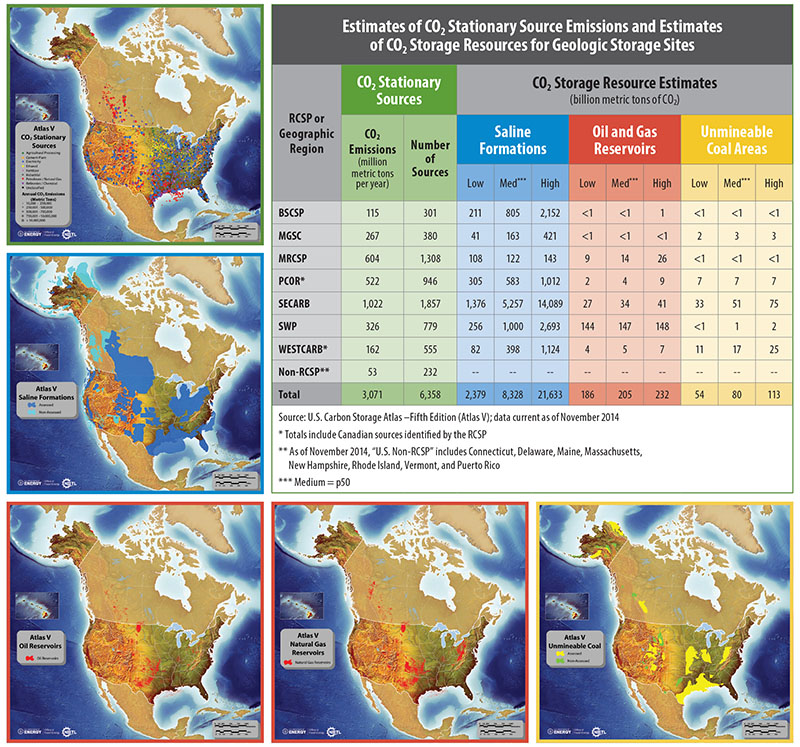
The primary option for storing captured CO2 is injecting it into geological formations deep underground. The United States has geological formations with sufficient capacity to store CO2 emissions from centuries of continued fossil fuel use based on 2011 emissions.[13]
A combination of regulations and technology can provide a high level of confidence that sequestered CO2 will be safely and permanently stored. In the United States, federal and state regulations cover CO2 sequestration site selection and injection. In addition, CO2 sequestration technologies for measurement, monitoring, verification, accounting, and risk assessment can minimize or mitigate the potential of sequestered CO2 to pose risks to humans and the environment.[14] Options for CO2 geologic storage options include:
- Deep Saline Formations: The largest potential for geologic storage in the United States is in deep saline formations, which are underground porous rock formations infused with brine. Deep saline formations are found in many locations across the country, but less is known about their storage potential because they have not been examined as extensively as oil and gas reservoirs.[15]
- Oil and Gas Reservoirs (Enhanced Oil Recovery with Carbon Dioxide, CO2-EOR): Oil and gas reservoirs offer sequestration potential as well as economic opportunity through CO2-EOR. CO2-EOR is a tertiary[16] oil production process which injects CO2 into oil wells to extract the oil remaining after primary production methods. Oil and gas reservoirs are thought to be suitable candidates for CO2 sequestration given that they have held oil and gas resources in place for millions of years, and previous fossil fuel exploration has yielded valuable data on subsurface areas that could help to ensure permanent CO2 sequestration. CO2-EOR operations have been operating in West Texas for over 30 years. Moreover, revenue from selling captured CO2 to EOR operators could help defray the cost of CCS at power plants and industrial facilities that adopt the technology.[17]
- Unminable Coal Beds:Coal beds that are too deep or too thin to be economically mined could offer CO2 storage potential. Captured CO2 can also be used in enhanced coalbed methane recovery (ECBM) to extract methane gas.[18]
Basalt formations and shale basins are also considered potential future geologic storage locations.[19]
Figure 2: MAP OF U.S. CO2 GEOLOGIC SEQUESTRATION RESOURCES

Source: National Energy Technology Laboratory. “NATCARB CO2 Storage Formations.”
Environmental Benefit / Emission Reduction Potential
CCS technology has the potential to reduce CO2 emissions from a coal or natural gas-fueled power plant by as much as 90 percent.[20] CCS could provide significant economy-wide CO2 emission reductions:
- The U.S. Energy Information Administration’s (EIA) modeling analysis of the Waxman-Markey American Clean Energy and Security Act of 2009 projected that, under the proposed cap-and-trade program, coal power plants with CCS could provide 11 percent of U.S. electricity by 2030, and that new coal power plants with CCS could account for 28 percent of new generating capacity. In contrast, under a business-as-usual scenario and without legislation, new coal power plants would account only for 11 percent of new generating capacity.[21]
- Due to rising global demand for energy, the consumption of fossil fuels is expected to rise through 2035, leading to greater CO2 emissions.[22] CCS technology offers the opportunity to reduce emissions while maintaining a role for fossil fuels in national energy portfolios.
- The International Energy Agency (IEA) forecasts that CCS could provide 19 percent of needed total global CO2 emission reductions by 2050 under its BLUE Map scenario.[23]
- Oil produced by CO2-EOR projects can be considered relatively lower-carbon than oil produced by other techniques. For example, the carbon stored by the Weyburn EOR project can offset approximately 40 percent of the combustion emissions resulting from the oil it produces, not including emissions from electricity use due to compression, lifting, and refining.[24]
Cost
The implementation of CCS technology raises the investment costs for power and industrial projects. New power plants and industrial facilities can be designed to incorporate CCS from their inception, or the technology can be retrofitted to existing sources of CO2 emissions. Overall, the cost of each project can vary considerably. The incremental cost of CCS varies depending on parameters such as the choice of capture technology, the percentage of CO2 captured, the type of fossil fuel used, and the distance to and type of geologic storage location. Overall, as with other new technologies, the cost of CCS is expected to be higher for the first CCS projects and decline thereafter as the technology moves along its “learning curve.”[25],[26]
Selling captured CO2 as a commodity is one option for mitigating the higher upfront costs and risks of investing in CCS. Enhanced oil recovery is an emerging opportunity for utilizing captured CO2. In the United States, CO2-EOR already accounts for 6 percent of domestic oil production, and the industry could take advantage of enormous oil reserves if more CO2 is captured and utilized.[27] 26.9 to 61.5 billion barrels could be extracted with “state of the art” CO2-EOR technology, while 67.2 to 136.6 billion barrels could be extracted with “next generation” CO2-EOR technology. [28]
Power Plant Capture costs
Carbon capture raises power plant costs by requiring capital investment in carbon capture equipment and by reducing the quantity of useful electricity. Additional generation capacity is needed at a power plant to power capture equipment, [29] and incorporating CCS at a power plant could decrease its net power output by as much 30 percent.[30] Overall, in 2010, the U.S. Department of Energy and the National Energy Technology Laboratory estimated that “CCS technologies would add around 80 percent to the cost of electricity for a new pulverized coal plant, and around 35 percent to the cost of electricity for a new advanced gasification-based plant.”[31]
In 2010, the National Energy Technology Laboratory (NETL) released a report on CCS costs for new integrated combined cycle (IGCC), pulverized coal (PC), and natural gas combined cycle (NGCC) power plants. The study compared the levelized costs of electricity for individual power plant configurations with and without CO2 capture.[32] For each power plant type, the average levelized cost of electricity with and without CCS was estimated to be:
Levelized Cost of Electricity for New-Build Power Plants with and without CCS
Power Plant Type (new-bUILD) | Average LCOE without CCS ($/MWH) | Average LCOE with CCS ($/MWh) |
IGCC | 97.8 | 141.7 |
PC | 75.0 | 137.1 |
NGCC | 74.7 | 108.9 |
Retrofitting existing plants for CCS is expected to be more expensive and reduce a plant’s overall efficiency when compared to building a new plant that incorporates CCS from the start.[33] In addition, retrofitting CCS on existing power plants faces additional constraints: insufficient land and space for capture equipment; a shorter expected plant life than a new plant, which limits the window in which to repay the investment in CCS equipment; and the tendency of existing plants to have lower efficiency, which consequently means that CCS will have a proportionally greater impact on net output than it would have in new plants.[34] New power plants without CCS can be designed to be “CCS-ready” so that the cost of later retrofitting the plant for CCS will be lower.[35]
Industrial Facility Capture Costs
The cost of capturing carbon from different industrial processes varies considerably. This variation results from the relative ease of capturing CO2 from certain industrial processes and the level of maturation for capture technologies. Carbon capture is easier when CO2 is produced in high purity and high concentration streams as the byproduct of certain industrial processes, such as natural gas processing, hydrogen production, and synthetic fuel production.[36] In contrast, it is relatively more difficult to capture CO2 from flue gas emissions, which may require “the reengineering of certain established and reliable production techniques.”[37] Similar to power plants, industrial processes that produce carbon via flue gas are cement production, iron and steel manufacturing, and refining. The U.S. Energy Information Administration estimated industrial carbon capture and CO2 transportation costs for the following industrial processes:[38]
Cost of CO2 Capture and Transportation for Various Industrial CO2 Sources
Industrial CO2 Source | Cost of CO2 Capture and Transp. ($/Metric ton) |
Coal and biomass-to-liquids | 36.10 |
Natural gas processing | 36.29 |
Hydrogen plants | 36.67 to 46.12 |
Refineries (Hydrogen) | 36.67 to 46.12 |
Ammonia plants | 39.69 |
Ethanol plants | 42.15 |
Cement plants | 81.08 |
CO2 Transportation and Storage Costs
Transportation and storage costs will vary by CO2 capture project and the proximity and availability of pipeline networks and injection sites. The Environmental Protection Agency estimates that the long-term average cost for CO2 transportation and storage is approximately $15 per metric ton of CO2.[39]
Current Status of CCS
Currently, CCS has been deployed at commercial-scale industrial facilities, and the first commercial-scale power plants with CCS are under construction. As of mid-2012, the Global Carbon Capture and Storage Institute (GCCSI) listed approximately 75 “large-scale integrated” power and industrial sector CCS projects in various stages of development around the world. Around 20 of these projects are located in the United States (see the Global Carbon Capture Institute’s large-scale integrated CCS project database). The International Energy Agency (IEA) labels CCS as a critical technology for limiting the rise in global temperature to 2° Celsius (3.6° F) by 2050 and calls for 38 power and 82 industrial large-scale integrated CCS projects to be in place by 2020 to meet this objective.[40] Given that only about ten large-scale integrated CCS projects are estimated to be in operation by the mid-2010s, the IEA has labeled the status of CCS as “not on track.”[41]
The status of the component technologies of CCS is reviewed below.
CO2 Capture
Carbon capture technologies have long been used for industrial processes like natural gas processing and CO2 generation for the food and beverage industry. Currently, in the United States, commercial-scale CCS projects include three natural gas processing facilities, a fertilizer plant, and a synfuel plant that capture their CO2 emissions and transport them for use in enhanced oil recovery.[42] In the power sector, the first commercial-scale power plants with CCS are under construction. Mississippi Power’s Kemper County IGCC project and the Boundary Dam with CCS Demonstration project in Canada are expected to begin operations in 2014.[43] Additional commercial-scale CCS projects for power generation and these industrial process, as well as ethanol and hydrogen production, are moving forward. Few or no commercial-scale projects have been proposed for other high-emitting CO2 sources, such as iron and steel, cement, and pulp and paper production.[44]
CO2 Transport
The United States already has approximately 3,900 miles of CO2 pipelines used to transport CO2 for EOR.[45] CO2 pipeline transport is commercially proven.
CO2 Storage
Globally, there is much research and policy activity regarding CO2 storage. Many countries are setting up legal and regulatory frameworks for CO2 injection and long-term monitoring and verification, while mapping geologic formations for CO2 storage potential.[46] Technologies are available to minimize or mitigate the risks of sequestered CO2 to humans and the environment,[47] but policies are needed to ensure that these technologies are deployed effectively. Sequestered CO2 can be monitored and accounted for once injected underground, while risk assessment tools can determine the suitability of sites for CO2 sequestration. CO2 injection in EOR wells is commercially proven and has a history of safely storing CO2 underground. Research by the University of Texas Bureau of Economic Geology found no evidence of leakage from the SACROC oil field where CO2-EOR has been performed since the 1970s.[48]
A well-developed regulatory framework for CO2 injection and sequestration is also essential to protect human health and the environment. In the United States, the Safe Drinking Water Act and the EPA’s Underground Injection Control Program impose safety requirements on CO2 injection.[49] In addition, the Clean Air Act and the EPA’s GHG Emissions Program require project operators to report data on CO2 injections and to submit monitoring, reporting, and verification (MRV) plans if CO2 is injected for long-term sequestration. U.S. state regulations can include additional requirements. In addition, the Underground Injection Control Program requires previous seismic history to be considered when selecting geologic CO2 sequestration sites. Large faults should be avoided entirely. In addition, the risk of small earthquakes causing CO2 leakage to the surface is mitigated by multiple layers of rock that prevent CO2 from reaching the surface even if they migrate from an injection zone.[50]
Finally, there is on-going work to determine the size of CO2 sequestration resources and the suitability of individual sites for CO2 injection. In 2012, the U.S. Department of Energy (DOE) and NETL released The North American Carbon Storage Atlas, in conjunction with partner agencies from Canada and Mexico. Also, since 2003, DOE has supported Regional Partnerships focused on geologic CO2 storage.[51] The partnerships are initiating large-scale tests to determine how storage reservoirs and their surroundings respond to large amounts of injected CO2 in a variety of geologic formations and regions across the United States. Through the American Recovery and Reinvestment Act of 2009, DOE and the Archer Daniels Midland Company (ADM) are sharing the investment costs of capturing one million tons of CO2 per year from ADM’s ethanol plant in Decatur, Illinois and injecting it in a nearby reservoir.[52] The Midwest Geologic Sequestration Consortium (MGSC) has begun to inject and sequester CO2 from the facility.[53]
Obstacles to Further Development or Deployment of CCS
- High Cost: Deploying CCS requires large incremental investments in capital equipment and higher operating costs.
- Lack of a Price on Carbon, GHG Emissions Performance Standards, or CCS incentives: Policies that place a financial cost on or otherwise limit GHG emissions, or subsidize CCS, are crucial for incentivizing investments in CCS.
- Need for Faster Commercial-Scale CCS Project Development: The first commercial-scale CCS projects integrated with power plants and certain industrial facilities will generate valuable information on the actual cost and performance of CCS as well as the optimal configuration of the technologies. These projects also will provide much-needed data to guide firms’ investments and will lead to cost reductions via technology improvements.
- Uncertainty in CO2 Storage Regulations:CO2 injection in geologic formations is regulated at the federal level by the Environmental Protection Agency’s Underground Injection Control (UIC) program,[54] and the quantity of injected CO2 must be reported under the Mandatory Greenhouse Gas Reporting Rule.[55] Additional regulations at federal, state, and local levels are being developed to specify site selection criteria; well, injection, and closure operational requirements; long-term monitoring and verification requirements; and long-term liability. Without a clear regulatory or legal framework in place, investment in CCS may be hindered.
Policy Options to Help Promote CCS
- Price on Carbon: Policies that place a price on GHG emissions, such as cap and trade, would discourage investments in traditional fossil-fuel use and spur investments in a range of clean energy technologies, including CCS.
- Including CCS in Clean Energy Standards: A clean energy standard is a policy that requires electric utilities to provide a certain percentage of electricity from designated low carbon dioxide-emitting sources. CCS has been included in state-level clean energy standards[56] and under a proposed federal clean energy standard.[57]
- Funding for Continued CCS Research, Development, and Demonstration: Globally, approximately $23.5 billion in public support has been made available for CCS demonstration, with much of this amount coming through recent economic stimulus packages.[58] By the end of 2010, public institutions had distributed only 55 percent of the available public support for CCS to actual CCS projects.[59] The United States has spent approximately $6.1 billion of the available $7.4 billion in public funding designated for CCS.[60] Under the American Recovery and Reinvestment Act of 2009, the U.S. Department of Energy’s Office of Fossil Energy received $3.4 billion to support clean coal and other aspects of CCS development.[61]
- Incentivizing CCS and CO2-EOR: Federal and state-level incentives can foster the initial, large-scale CCS projects that are needed to fully demonstrate the technology. At the federal level, Section 45Q tax credits provide $10 per metric ton of CO2 stored through enhanced oil recovery and $20 per metric ton of CO2 stored through deep saline formations. The National Enhanced Oil Recovery Initiative recommends modifications to improve the functionality and financial certainty of the existing 45Q tax credit, as well as the introduction of a larger, competitively awarded tax credit for captured carbon dioxide for use in EOR. The Initiative also recommends U.S. states to consider incentives such as allowing cost recovery through the electricity rate base for CCS power projects; including CCS under electricity portfolio standards; offering long-term off-take agreements for the products of a CCS project; and providing supportive tax policy for CCS or CO2-EOR projects.[62]
- Setting GHG Emissions Rates: Policymakers can enact regulations that require CCS via a new source performance standard for power plants or a low-carbon performance standard (similar to the renewable portfolio standards that many states already have). In 2012, the EPA proposed new greenhouse gas emissions standards for new power plants, which would likely require new coal-fired power plants to meet emissions standards by including CCS technology.[63]
- Defining a CO2 Storage Regulatory Framework: Uncertainty regarding the regulatory or legal framework governing CO2 storage may hinder investment in CCS. Determining regulatory authorities and legal requirements for CO2 sequestration will provide additional certainty for project developers and operators.
Related Business Environmental Leadership Council (BELC) Company Activities
Related C2ES Resources
- Climate Change 101: Technological Solutions, 2011
- National Enhanced Oil Recovery Initiative’s recommendations for CO2-EOR (NEORI Report and 45Q Tax Credit Modifications), 2012
- Greenhouse Gas Accounting Framework for Carbon Capture and Storage Projects, 2012
Further Reading / Additional Resources
U.S. Department of Energy/National Energy Technology Laboratory
- DOE Office of Fossil Energy - Clean Coal Technologies, Carbon Sequestration
- NETL - Carbon Storage Program
- DOE/NETL Carbon Dioxide Capture and Storage R&D Roadmap (2010)
- The North American Carbon Storage Atlas (2012)
Global CCS Institute
International Energy Agency
- Technology Roadmap - Carbon Capture and Storage (2009)
- A Policy Strategy for Carbon Capture and Storage (2012)
- Tracking Progress in Carbon Capture and Storage (2012)
Congressional Budget Office
Massachusetts Institute of Technology (MIT)
[1] U.S. Environmental Protection Agency (EPA). 2012a. Inventory of U.S. Greenhouse Gas Emissions and Sinks: 1990-2010. http://www.epa.gov/climatechange/emissions/downloads12/US-GHG-Inventory-2012-Main-Text.pdf
[2] Ibid.
[3] Ibid.
[4] U.S. Energy Information Agency (EIA). 2011a. “What is the role of coal in the United States.” http://205.254.135.7/energy_in_brief/role_coal_us.cfm
[5] EIA. 2012a. “What is shale gas and why is it important.” http://205.254.135.7/energy_in_brief/about_shale_gas.cfm
[6] EIA. 2011b. Annual Energy Review 2010. Table 8.2a Electricity Net Generation: Total (All Sectors), Selected Years, 1949-2010. http://www.eia.gov/totalenergy/data/annual/pdf/sec8_8.pdf
[7] EIA. “International Energy Statistics.” Accessed 6 July 2012. http://www.eia.gov/cfapps/ipdbproject/IEDIndex3.cfm?tid=1&pid=1&aid=2
[8] EIA, 2012.
[9] National Enhanced Oil Recovery Initiative (NEORI). 2012a. Carbon Dioxide Enhanced Oil Recovery: A Critical Domestic Energy, Economic, and Environmental Opportunity. http://www.neori.org/NEORI_Report.pdf
[10] Global Carbon Capture and Storage Institute (GCCSI). 2011. The Global Status of CCS: 2011. http://cdn.globalccsinstitute.com/sites/default/files/publications/22562/global-status-ccs-2011.pdf
[11] United Nations Industrial Development Organization (UNIDO). 2010. Carbon Capture and Storage in Industrial Applications: Technology Synthesis Report Working Paper – November 2010. http://cdn.globalccsinstitute.com/sites/default/files/publications/15661/carbon-capture-and-storage-industrial-applications-technology-synthesis-report.pdf
[12] Dooley, J., Davidson, C., and Dahowski, R. 2009. “Comparing Existing Pipeline Networks with the Potential Scale of Future U.S. CO2 Pipeline Networks.” Energy Procedia. Volume 1, Issue 1, February 2009.
[13] U.S. National Technology Energy Laboratory (NETL), et al. 2012. The North America Carbon Storage Atlas 2012. http://www.netl.doe.gov/technologies/carbon_seq/refshelf/NACSA2012.pdf
[14] NETL, et al. 2012.
[15] NETL, et al. 2012.
[16] Tertiary oil production follows primary and secondary production. Primary and secondary oil production only recovers 30 to 50 percent of the original amount of oil found in a given oil reservoir. Tertiary production can recover an additional 15 percent of the original oil. The tertiary phase require(s) the use of some injectant that reacts with the oil to change its properties and allow it to flow more freely within the reservoir. Heat, hot water or chemicals can do that. These techniques are commonly lumped into a category called enhanced oil recovery or EOR. One of the most utilized of these methods is carbon dioxide (CO2) flooding. Almost pure CO2 (>95% of the overall composition) has the property of mixing with the oil to swell it, make it lighter, detach it from the rock surfaces, and cause the oil to flow more freely within the reservoir so that it can be swept up in the flow from injector to producer well. (Melzer NEORI paper).
[17] NETL. 2010a. Carbon Dioxide Enhanced Oil Recovery. Untapped Domestic Energy Supply and Long Term Carbon Storage Solution. http://www.netl.doe.gov/technologies/oil-gas/publications/EP/small_CO2_eor_primer.pdf
[18] NETL, et al. 2012.
[19] Ibid.
[20] Finkenrath, M. 2011. Cost and Performance of Carbon Dioxide Capture from Power Generation. International Energy Agency. http://www.iea.org/papers/2011/costperf_ccs_powergen.pdf
[21] Center for Climate and Energy Solutions (C2ES). 2009. “In Brief: What the Waxman-Markey Bill Does for Coal.” /federal/what-waxman-markey-does-for-coal
[22] International Energy Agency. 2011. “World Energy Outlook Factsheet – How will global energy markets evolve to 2035?” http://www.worldenergyoutlook.org/media/weowebsite/factsheets/factsheets.pdf
[23] International Energy Agency. 2010. Energy Technology Perspectives 2010 – Scenarios and Strategies to 2050. http://www.iea.org/Textbase/nppdf/free/2010/etp2010_part1.pdf
[24] Taglia, P. 2010. Enhanced Oil Recovery (EOR) – Petroleum Resources and Low Carbon Fuel Policy in the Midwest. http://cleanwisconsin.org/proxy.php?filename=files/EnhancedOilRecovery.pdf
[25] McKinsey & Company. 2008. Carbon Capture and Storage: Assessing the Economics. http://www.mckinsey.com/clientservice/ccsi/pdf/CCS_Assessing_the_Economics.pdf
[26] Kuuskraa, Vello. 2007. A Program to Accelerate the Deployment of CO2 Capture and Storage
(CCS): Rationale, Objectives, and Costs. Prepared for the Pew Center on Global Climate Change. http://www.c2es.org/white_papers/coal_initiative/ccs_demo
[27] Kuuskra, V., Van Leeuwen, T., and Wallace M. 2011. Improving Domestic Energy Security and Lowering CO2 Emissions with “Next Generation” CO2-Enhanced Oil Recovery (CO2-EOR). Prepared by Advanced Resources International (ARI) for the U.S. Department of Energy and the U.S. National Energy Technology Laboratory.
[28] Ibid.
[29] The use of power plant electricity for CCS equipment is sometimes referred to as parasitic load.
[30] U.S. Department of Energy (DOE) and U.S. National Energy Technology Laboratory (NETL). 2010. DOE/NETL Carbon Dioxide Capture and Storage RD&D Roadmap. http://www.netl.doe.gov/technologies/carbon_seq/refshelf/CCSRoadmap.pdf
[31] Ibid.
[32] NETL. 2010b. Cost and Performance Baseline for Fossil Energy Plants Volume 1: Bituminous Coal and Natural Gas to Electricity. http://www.netl.doe.gov/energy-analyses/pubs/BitBase_FinRep_Rev2.pdf
[33] Finkenrath, 2012.
[34] Ibid.
[35] Ibid.
[36] UNIDO, 2010.
[37] Ibid.
[38] EIA. 2011c. Assumptions to the Annual Energy Outlook 2011. ftp://ftp.eia.doe.gov/forecasting/0554(2011).pdf
[39] Dooley, J., Dahowski, R., and Davidson, C. 2008. On the Long-Term Average Cost of CO2
Transport and Storage. Pacific Northwest National Laboratory. http://www.pnl.gov/main/publications/external/technical_reports/pnnl-17389.pdf
[40] IEA. 2012. Tracking Clean Energy Progress – Energy Technology Perspectives 2012 excerpt as IEA input to the Clean Energy Ministerial. http://www.iea.org/media/etp/Tracking_Clean_Energy_Progress.pdf
[41] Ibid.
[42] GCCSI, 2011.
[43] GCCSI, 2011.
[44] GCCSI, 2011.
[45] Dooley, J., Davidson, C., and Dahowski, R. 2008. Comparing Existing Pipeline Networks with the
Potential Scale of Future U.S. CO2 Pipeline Networks. http://www.pnnl.gov/main/publications/external/technical_reports/PNNL-17381.pdf
[46] GCCSI, 2011.
[47] NETL, et al. 2012.
[48] NEORI. 2012b. “CO2-EOR Safety.” http://www.neori.org/NEORI_CO2EOR_Safety.pdf
[49] EPA. 2012b. “Geologic Sequestration of Carbon Dioxide.” Accessed 6 July 2012. http://water.epa.gov/type/groundwater/uic/wells_sequestration.cfm
[50] Peridas, G. 2012. “CCS and Earthquakes – Anything to Worry About?.” Accessed 6 July 2012. ENGO Network on CCS. http://www.engonetwork.org/Blog.html?entry=ccs-and-earthquakes-anything-to
[51] DOE. 2012. “Carbon Sequestration Regional Partnerships.” Accessed 6 July 2012. http://www.fossil.energy.gov/programs/sequestration/partnerships/index.html
[52] NETL. 2012. “Archer Daniels Midland Company: CO2 Capture from Biofuels Production and Sequestration into the Mt. Simon Sandstone.” Accessed 6 July 2012. http://www.netl.doe.gov/publications/factsheets/project/FE0001547.pdf
[53] Midwest Geological Sequestration Consortium (MGSC). 2012. “ISGS-led consortium begins injection of CO2 for storage at the Illinois Basin - Decatur Project.” http://sequestration.org/resources/topStories.html
[54] EPA. 2012b.
[55] EPA. 2011. “Fact Sheet for Geologic Sequestration and Injection of Carbon Dioxide: Subparts RR and UU.” http://epa.gov/climatechange/emissions/downloads11/documents/Subpart-RR-UU-factsheet.pdf
[56] C2ES. 2012a. “Renewable & Alternative Energy Portfolio Standards.” Accessed 6 July 2012. /sites/default/modules/usmap/pdf.php?file=5907
[57] C2ES. 2012b. Summary of the Clean Energy Standard Act. /docUploads/bingaman-clean-energy-standard-act-summary.pdf
[58] GCCSI, 2011.
[59] Ibid.
[60] Ibid.
[61] DOE. 2011. “Recovery Act – Implementation of the American Recovery and Reinvestment Act of 2009.” http://www.fossil.energy.gov/recovery/index.html
[62] NEORI, 2012a.
[63] C2ES. 2012c. “Greenhouse Gas Standards for New Power Plants.” /federal/executive/epa/ghg-standards-for-new-power-plants