As the proud successor to the Pew Center on Global Climate Change, and recently named the world’s top environmental think tank, C2ES provides independent analysis and innovative solutions to the twin challenges of energy and climate change.

Natural Gas

PDF version

Quick Facts

  • Natural gas constitutes 25 percent of both total U.S. energy consumption and total global energy consumption.1,2  In the United States, natural gas consumption is roughly evenly split among the electric power, industrial, and residential and commercial sectors.
  • Natural gas-fueled generation provides roughly one fifth of all U.S. electricity.
  • About 16 percent of total U.S. greenhouse gas emissions are related to natural gas, 90 percent of which are due to natural gas combustion with the remainder coming from venting and fugitive methane releases (8 percent) and carbon dioxide removed during natural gas processing (2 percent).3
  • Natural gas electric power generation emits roughly half as much carbon dioxide (CO2) as traditional coal-fueled electricity generation per kilowatt-hour.4
  • Compared to gasoline- and diesel-fueled vehicles, vehicles fueled by natural gas can have greenhouse gas emissions that are roughly 15-30 percent lower.5
  • Natural gas is primarily a domestic energy resource. In 2008, net imports constituted only 13 percent of total U.S. natural gas consumption.6
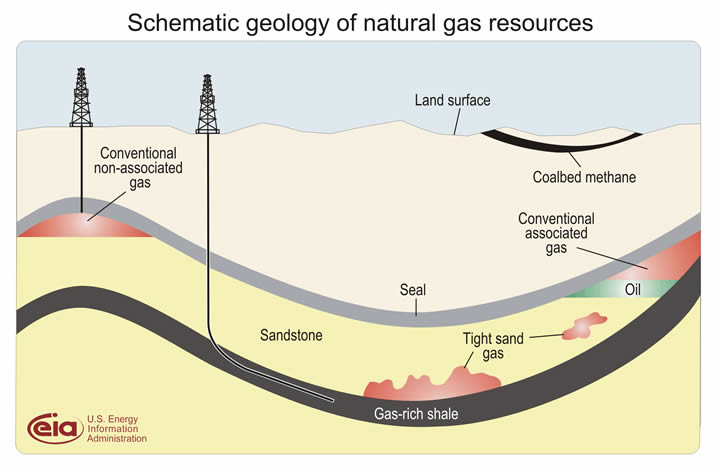
  • Recent technological advances in horizontal drilling and hydraulic fracturing have significantly increased the amount of “unconventional” shale gas that can be economically recovered. From 2007 to 2008 alone, shale gas production increased by 71 percent.7

Background

Natural gas is a fossil fuel that consists mainly of methane (CH4). The combustion of natural gas emits carbon dioxide (CO2), the primary greenhouse gas (GHG); however, methane itself is also a potent GHG, 21 times more powerful in terms of its heat-trapping ability than CO2.8  This document focuses on CO2 from natural gas combustion and processing and methane emissions from oil and gas systems, which are not the only or primary source of methane emissions.9

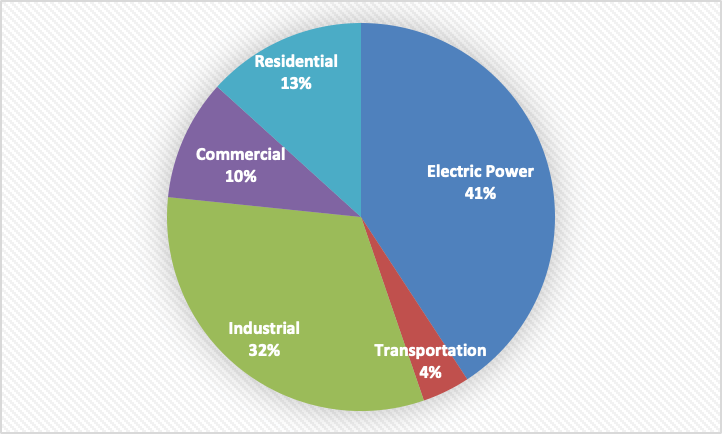
Natural gas-related emissions account for about 16 percent of total U.S. greenhouse gas (GHG) emissions, 90 percent of which are due to CO2 from natural gas combustion with the remainder coming from fugitive methane releases (8 percent) and CO2 removed during natural gas processing (2 percent).10,11,12 No one sector dominates natural gas consumption; rather, the electric power, industrial, residential, and commercial sectors are all significant end users (see Figure 1).

Figure 1: U.S. Natural Gas Consumption by Sector (2008)13
Natural Gas: Figure 1


Figure 2: U.S. Residential Sector Natural Gas Consumption by End Use (2006)14

Natural Gas: Figure 2


Figure 3: U.S. Commercial Sector Natural Gas Consumption by End Use (2006)15
Natural Gas: Figure 3


Figure 4: Industrial Natural Gas Consumption by Subsector (2006)16
Natural Gas: Figure 4


Description

Primary sources of natural gas-related GHG emissions are:

  • Electricity Generation: In 2008, electricity generation accounted for 29 percent of U.S. natural gas consumption. Natural gas electricity generation relies on three basic technologies:
    • Steam turbine plants: These plants operate like traditional coal-fueled power plants where fossil fuel (in this case natural gas) combustion heats water to create steam. The steam turns a turbine, which runs a generator to create electricity.
    • Combustion turbine plants: These plants are generally used to meet peak electricity demand. They operate similarly to jet engines—natural gas is combusted and used to turn the turbine blades and spin an electrical generator.17
    • Combined cycle plants: Combined cycle plants are highly efficient because they combine combustion turbines and steam turbines. The hot exhaust from a gas-fired combustion turbine is used to create steam to power a steam turbine.18  Such high efficiency combined cycle plants emit less than half the CO2 per megawatt-hour as similarly rated coal power plants.19  A typical natural gas combined cycle power plant has a heat rate (i.e., the amount of fuel used per unit of electricity generation) that is about one third lower than for a combustion turbine or gas-fired steam turbine plant.20
  • Residential Sector: Natural gas is used primarily for space and water heating (see Figure 2).
  • Commercial Sector: More than half of commercial-sector natural gas use is for space and water heating, but other uses—including cogeneration (the use of natural gas to generate electricity and useful heat, also referred to as combined heat and power, or CHP)—are also significant (see Figure 3).
  • Industrial Sector: In the industrial sector, two subsectors (refining and bulk chemicals) together account for more than one third of all energy-related natural gas consumption (see Figure 4). Process heat, conventional boiler use, and cogeneration account for 85 percent of natural gas use in manufacturing.21
  • Oil and Gas Industry Operations
    • Formation CO2: Formation CO2 is often found in raw natural gas and is separated and generally vented to the atmosphere during natural gas processing.
    • Fugitive emissions: Methane emissions mainly occur in natural gas and oil systems due to equipment or pipeline leaks and routine venting activities.22
    • Other CO2 emissions23: “Lease gas” is combusted to power gas and oil field operations (e.g., dehydration, compression). Flaring is the burning off of unwanted gas. “Plant fuel” is natural gas used to power gas processing plants; likewise, “pipeline fuel” is natural gas used to power natural gas transmission and storage operations.
  • Vehicles: In 2007, compressed natural gas (CNG) and liquid natural gas (LNG) vehicles comprised only about 0.5 percent (about 120,000 vehicles) of the U.S. vehicle stock.24  Nearly 40 percent of natural gas vehicles (NGVs) are medium- or heavy-duty vehicles.25  Globally, there are reportedly more than 9.6 million NGVs with almost three quarters of them in just five countries (Pakistan, Argentina, Brazil, Iran, and India).26  

GHG abatement options related to natural gas include:

  • Electricity Sector
    • Fuel switching: Fuel switching refers to displacing traditional coal-fueled electricity generation with less carbon-intensive natural gas generation. The most economic option for fuel switching is to operate fewer existing coal power plants, or to operate those plants at lower levels of output, and to ramp up generation from existing natural gas power plants or to build new natural gas plants to replace coal generation. In 2007, U.S. natural gas combined cycle plants had an average capacity factor of 42 percent compared to nearly 74 percent for coal power plants, indicating potential for fuel switching with existing power plants.27
    • Electricity generation efficiency improvements: Modern natural gas combined cycle power plants have higher efficiencies than gas-fired steam cycle plants; replacing the latter with the former can reduce the GHG emissions from gas-fired electricity generation.28
    • Carbon capture and storage (CCS): Similar to its application with coal-fueled power plants, CCS can be coupled with natural gas power plants to capture and permanently sequester large percentages of the CO2 emissions from electricity generation (see Climate TechBook: Carbon Capture and Storage).
  • Industrial Sector
    • Combined heat and power (CHP, or cogeneration): In natural gas-fueled industrial CHP applications, natural gas is used to generate both useful heat and electricity. CHP has much higher efficiency than separate generation of heat and electricity from the same fuel supply, so replacing separate power and heat generation with CHP requires less fuel use and thus lowers emissions.
    • Other efficiency measures: Other efficiency measures, such as preventive maintenance and advanced process controls for steam systems, can lead to more efficient use of energy and thus lower emissions.29
  • Residential and Commercial Sectors
    • Building envelope: Improved building envelopes can reduce space heating energy needs and thus reduce natural gas consumption and related GHG emissions (see Climate TechBook: Building Envelope).
    • Efficiency and alternative space and water heating options: Natural gas space and water heating systems can be made more efficient and other technologies, like solar water heating and heat pumps, can replace or supplement natural gas use (see Climate TechBook: Residential End-Use Efficiency).
  • Oil and Gas Industry Operations
    • CCS: Natural gas processing facilities that remove CO2 from raw natural gas already generate high-purity streams of CO2. Such facilities offer some of the least expensive opportunities for deploying CCS, since capturing a high-purity stream of CO2 is less expensive than capturing CO2 from power plant exhaust streams.30  In some cases, CO2 from natural gas processing is already being captured and injected into geological formations for enhanced oil recovery (CO2-EOR).31
    • Methane mitigation: Fugitive emissions can be reduced by upgrading equipment (e.g., valves), changing procedures to reduce venting, and improving leak detection and measurement efforts.32
  • Vehicles
    • Compared to gasoline- and diesel-fueled vehicles, vehicles fueled by natural gas can have greenhouse gas emissions that are roughly 15-30 percent lower.33


Environmental Benefit / Emission Reduction Potential

Natural gas is both a lower-carbon fossil fuel that can displace more carbon-intensive fuels and also a significant source of GHG emissions itself that must be controlled. The role that natural gas plays in GHG emission reductions will depend primarily on the extent to which energy efficiency and conservation measures and the deployment of non-emitting electricity generation technologies reduce natural gas consumption, and the extent to which natural gas replaces coal used for electricity generation. The degree to which natural gas will displace coal-fueled electricity generation under a policy that reduces U.S. GHG emissions, such as cap and trade, will depend on such factors as the policy’s reduction targets and timetable, the future supply and price of natural gas, the cost and feasibility of building alternative low- or non-emitting electricity generation technology (i.e., renewables, coal with CCS, and nuclear power), and the number of offsets allowed under cap and trade.34

A recent modeling analysis by the U.S. Energy Information Administration (EIA) of the GHG cap-and-trade bill passed by the U.S. House of Representatives (H.R. 2454, the American Clean Energy and Security Act of 2009) in June 2009 illustrates the role of natural gas in U.S. GHG abatement and how that role is projected to vary depending on future circumstances.35  In its core (or “Basic”) policy case, EIA projected that, by 2030, in comparison to 2009 consumption, industrial natural gas consumption would fall by almost 6 percent while residential natural gas consumption would be more than 7 percent lower and commercial natural gas consumption almost 2 percent higher. In the same analysis, EIA projected that as efficiency, nuclear power, renewables, and coal with CCS expanded, natural gas consumption for electricity generation would be 22 percent lower in 2030 than in 2009. However, EIA’s analysis also illustrates how the role of natural gas would be significantly different in a future scenario where fewer emission reduction options are available (e.g., if progress building new nuclear plants or deploying CCS is slower than expected). EIA performed a model run (the “No International/Limited” policy case) that assumed nuclear power and coal power plants using CCS could only be deployed at the low levels expected under “business as usual” and that the use of international offsets under domestic cap and trade is greatly restricted. This represents a pessimistic, higher-cost scenario since some of the most important and cost-effective GHG abatement options are restricted. In this case, EIA projects for 2030 even greater reductions in natural gas consumption in the industrial, residential, and commercial sectors (about 23, 16, and 6 percent, respectively, compared to 2009). At the same time, EIA projects that fuel switching will lead to natural gas consumption in the electric power sector that is nearly 83 percent higher in 2030 than in 2009, for total projected natural gas consumption in 2030 that is 14 percent higher than in 2009.

The same EIA modeling analyses discussed above project that NGV fuel consumption will increase over time but will actually grow less quickly under cap and trade than under “business as usual,” remaining a very small component of transportation energy in any case.

The International Energy Agency (IEA) analyzed emission reduction options under an aggressive international effort to reduce global energy-related GHG emissions.36  IEA projected that while global coal and oil use would decline relative to current levels by 2050 in the case of a global effort to reduce emissions, natural gas consumption would actually increase by 25 percent; however, under “business-as-usual” IEA projected that natural gas consumption would double over the same period. In the global power generation sector, IEA estimated that an effort to reduce emissions would mean that, by 2050, global power generation from natural gas would be roughly twice current levels (though still about one fifth of total generation), while 75 percent of electricity generation from natural gas would be coupled with CCS. IEA projected that improvements in efficiency from natural gas electricity generation and switching from coal to natural gas electricity generation could provide 2 and 10 percent, respectively, of global GHG abatement from the electric power sector by 2050.


Cost

Many of the options for reducing natural gas consumption via energy efficiency in the residential, commercial, and industrial sectors are estimated to be among the lowest-cost GHG abatement options. Some analysts estimate that significant GHG abatement opportunities from more efficient use of natural gas exist at “negative cost,” that is, the cost savings from reduced expenditures on natural gas fuel outweigh the higher costs of more efficient equipment, better home insulation, etc.37

In the U.S. electric power sector, the degree of fuel switching will depend on the difference in cost between utilizing existing natural gas power plants compared to existing coal plants and the relative cost of building new natural gas power plants compared to alternative low-carbon options (e.g., nuclear power, renewables, and coal with CCS). These cost differentials depend greatly on the price of natural gas (see Figures 5-8 showing the effect of natural gas and carbon prices on the variable cost of electricity generation from existing plants). A recent analysis by ICF International estimated that a carbon price of $10 per metric ton of CO2 adds about $0.01 per kilowatt-hour (kWh) to the marginal cost of generation at a coal power plant and about $0.004 for a natural gas combined-cycle plant.38  At natural gas prices like those seen in 2006-2007 ($7-8/MMBtu), ICF projected that a carbon price of $25 per ton of CO2 would lead to significant fuel switching from coal to natural gas among existing power plants. When considering investments in new power plants, power generators must consider not only the marginal cost of generating electricity from a new unit but also up-front capital costs and other fixed expenses. Capital costs account for roughly 40 and 75 percent of the levelized cost of electricity from a new coal power plant and nuclear plant, respectively, but fuel costs account for about 80 percent of the levelized cost of electricity from a natural gas power plant.39,40  In short, natural gas power plants are relatively inexpensive to build, but their cost of electricity depends greatly on the price of natural gas. According to the same ICF analysis, new wind and nuclear power plants have a lower levelized cost of electricity than new natural gas combined cycle plants at a carbon price of $20-30 per ton of CO2. At about $55 per ton of CO2, coal with CCS has a lower levelized cost of electricity than a new natural gas power plant.

Reducing fugitive emissions from oil and natural gas systems can be a low-cost option for reducing GHG emissions, and some analyses suggest many such reductions will quickly pay for themselves because methane is a valuable commodity.41


Figures 5-8: Effects of Natural Gas and Carbon Prices on Existing Power Plant Dispatch42

Figure 5: No Carbon Price
Natural Gas: Figure 5


Figure 6: $10 per Ton Carbon Price
Natural Gas: Figure 6


Figure 7: $20 per Ton Carbon Price
Natural Gas: Figure 7


Figure 8: $30 per Ton Carbon Price
Natural Gas: Figure 8


Notes: The figures above are intended as illustrative of the impact of natural gas and carbon prices on the marginal cost of generation from existing power plants. Controlled and uncontrolled coal refer to pulverized coal power plants with and without SO2 and NOX pollution control equipment installed. NGCC refers to natural gas combined cycle power plants. VOM refers to variable operating and maintenance costs. Natural gas prices are in dollars per million Btu.


Current Status of Natural Gas

Natural gas constitutes 24 percent of both of total U.S. energy consumption and total global energy consumption.43,44  Total U.S. natural gas consumption has grown slightly during the past decade (by 4.5 percent), but consumption trends have varied by sector, with industrial consumption declining by a fifth between 1998 and 2008.45  In 2008, natural gas fueled 21 percent of total U.S. electricity generation.46

Over the past two decades, natural gas electricity generation has grown much more than total electricity generation (247 and 52 percent growth, respectively, between 1988 and 2008).47  This growth was due in large part to the much lower air pollutant emissions from natural gas power generation compared to other fossil fuels and the lower capital cost and shorter construction time of natural gas power plants compared to coal power plants.48

Natural gas prices have exhibited a large degree of volatility. Looking at the past two decades, from 1988 to 1998, average annual wellhead prices ranged between $2-3 per thousand cubic feet (in 2008$) while, from 1998 to 2008, average annual wellhead prices more than tripled to over $8 (in 2008$). In 2009, however, average monthly wellhead prices from March through August were down more than 60 percent compared to the same months in 2008. Natural gas prices have experienced large percentage changes up and down over time due to severe weather events, colder or warmer than expected weather, strong economic growth, economic downturns, and other factors. Certain natural gas consumers have expressed concerns that policies to reduce GHG emissions could promote fuel switching in the electric power sector, driving up demand for natural gas and its price (in a so-called “dash to gas”), which could have negative impacts on manufacturers who depend on natural gas.49

Natural gas is primarily a domestic energy resource. In 2008, net imports constituted only 13 percent of total U.S. natural gas consumption, and pipeline imports from Canada accounted for 90 percent of U.S. natural gas imports.50  In roughly the last two years, the outlook for U.S. natural gas supply has changed dramatically, with experts no longer predicting that the United States will become increasingly reliant on natural gas imports (particularly imports of liquefied natural gas, or LNG); rather, technological advances—related, in particular, to horizontal drilling and hydraulic fracturing—have significantly increased the amount of “unconventional” shale gas that can be economically recovered.51,52  From 1998 to 2007, unconventional natural gas production (which includes tight gas, coalbed methane, and shale gas) expanded from 28 percent of U.S. annual production to 46 percent.53,54  While shale gas is currently the second largest component of unconventional gas production, shale gas production is growing rapidly; from 2007 to 2008 alone, shale gas production increased by 71 percent (an increase of nearly 840 billion cubic feet, equal to 4 percent of total U.S. natural gas production in 2008).55  Moreover, total U.S. natural gas production in the first eight months of 2009 was nearly 3 percent higher than in the same period in 2008.56  In its most recent biennial report (from June 2009), the Potential Gas Committee estimated a total U.S. natural gas resource base (proven reserves plus unproven resources) that was 36 percent higher than its previous estimate—with most of this increase due to shale gas resources—and equivalent to about 100 years of U.S. natural gas consumption at current levels.57,58,59


Obstacles to Optimal Development or Deployment of Natural Gas

  • Lack of a Price on Carbon or GHG Emission Performance Standards
    In the absence of policies that place a financial cost on GHG emissions or that set performance standards, firms and households fail to optimize investment decisions and operations for reducing GHG emissions.
  • Barriers to Energy Efficiency
    With or without a carbon price, there are a number of market and behavioral failures than can prevent firms and households from making optimal choices concerning energy efficiency that would reduce natural gas consumption. These include lack of information about efficiency options and potential energy and cost savings, misaligned incentives, and bounded rationality (e.g., the use of rules-of-thumb that can lead to suboptimal decisions).60  For more information on the barriers to energy efficiency see Climate TechBook: Buildings Overview. Industrial GHG Abatement, and Residential Energy Efficiency.
  • Legal and Regulatory Barriers
    Certain GHG abatement options related to natural gas are constrained by legal and regulatory barriers. In particular, the deployment of CCS with natural gas processing facilities or natural gas-fueled electricity generation requires a regulatory and legal framework for geological carbon storage (see Climate TechBook: Carbon Capture and Storage). In addition, CHP deployment can face regulatory hurdles related to grid integration and electricity tariffs (see Climate TechBook: Combined Heat and Power).61  Finally, many state-regulated natural gas local distribution companies face a regulatory disincentive to help their customers pursue efficiency measures since the companies’ revenues are based on natural gas sales.
  • Research, Development, and Demonstration (RD&D)
    Research and development and learning-by-doing spillovers from demonstration projects mean that firms will under-invest in RD&D since they cannot fully appropriate the returns from such investments.
  • Limited Infrastructure for Natural Gas Vehicles
    While there are about 162,000 gasoline stations in the United States, there are fewer than 800 vehicle fueling stations that offer CNG.62,63
  • Concerns over Unconventional Gas Production’s Environmental Impacts
    The Energy Policy Act of 2005 amended the Safe Drinking Water Act to exclude underground injection of fluids for hydraulic fracturing related to oil, gas, and geothermal production from regulation by the Environmental Protection Agency.64 Because gas producers often mix chemicals with the large volumes of water injected for hydraulic fracturing, these chemicals have been found to contaminate drinking water in some cases, and producers have not always disclosed the chemicals they use.65  Thus concerns remain over whether hydraulic fracturing is sufficiently regulated to protect human health.66


Policy Options to Help Optimize Natural Gas Use

  • Putting a Price on Carbon
    A policy, such as cap and trade (see Climate Change 101: Cap and Trade), that puts a price on GHG emissions would lead firms and households to make investment and operating decisions that reduce GHG emissions—ranging from fuel switching by electricity generators to investments in home insulation or programmable thermostats by households.
  • GHG Reduction Credits or Offsets
    Fugitive methane emissions from oil and gas industry operations would prove administratively difficult to address directly as covered sources under an emissions pricing policy such as cap and trade. Allowing projects that reduce methane emissions to qualify for offset credits that can be traded under a cap-and-trade program, however, can provide a financial incentive for firms to undertake such projects.
  • Mandating GHG Performance Standards
    Policymakers could rely on performance standards to promote greater reliance on natural gas as a lower-carbon fuel source by enacting new regulations that establish maximum allowable CO2 emission rates for power plants (California, Washington, and Oregon have such standards).67  Prescriptive standards could also be applied to oil and gas system operations to reduce fugitive emissions.
  • Product Standards
    The government can and has set minimum efficiency standards for a variety of products including those that consume natural gas, such as furnaces, boilers, and water heaters (see Climate TechBook: Residential Energy Efficiency and HVAC).
  • Buildings Codes and Standards
    Mandatory or voluntary buildings codes and standards adopted by state and local governments or developed by other entities can require new buildings to have improved building envelopes and thus require less energy (e.g., from natural gas) for heating or provide information on how builders can create more energy-efficient buildings (see Climate TechBook: Buildings Overview and Building Envelope).
  • Decoupling of Utility Profits from Sales
    By ensuring cost-recovery and a rate of return for energy efficiency investments, state regulators can address the disincentive utilities face regarding promoting customer energy efficiency measures (see C2ES factsheet on Decoupling).
  • Efficiency Education and Information Programs
    Education and information programs can take a variety of forms such as voluntary labeling of energy-efficient household products (e.g., the ENERGY STAR program) to publicly funded energy assessments, industrial energy efficiency case studies, and training (e.g., the Save Energy Now program of the Department of Energy’s Industrial Technologies Program).
  • Research, Development, and Demonstration (RD&D)
    Continued and increased government financial incentives and cooperation with the private sector related to RD&D could accelerate technology advances and market penetration, with possible technology areas of focus including advanced natural gas turbines with higher efficiencies and CCS.
  • Policies to Address Environmental Impacts of Natural Gas Production
    Public disclosure requirements regarding toxic chemicals used during hydraulic fracturing, additional research on the potential impacts of unconventional gas production on drinking water and other environmental concerns, and regulatory safeguards to minimize any such impacts would facilitate the continued expansion of U.S. natural gas production.


Related Business Environmental Leadership Council (BELC) Company Activities


Related C2ES Resources


Building Solutions to Climate Change, 2006.

Climate Change 101: Technology, 2011.

Coverage of Natural Gas Emissions & Flows under a GHG Cap-and-Trade Program, 2008.

Greenhouse Gas Offsets in a Domestic Cap-and-Trade Program, 2008.

Multi-Gas Contributors to Global Climate Change: Climate Impacts and Mitigation Costs of Non-CO2 Gases, 2003.

A Performance Standards Approach to Reducing CO2 Emissions from Electric Power Plants, 2009.

Policy Options for Reducing GHG Emissions from Transportation Fuels, 2009.

The U.S. Electric Power Sector and Climate Change Mitigation, 2005.

State Maps

Towards a Climate-Friendly Built Environment, 2005.

Further Reading / Additional Resources

Congressional Research Service (CRS)

  • Displacing Coal with Generation from Existing Natural Gas-Fired Power Plants, 2010.
  • Methane Capture: Options for Greenhouse Gas Emission Reduction, 2009.
  • Unconventional Gas Shales: Development, Technology, and Policy Issues, 2009.

U.S. Department of Energy

U.S. Energy Information Administration (EIA), Natural Gas

U.S. Environmental Protection Agency (EPA)

Gillingham, Kenneth, Richard Newell, and Karen Palmer, Energy Efficiency Economics and Policy, Resources for the Future (RFF) Discussion Paper 09-13, 2009.

Global Energy Technology Strategy Program, Carbon Dioxide Capture and Geologic Storage, 2006.

U.S. Government Accountability Office (GAO), Natural Gas Flaring and Venting: Opportunities to Improve Data and Reduce Emissions, 2004.

ICF International, Availability, Economics, and Production Potential of North American Unconventional Natural Gas Supplies, prepared for the Interstate Natural Gas Association of America (INGAA) Foundation, Inc., 2008.

International Energy Agency (IEA), Energy Technology Perspectives 2008: Scenarios and Strategies to 2050, 2008.

McKinsey & Company, Unlocking Energy Efficiency in the U.S. Economy, 2009.

Navigant Consulting Inc., North American Natural Gas Supply Assessment, prepared for the American Clean Skies Foundation, 2008.


1 U.S. Energy Information Administration (EIA), Annual Energy Review 2009, 2010, Table 1.3.
2 EIA, International Energy Outlook 2009, 2009, see Table A2.
3 Bluestein, Joel, Coverage of Natural Gas Emissions & Flows Under a GHG Cap-and-Trade Program, 2008, Prepared for the Pew Center on Global Climate Change.
4 U.S. Environmental Protection Agency (EPA), Clean Energy – Natural Gas.
5 U.S. Department of Energy (DOE), Energy Efficiency & Renewable Energy (EERE), Alternative Fuels and Advanced Vehicles Data Center: Natural Gas Emissions.
6 EIA, Natural Gas Summary.
7 EIA, Shale Gas Production.
8 Carbon dioxide equivalent is a metric used to compare the amounts and effects of different greenhouse gases. It is determined by multiplying the emissions of a gas (by mass) by the gas’s global warming potential (GWP), an index representing the combined effect of the length of time a given greenhouse gas remains in the atmosphere and its relative effectiveness in absorbing outgoing infrared radiation. CO2 is the standard used to determine the GWPs of other gases. CO2 has been assigned a 100-year GWP of 1 (i.e., the warming effect over a 100-year time frame relative to other gases). Methane (CH4) has a 100-year GWP of 21.
9 Other sources of methane emissions include enteric fermentation, landfills, coal mines, and manure management. For more information on methane emission sources, see EPA, Methane: Sources and Emissions.
10 Bluestein, Joel, Coverage of Natural Gas Emissions & Flows Under a GHG Cap-and-Trade Program, 2008, Prepared for the Pew Center on Global Climate Change.
11 Fugitive emissions generally come from equipment leaks, process venting, disposal of waste gas streams (e.g., by venting or flaring), and accidents and equipment failures. 
12 CO2 is often found in raw natural gas when it is extracted (formation CO2) and is removed from the gas as part of natural gas processing.
13 EIA, Natural Gas Consumption by End Use.
14 DOE-EERE, Buildings Energy Data Book, Table 2.1.5.
15 DOE-EERE, Buildings Energy Data Book, Table 3.1.4.
16 EIA, An Updated Annual Energy Outlook 2009 Reference Case Reflecting Provisions of the American Recovery and Reinvestment Act and Recent Changes in the Economic Outlook, 2009.
17 For a more detailed explanation, see DOE’s “How Gas Turbine Power Plants Work.”
18 For a more detailed explanation, see EGL’s Gas-Fired Combined Cycle Power Plants: How Do They Work?
19 A new natural gas combined cycle power plant is estimated to emit roughly 42-44 percent as much CO2 per unit of net electricity generation compared to a new pulverized coal power plant. DOE National Energy Technology Laboratory (NETL), Cost and Performance Baseline for Fossil Energy Plants, Volume 1: Bituminous Coal and Natural Gas to Electricity Final Report, 2007, see Exhibit ES-2..
20 Comparison based on heat rates assumed in EIA’s Assumptions to the Annual Energy Outlook 2009, Table 8.2, and EPA’s National Electric Energy Data System (NEEDS) 2006 database.
21 EIA, Manufacturing Energy Consumption Survey (MECS), 2002, see Table 5.2.
22 International Energy Agency (IEA), Energy Technology Perspectives 2008: Scenarios and Strategies to 2050, 2008.
23 For detail on oil and gas operations emissions see Table 1 in Bluestein (2008).
24 DOE-EERE, Transportation Energy Data Book, Tables 3.3 and 6.1. 
25 EIA, Alternatives to Traditional Transportation Fuels 2007, 2009.                                    
26 International Association for Natural Gas Vehicles (IANGV), Natural Gas Vehicle Statistics, 2008.
27 EIA, Electric Power Annual 2007, 2009, see Figure ES 3.
28 IEA, 2008, p.256.
29 McKinsey & Company, Reducing U.S. Greenhouse Gas Emissions: How Much at What Cost?, 2007.
30 Dooley, JJ et al., Global Energy Technology Strategy Program, Carbon Dioxide Capture and Geologic Storage, 2006.
31 DOE National Energy Technology Laboratory (NETL), Carbon Sequestration Through Enhanced Oil Recovery, 2008.
32 IEA, 2008.
33 DOE-EERE, Alternative Fuels and Advanced Vehicles Data Center: Natural Gas Emissions.
34 For an explanation of how offsets are used in a cap-and-trade program, see C2ES’s Congressional policy brief, Greenhouse Gas Offsets in a Domestic Cap-and-Trade Program, November 2008.
35 EIA, Energy Market and Economic Impacts of H.R. 2454, the American Clean Energy and Security Act of 2009, 2009.
36 IEA, 2008. This document cites the projections from IEA’s BLUE Map scenario which achieves a 50 percent reduction from current global energy-related CO2 emissions by 2050, which is a 77 percent reduction from projected “business-as-usual” emissions in 2050. 
37 See, for example, McKinsey & Company, 2009, Unlocking Energy Efficiency in the U.S. Economy.
38 Fine, Steven and Elliot Roseman, “The Costs of Going Green: Carbon Costs Will Reshape the Generation Fleet and Affect Retail Rates,” Public Utilities Fortnightly, June 2009.
39 The levelized cost of electricity is an economic assessment of the cost of electricity generation from a representative generating unit of a particular technology type (e.g. wind, coal) including all the costs over its lifetime: initial investment, operations and maintenance, cost of fuel, and cost of capital.
40 Du, Yangbo and John Parsons, Update on the Cost of Nuclear Power, MIT Center for Energy and Environmental Policy Research, 2009, see Figure 1.
41 See the EPA Natural Gas STAR program’s estimates of payback periods for Recommended Technologies and Practices.
42 Existing plant dispatch cost estimates come from Fine and Roseman (2009), Figure 1.
43 EIA, Annual Energy Review 2008, 2009, Table 1.3.
44 EIA, International Energy Outlook 2009, 2009, see Table A2.
45 EIA, Annual Energy Review 2008, 2009, see Table 6.5.
46 EIA, Annual Energy Review 2008, 2009, see Table 8.2a.
47 EIA, Annual Energy Review 2008, 2009, see Table 8.2a.
48 EIA, Repeal of the Powerplant and Industrial Fuel Use Act (1987).
49 See, for example, the statement of Richard Wells, Dow Chemical Company, to the House Subcommittee on Energy and the Environment, 23 April 2009.
50 EIA, Natural Gas Summary.
51 Yergin, Daniel and Robert Inesin, “America's Natural Gas Revolution,” Wall Street Journal Op-Ed, 2 November 2009.
52 For an explanation of horizontal drilling and hydraulic fracturing, see the American Petroleum Institute (API) video.
53 Navigant Consulting, The Dynamics of Abundance of North American Domestic Natural Gas Supply, Presentation, June 2009.
54 For helpful descriptions of conventional and unconventional natural gas types, see ICF International, Availability, Economics, and Production Potential of North American Unconventional Natural Gas Supplies, prepared for the INGAA Foundation, Inc, 2008, p. 11.
55 EIA, Shale Gas Production.
56 Refers to dry production. See EIA, U.S. Natural Gas Monthly Supply and Disposition Balance.
57 Bluestein, Joel, ICF International, statement to the Senate Committee on Environment and Public Works, 28 November 2009.
58 The Potential Gas Committee (PGC) is a non-profit entity and consists of volunteer experts who are associated with a wide variety of natural gas industry, governmental, and academic institutions.
59 According to Whitney, Gene et al., U.S. Fossil Fuel Resources: Terminology, Reporting, and Summary, Congressional Research Service, October 2009, “proved reserves are those amounts of oil, natural gas, or coal that have been discovered and defined, typically by drilling wells or other exploratory measures, and which can be economically recovered” and “undiscovered resources are amounts of oil and gas estimated to exist in unexplored areas. If they are considered to be recoverable using existing production technologies, they are referred to as undiscovered recoverable resources.”
60 As an example of misaligned incentives, if a firm allocates energy costs across departments as an overhead cost, no department will realize the full benefit of its investments in energy efficiency thus reducing the incentive of any individual department to pursue energy efficiency.
61 IEA, 2008.
62 National Petroleum News, NPN MarketFacts 2008.
63 DOE-EERE, Alternative Fueling Station Total Counts by State and Fuel Type.
64 See Title III, Subtitle C, Sec. 322 of the Energy Policy Act of 2005.
65 Mouawad, Jad and Clifford Krauss, “Gas Company Won’t Drill in New York Watershed,” New York Times, 27 October 2009.
66 House Committee on Government Oversight and Reform, Hearing on Oil and Gas Exemptions in Federal Environmental Protections, October 2007. 
67 For more information on CO2 emission performance standards for electric power plants, see Rubin, Edward, A Performance Standards Approach to Reducing CO2 Emissions from Electric Power Plants, prepared for the Pew Center, June 2009.