Quick Facts
Background
Electric power generation is a major source of greenhouse gas (GHG) emissions, primarily carbon dioxide (CO2) from fossil fuel combustion. In the United States, electricity generation is responsible for roughly one third of total GHG emissions (80 percent of which come from coal use).[7]Globally, electricity generation accounts for more than 27 percent of total CO2 emissions and more than one fifth of total GHG emissions.[8]Given the magnitude of GHG emissions from the electricity sector, low-carbon electricity generation technologies are crucial for achieving the significant GHG emission reductions necessary to avoid dangerous climate change.
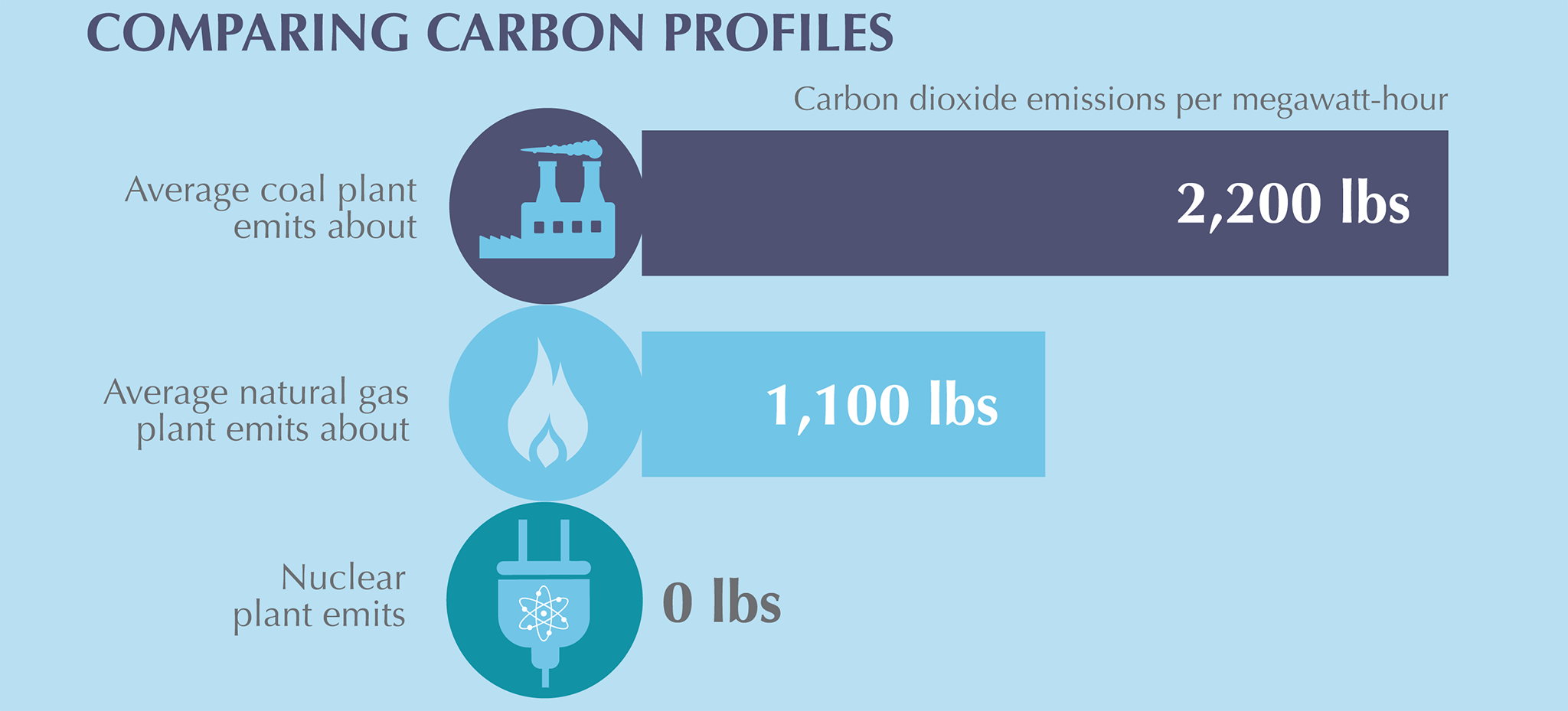
Nuclear power is one option in the portfolio of low-carbon electricity generation technologies, which also includes renewables (e.g., wind, solar, and biomass) and fossil fuels coupled with carbon capture and storage (CCS). Nuclear power emits no GHGs from electric power generation, and its overall lifecycle GHG emissions profile is low and similar to that of solar power.[9]In addition, nuclear power is already a widely deployed technology and can—like coal-fueled generation—provide reliable baseload electric power.
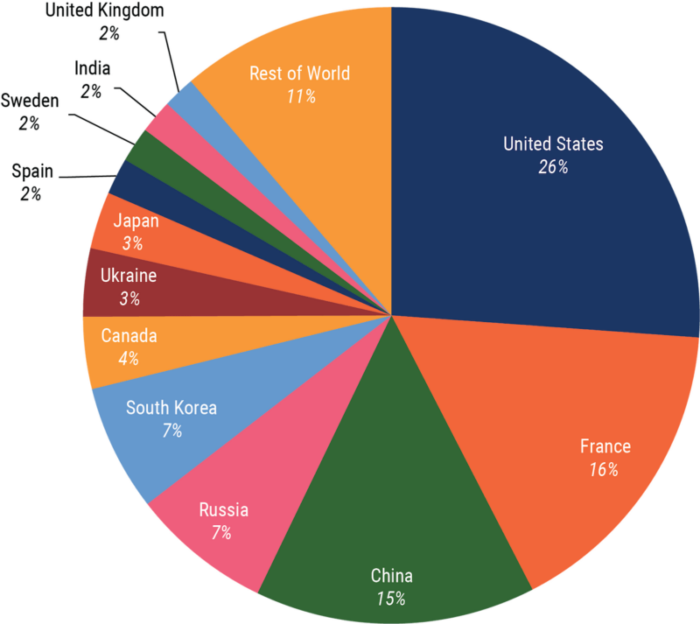
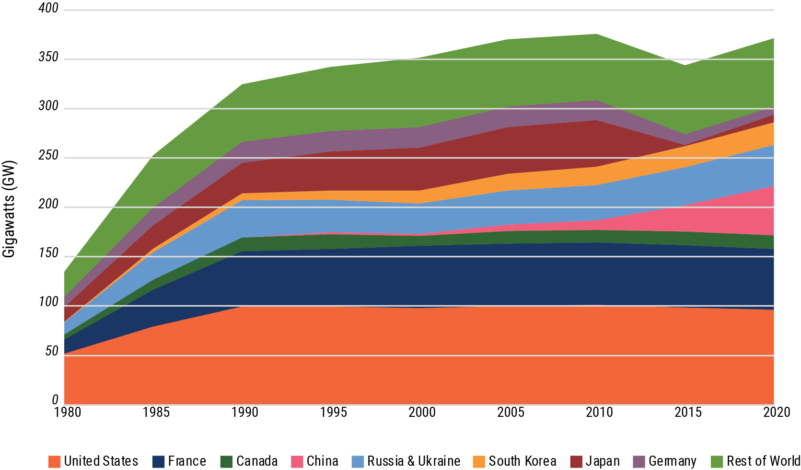
Currently, nuclear power is by far the largest source of low-carbon electricity in the United States. In 2010, nuclear power provided one fifth of total U.S. electricity, which was nearly twice as much as generated from all renewable sources (including conventional hydropower).[10] The United States has 104 operating nuclear reactors at 65 plants in 31 states.[11] Globally, nuclear power generates roughly 14 percent of total electricity.[12]
In order for nuclear power to significantly expand domestically and globally, the United States and the rest of the world must adopt policies to promote low-carbon technology deployment and adequately address concerns about nuclear power safety, nuclear weapons proliferation, and the long-term handling of spent nuclear fuel.
Description
Current nuclear power technology harnesses the energy released by nuclear fission. Atomic nuclei consist of protons and neutrons held together by a strong energy bond. In nuclear fission, a neutron strikes the nucleus of a very heavy atom and splits it apart into lighter atoms, releasing additional neutrons and energy as well. These neutrons, in turn, can fission other atoms. Under precise, controlled conditions, this nuclear fission process can occur as a continuous chain reaction that releases heat in useful amounts.
Environmental Benefit/Emission Reduction Potential
Many analyses that look at the lowest-cost options for decarbonizing the electric power sector (e.g., via a GHG emissions pricing policy) project a substantial role for new nuclear power plants in meeting demand for non-emitting electricity generation.
In its 2011 outlook for “business as usual” (i.e., a scenario with no new policies), the U.S. Energy Information Administration (EIA) projects only 10 gigawatts (GW) of new nuclear generating capacity from now through 2035—a 10 percent increase from current nuclear generating capacity over 25 years.[26] Over the same period, EIA projects that total electricity demand will grow by 25 percent.
In contrast, EIA recently modeled an economy-wide carbon price and projected that such an emission reduction policy would spur the deployment of 75 GW of new nuclear generating capacity by 2035.[27]Analysis of the same policy by the U.S. Environmental Protection Agency (EPA) estimated that nuclear power would increase to 44 percent of total U.S. electricity generation by 2050.[28]
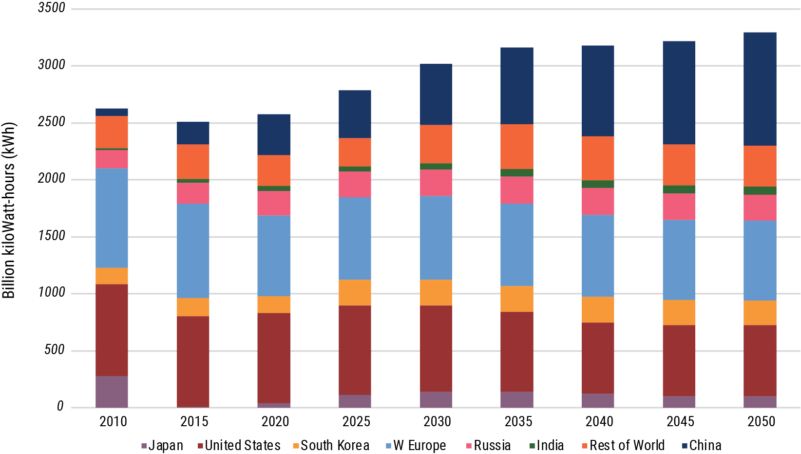
As one indicator of the significant potential role for nuclear power in global GHG abatement, the International Energy Agency (IEA) estimated that nuclear power could provide 6 percent of total energy-related emission reductions compared to “business as usual” by 2050 (and 19 percent of emission reductions from the power sector).[29]IEA projected that, in this scenario, nuclear power would increase from about 14 percent of global electricity generation currently to nearly one fourth of total power generation by mid-century.
Cost
Nuclear power requires very large upfront capital investments in constructing the power plant (e.g., a new 1 gigawatt nuclear power plant might cost $6 billion including the cost of financing). For nuclear power, the capital cost of the plant constitutes roughly three fourths of the levelized cost of electricity, with fuel and operations and maintenance (O&M) costs making up the remainder of the cost in roughly equal proportions.[30],[31] In contrast, capital costs account for roughly 40 percent of the levelized cost of electricity from a new coal power plant, and fuel costs account for about 80 percent of the levelized cost of electricity from a natural gas power plant.[32] In short, nuclear plants are relatively expensive to build but relatively inexpensive to operate.
The cost of new U.S. nuclear power plants is uncertain due to a long hiatus in the construction of new nuclear plants in the United States, and cost estimates have been trending upward. In 2010, EIA increased its annually updated estimate of the capital cost of a generic new nuclear power plant by 37 percent, citing a trend of rising costs for capital-intensive power sector projects, higher global commodity prices, and the relative scarcity of engineering and construction firms capable of undertaking such complex projects.[33]
During the 1980s and early ‘90s, new nuclear power plants experienced long delays in construction schedules and massive cost overruns, which makes potential lenders see new nuclear power plants as riskier than other power plant investments and thus makes new nuclear plant construction more expensive to finance. Given the capital-intensity of nuclear power, financing is challenging for new plants.
EIA’s latest estimates for the levelized cost of electricity from new power plants using various electricity generation technologies put nuclear power at roughly the same cost as electricity from new coal plants but roughly 80 percent more costly than electricity from new natural gas combined cycle plants.[34] This cost differential makes new nuclear power plants hard to justify without a policy that changes the relative costs of different types of electricity generation based on GHG emissions.
The once-through nuclear fuel cycle is currently the least costly approach to nuclear power.[35]
Current Status of Nuclear Power
More than 90 percent of U.S. nuclear capacity came online in the 1970s and ‘80s before cost overruns, construction delays, and safety concerns ended this wave of nuclear plant construction. Whereas the build-out of the existing U.S. nuclear fleet saw a large number of companies building a variety of idiosyncratic nuclear plant designs with a regulatory licensing process that allowed for significant delays, the new wave of potential new nuclear plants in the United States is foreseen to include a small number of firms with nuclear power experience building a limited number of standardized plant designs under a new licensing framework that front-loads much of the regulatory risk.
The Energy Policy Act of 1992 overhauled the nuclear licensing process, which used to require two licenses—one to build the plant and another to operate it. Under the new process the U.S. Nuclear Regulatory Commission (NRC) can: 1) pre-approve a prospective site for a new nuclear plant, 2) certify a new reactor design, and 3) issue a single combined construction and operating license (COL).[36]
In 2005, Congress enacted new financial incentives (mainly federal loan guarantees) to help spur the first wave of a new generation of nuclear power plants. Subsequently, U.S. electricity providers did begin to pursue new nuclear plants. Currently, 12 license applications are under active review by the NRC for up to 20 new reactors, with all of the license applications filed since 2007.[37]
Nonetheless, the high capital costs of new nuclear plants, the relatively lower cost of new natural gas generation following the domestic “shale gas revolution,” and continuing lack of federal policy to reduce GHG emissions and incentivize low-carbon energy technology all limit enthusiasm for new nuclear projects in the United States. As of April 2011, only two new nuclear plants have advanced as far as pre-construction activities on the ground (Vogtle in Georgia [Southern Company] and V.C. Summer in South Carolina [Scana]). The U.S. Department of Energy (DOE) has conditionally awarded a federal loan guarantee to one new nuclear plant (Vogtle) and is negotiating with three other projects.[38] Along with a third project in Texas (sponsored by NRG Energy and Toshiba), the Georgia and South Carolina reactors are considered the most likely to actually proceed in the near term if granted licenses by the NRC.[39] The process of licensing and building the first few new nuclear plants is expected to take approximately 9-10 years, with the nuclear industry expecting 4-8 new plants to start commercial operation by 2020.[40]
Industry experts consider successful on-time, on-budget completion of this handful of new reactors crucial for creating confidence that new reactor construction can avoid the pitfalls of the past and enabling subsequent nuclear project developers to obtain financing from the private sector without government backing.
Nuclear power also faces potential political and public acceptance hurdles. After decades, the United States still has yet to resolve the issue of long-term handling of spent nuclear fuel. The Obama Administration withdrew the license application for the long-awaited Yucca Mountain geologic repository and has appointed a blue-ribbon commission to reassess the options for long-term spent fuel management. The commission will deliver its final report in early 2012. Presently, the United States is pursuing a once-through nuclear fuel cycle. A fully closed fuel cycle would require not just advanced reprocessing and recycling technology but also the capability to manufacture a new type of reactor fuel from the reprocessing outputs.[41] According to the nuclear industry, the new generation of reactors necessary for a fully closed fuel cycle is decades away from commercial development.[42]
In March 2011, a catastrophic earthquake and resultant tsunami struck Japan and led to the failure of reactor and spent fuel storage cooling systems at the Fukushima Daiichi nuclear power station and subsequent damage to the reactors and fuel rods and releases of radioactivity. As of May 2011, it is too early to tell what implications the nuclear accident in Japan will have for nuclear power in the United States—whether it will dampen power generators’ interest in new reactors, delay regulatory approvals, lead to any retirements of existing reactors, or not affect the industry at all. President Obama and other political leaders have expressed continued support for new nuclear power following the crisis in Japan, and the NRC has undertaken efforts to learn from the Japanese crisis and identify implications for the safety of existing and planned U.S. reactors.
Worldwide, 64 new reactors are currently under construction in 15 countries. 25 of these reactors are in China, which has only 7 reactors operating now.[43] China has ambitious plans for building new reactors.[44] The other countries currently building multiple new reactors are Russia, India, and South Korea.
The Japanese nuclear accident will have repercussions for the global outlook for nuclear power. The Japanese government has abandoned a plan that called for 14 new reactors by 2030.[45] The Japanese nuclear accident has spurred renewed debate over the future of nuclear power in parts of Europe.[46] China will reportedly strengthen oversight over its reactors and their approvals but will not change its overall strategy toward nuclear power.[47]
Obstacles to Further Development or Deployment of Nuclear Power
In the absence of regulation of GHG emissions, new nuclear power is typically more expensive than existing or new conventional fossil fueled electricity generation.
The up-front capital investments required for nuclear power plants make financing difficult for U.S. electric power generators given their relatively small market capitalizations, especially in restructured electricity markets. Many of the existing nuclear plants proved to be far more expensive to build than expected and faced long delays in construction schedules.[48] Commercial lenders are thus reluctant to finance new nuclear plants on a project finance basis at a cost of capital comparable to other power generation technologies until “first-mover” firms demonstrate that new nuclear plants can be built on time and within budget.
Experts have concluded that geological repositories can safely isolate nuclear waste over the long term; however, so far no country has successfully implemented such an approach for spent nuclear fuel and high-level nuclear waste.[49],[50] Other countries (Sweden and Finland) have sited final geological waste disposal facilities with public acceptance,but these repositories are not yet fully licensed, constructed, and operational.[51] The United States currently has over 60,000 tons of nuclear waste at more than 100 temporary sites (primarily nuclear power plants) around the country, and existing nuclear power plants generate approximately 2,000 tons each year.[52] Moreover, even the proposed fully closed fuel cycle that may be a future option will still necessitate long-term geological waste disposal.
Under the provisions of the 1982 Nuclear Waste Policy Act, the federal government has responsibility for managing spent nuclear fuel produced by commercial reactors. The federal government has been collecting fees from nuclear power generators as part of contracts that originally required DOE to begin taking spent nuclear fuel for long-term disposal in 1998.[53] In 1987, Congress designated Yucca Mountain in Nevada as the sole candidate for a federal long-term geological repository for nuclear waste. However, the site engendered intense political opposition from Nevadans, and the Obama Administration has terminated the Yucca Mountain nuclear waste repository program.[54] Given current law, indefinite storage at reactor sites and other existing temporary facilities is the only alternative to Yucca Mountain absent additional congressional action.[55]Given the challenges encountered in opening a long-term geological repository, DOE has not yet begun taking spent nuclear fuel from nuclear plants and is not expected to do so for several years.
Several states—including California and Wisconsin—have laws that effectively ban the construction of new nuclear plants until a federal long-term waste disposal repository is operating.[56] Elsewhere, the lack of a solution for long-term spent nuclear fuel management creates uncertainty for new nuclear power plant sponsors. However, the NRC has determined that spent nuclear fuel can be safely stored at reactor sites for 30 years after a reactor shuts down, and NRC has proposed at least 60 years of storage after reactor shut-down as a safe period.[57]
The industrial resources and supply chains needed to build and operate nuclear plants may present challenges to a significant expansion.[58],[59],[60],[61] Moreover, the current nuclear workforce is aging and retirements may exceed new entries resulting in a loss of experienced operator and maintenance personnel.[62]
The global nuclear power industry has experienced four serious nuclear reactor accidents—at Windscale (1952) in the United Kingdom, Three Mile Island (1979) in the United States, Chernobyl (1986) in the former Soviet Union, and Fukushima Daiichi (2011) in Japan—and several fuel cycle facility incidents.[63] Nuclear reactor damage is a threat to public health as it can lead to release of radioactivity to the air and groundwater. To date, the United States has had no immediate radiological injuries or deaths among the public attributable to accidents involving commercial nuclear power reactors.[64] Following the Three Mile Island accident, improvements were made to plant safety equipment, procedures, and training in U.S. reactor operations which significantly increased the safety of the U.S. nuclear fleet.[65] Moreover, new reactor designs have projected risks—particularly vulnerability to loss-of-coolant accidents—that are one to two orders of magnitude less than those of operating LWRs.[66] Nonetheless, the recent Japanese nuclear accident has once again focused attention on the safety of existing and planned nuclear reactors.
In addition to accidents, intentional attacks on nuclear power plants by terrorists could theoretically lead to nuclear reactor damage. Following the September 11th terrorist attacks, security at nuclear power plants came under increased scrutiny, and new regulations from the NRC increased the level of protection against terrorist attacks.
The nuclear proliferation risk stems principally from the potential for countries to covertly use uranium enrichment or spent nuclear fuel reprocessing plants to generate materials for use in nuclear weapons, and theft of poorly secured nuclear materials could result in transfer to a dangerous state or terrorist group.[67] In particular, current commercial reprocessing technology generates separated plutonium that is directly usable in nuclear weapons.[68]
Policy Options to Help Promote Nuclear Power
A policy, such as cap and trade (see Climate Change 101: Cap and Trade [1]), that puts a price on GHG emissions would discourage investments in traditional fossil-fuel use and spur investments in a range of low-carbon energy technologies, including nuclear power.
A policy that required electric utilities to supply increasing percentages of low-carbon electricity (e.g., a clean energy standard [2]) would likely substantially increase investments in new nuclear power.
Policymakers could rely on performance standards to drive nuclear deployment by enacting new regulations that establish maximum allowable CO2 emission rates for power plants (California, Washington, and Oregon have such standards).[69] If stringent enough, such standards could lead power generators to turn to nuclear power and other non-emitting technologies.
The Energy Policy Act of 2005 included provisions for loan guarantees, production tax credits, and standby insurance for “first-mover” new nuclear power plants.[70] Commercial lenders have indicated that the first wave of new nuclear plants built in the United States without assured cost recovery from electricity ratepayers would be difficult or impossible to finance without federal loan guarantees owing to the perceived high risk of such projects in light of the poor track record of constructing the existing U.S. nuclear fleet.[71] With the current level of federal loan guarantees available for new nuclear power plants, two or three “first-mover” nuclear plants could obtain financing backed by federal loan guarantees and—if they demonstrate success in on-time, within-budget construction and operation—lower the perceived risk of investing in new nuclear power plants and make subsequent plants’ financing easier and less costly. An expanded loan guarantee program could support more “first-mover” nuclear projects.[72]
In January 2010, President Obama established the Blue Ribbon Commission on America’s Nuclear Future [3], a step also supported by congressional leaders and the nuclear industry. The commission was tasked with evaluating alternatives and recommending a new plan for managing the back end of the nuclear fuel cycle (i.e., the storage, processing, and disposal of spent nuclear fuel). The commission’s final report is due in early 2012. Implementation of the commission’s recommendations will likely require congressional action as the only option for long-term waste management under current federal law is Yucca Mountain.
MIT’s 2003 report on nuclear power recommended several avenues for research, including: advanced LWRs and high temperature gas reactors; lab-scale research on reprocessing technologies with the potential for lower cost and greater proliferation resistance; establishment of a large nuclear system analysis, modeling, and simulation project; and a global uranium resource evaluation.[73]Several other expert reports have also suggested that efforts related to reprocessing focus on R&D rather than deployment, including reports by the Government Accountability Office, the National Academy of Sciences, and the directors of the Department of Energy’s national laboratories.[74],[75]
The NRC and nuclear plant owners can continue to advance nuclear plant safety via adequate regulation and oversight, continuous improvement based on operating experience, and an emphasis on safety culture. In particular, regulators and the nuclear industry will have to learn from and take steps necessary to minimize the risks exposed by the Japanese nuclear accident.
R&D investments in and international collaboration on technical safeguards—i.e., the technologies used to monitor and protect nuclear materials from proliferation threats domestically and under international agreements—and the inclusion of increased proliferation resistance in next-generation nuclear reactor designs can limit the risk of nuclear proliferation.[76] The MIT nuclear report and the directors of the national laboratories recommend that nuclear supplier states (e.g., the G-8) offer fuel cycle services to nations developing new nuclear capabilities on attractive terms in order to slow the process of additional nations, especially new users with only a few reactors, building enrichment and reprocessing facilities.[77],[78] In December 2010, the International Atomic Energy Agency (IAEA) approved the creation of such an international fuel bank, which will be funded in part by the United States.[79]
The federal government can foster a robust nuclear workforce via increased educational funding for relevant graduate and undergraduate university education and certification programs at community colleges.[80] Grants for job retraining could also help displaced workers transition into nuclear and other growing energy industries.
Related Business Environmental Leadership Council (BELC) Company Activities
Related C2ES Resources
Climate Change 101: Technological Solutions [14], 2011.
A Performance Standards Approach to Reducing CO2Emissions from Electric Power Plants [15], 2009.
The U.S. Electric Power Sector and Climate Change Mitigation [16], 2005.
Further Reading / Additional Resources
Blue Ribbon Commission on America’s Nuclear Future [3].
Congressional Budget Office (CBO), Nuclear Power’s Role in Generating Electricity [17], 2008.
Congressional Research Service (CRS)
International Atomic Energy Agency (IAEA [18]).
International Energy Agency (IEA)
Keystone Center, Nuclear Power Joint Fact-Finding [21], 2007.
Massachusetts Institute of Technology (MIT)
National Research Council of the National Academy of Sciences, Disposition of High-Level Waste and Spent Nuclear Fuel: Continuing Societal and Technical Challenges, 2001.
Nuclear Energy Agency (NEA [24]).
Nuclear Energy Institute (NEI [25]).
U.S. Department of Energy (DOE)
U.S. Nuclear Regulatory Commission (NRC [28]).
[1]U.S. Energy Information Administration (EIA), ElectricPower Monthly [29], April 2011, see Table 1.1.
[2]EIA, International Energy Statistics [30], 2009 data.
[3]EIA, International Energy Statistics [30], 2008 data.
[4]EIA, International Energy Statistics [30]. In 2009, the United States, France, and Japan accounted for 57 percent of global nuclear energy generation.
[5]U.S. Environmental Protection Agency (EPA), EPA Analysis of the American Power Act of 2010 [31], June 2010, ADAGE Model Scenario 2.
[6]International Energy Agency (IEA), Energy Technology Perspectives 2010: Scenarios and Strategies to 2050, 2010, BLUE Map Scenario.
[7]EPA, Inventory of U.S. Greenhouse Gas Emissions and Sinks: 1990-2009 [32], 2011. See Tables ES-7 and 2-13.
[8]Intergovernmental Panel on Climate Change (IPCC), "Introduction." In Mitigation of Climate Change [33]. Contribution of Working Group III to the Fourth Assessment Report. Cambridge: Cambridge University Press, 2007.
[9]Fthenakis, VM and HC Kim, “Greenhouse-Gas Emissions from Solar Electric- and Nuclear Power: A Life-Cycle Study,” Energy Policy 35: 2549-2557, 2007.
[10]EIA, ElectricPower Monthly [29], April 2011, see Table 1.1.
[11]Holt, Mark, Advanced Nuclear Power and Fuel Cycle Technologies: Outlook and Policy Options, Congressional Research Service (CRS), July 2008. All of 104 U.S. nuclear reactors were ordered between 1963 and 1973.
[12]IEA, Key World Energy Statistics 2010 [34], 2008 data.
[13]For a helpful overview of the basics of nuclear power, see EIA’s Introduction to Nuclear Power [35].
[14]Massachusetts Institute of Technology (MIT), The Future of Nuclear Power [23], 2003. For a helpful overview of nuclear fuel and the nuclear fuel cycle, see “Appendix Chapter 1 – Nuclear Fuel Cycle Primer.”
[15]Government Accountability Office (GAO), Global Nuclear Energy Partnership: DOE Should Reassess Its Approach to Designing and Building Spent Nuclear Fuel Recycling Facilities [36], April 2008.
[16]MIT, 2003.
[17]Holt, July 2008.
[18]Nuclear Energy Agency (NEA), Nuclear Energy Outlook 2008 [37]. About 20 percent of current nuclear plants today use heavy water as a moderator and coolant (mostly in Canada and India), while the United Kingdom has 18 gas-cooled reactors.
[19]In a BWR, the water heated by the energy released during the nuclear fission chain reaction in the reactor core turns directly into steam to power the turbine-generator (for an explanation of a BWR, see EIA’s Boiling-Water Reactor [38]). In a PWR, the water passing through the reactor core is kept under pressure so that it does not turn to steam but rather is used to exchange heat with a separate water loop to create steam and power a turbine-generator (an explanation of a PWR, see EIA’s Pressurized-Water Reactor and Reactor Vessel [39]).
[20]EIA, U.S. Nuclear Reactors [40].
[21]NEA, 2008.
[23]MIT, 2003.
[24]MIT, Update of the MIT 2003 Future of Nuclear Power [23], May 2009.
[25]Holt, July 2008.
[26]EIA, Annual Energy Outlook 2011 [42], April 2011. EIA projects 6 GW from 5 new plants and the rest of the capacity growth from uprates at existing plants.
[27]EIA, Energy Market and Economic Impacts of the American Power Act of 2010 [43], July 2010, “Basic” policy case.
[28]EPA, EPA Analysis of the American Power Act of 2010 [31], June 2010, ADAGE Model Scenario 2.
[29]IEA, 2010. IEA developed the BLUE Map roadmap for achieving a 50 percent reduction below current GHG emission levels in order to stabilize atmospheric CO2 concentration at 450ppm.
[30]The levelized cost of electricity is an economic assessment of the cost of electricity generation from a representative generating unit of a particular technology type (e.g. wind, coal) including all the costs over its lifetime: initial investment, operations and maintenance, cost of fuel, and cost of capital.
[31]Du, Yangbo and John Parsons, Update on the Cost of Nuclear Power [44], MIT Center for Energy and Environmental Policy Research, 2009, see Figure 1.
[32]Du and Parsons, 2009.
[33]EIA, Updated Capital Cost Estimates for Electricity Generation Plants [45], November 2010.
[34]EIA, Levelized Cost of New Generation Resources in the Annual Energy Outlook 2011 [46], April 2011.
[35]MIT, 2009.
[36]Nuclear Energy Institute (NEI), Status and Outlook for Nuclear Energy in the United States, May 2009.
[37]NEI, Status and Outlook for Nuclear Energy in the United States, April 2011.
[38]NEI, April 2011.
[39]According to NRC Chairman Gregory Jaczko, the rest of the proposed new nuclear power plants with license applications with NRC are taking a “‘wait and see’” approach because of “a decline in energy demand from the recession and a drop in the price of natural gas.” Davis, Tina, “Southern, Scana, NRG Most Likely to Build Reactors [47],” Bloomberg, 3 December 2010.
[40]NEI, April 2011. NEI reports that this 9-10 year process breaks down as follows: approximately two years to prepare an application to the NRC for a COL, approximately three and a half years for NRC review and approval of the COL, and 4-5 years for construction. NEI expects that subsequent plants might have a licensing and construction timeline of only about six years.
[41]NEI, Advanced Fuel-Cycle Technologies Hold Promise for Used Fuel Management Program, Jan 2009.
[42]NEI, Jan 2009.
[43]International Atomic Energy Association (IAEA), Power Reactor Information System (PRIS). Taiwanese reactors are not included in the Chinese totals.
[44]Xu, Wan, “China to Erect Nuclear Reactors to Match U.S.,” Wall Street Journal, 27 May 2009.
[45]Fackler, Martin, “Japan to Cancel Plan to Build More Nuclear Plants [48],” New York Times, 10 May 2011.
[46]Following the Japanese reactor crisis, Germany decided it would shut-down a third-of its reactors (those built before 1980) at least until June 2011, with their ultimate fate uncertain. In contrast, in the fall of 2010, Chancellor Merkel had announced that German reactors would have their lives extended.
[47]“China’s Nuclear Safety Review Impact Will Be ‘Small,’ Energy Official Says [49],” Bloomberg News, 11 May 2011.
[48]MIT, 2009.
[49]MIT, 2003.
[50]The United States has built and operates the Waste Isolation Pilot Plant [50], a geological repository for defense-related transuranic waste.
[51]NEI, “Sweden Picks Location for Its Used Fuel Repository [51],” Nuclear Energy Insight, July 2009.
[52]Vogel, Steve, “Controversy Over Yucca Mountain May Be Ending [52],” Washington Post, 4 March 2009.
[53]Wald, Matthew, “As Nuclear Waste Languishes, Expense to U.S. Rises [53],” New York Times, 17 February 2008.
[54]Vogel, 2009.
[55]Holt, Mark, Nuclear Waste Disposal: Alternatives to Yucca Mountain, CRS, February 2009.
[56]NEI, “State Bills Promote New Nuclear Plants [54],” May 2008.
[57]Nuclear Regulatory Commission (NRC), “Waste Confidence Decision Update [55],” December 2010.
[58]Directors of DOE National Laboratories, A Sustainable Energy Future: The Essential Role of Nuclear Energy [56], Aug 2008.
[59]Klein, Dale, “Perspectives and Challenges of the Nuclear Renaissance [57],” Address by NRC Chairman to the American Nuclear Society, Raleigh, NC, 31 January 2008.
[60]NEI, “New Nuclear Plants Create Opportunities for Expanding US Manufacturing [58],” August 2008.
[61]U.S. Department of Energy (DOE), DOE NP2010 Nuclear Power Plant Construction Infrastructure Assessment [59], 2005.
[62]Keystone Center, Nuclear Power Joint Fact-Finding [21], 2007.
[63]MIT, 2003. See the MIT report for examples of fuel cycle facility incidents.
[64]Keystone, 2007.
[65]Keystone, 2007.
[66]Holt, July 2008.
[67]Nuclear Energy Study Group of the American Physical Society (APS) Panel on Public Affairs, Nuclear Power and Proliferation Resistance: Securing Benefits, Limiting Risk [60], 2005.
[68]APS, 2005.
[69]For more information on CO2 emission performance standards for electric power plants, see Rubin, Edward, A Performance Standards Approach to Reducing CO2 Emissions from Electric Power Plants [15], prepared for the Pew Center, June 2009.
[70]NEI, May 2009.
[71]Roy, Rukmini et al., Loan Guarantees for Advanced Nuclear Energy Facilities: Bankers' Viewpoints on DOE Implementing Regulations [61], Letter to DOE Secretary Bodman, March 2007.
[72]To illustrate the potential unmet demand for loan guarantees, project sponsors submitted 10 full applications for nuclear loan guarantees. See Slocum, John and John Reed, “Maximizing U.S. Federal Loan Guarantees for New Nuclear Energy [62],” Bulletin of the Atomic Scientists, 29 July 2009.
[73]MIT, 2003.
[74]Holt, July 2008.
[75]Directors of DOE National Laboratories, 2008.
[76]APS, 2005.
[77]MIT, 2003.
[78]Directors of DOE National Laboratories, 2008.
[79]“IAEA Approves Global Nuclear Fuel Bank [63],” World Nuclear News, 6 December 2010.
Links:
[1] http://www.c2es.org/docUploads/Cap%2526Trade.pdf
[2] http://www.c2es.org/federal/policy-solutions/clean-energy-standards
[3] http://brc.gov/
[4] http://www.c2es.org/companies_leading_the_way_belc/company_profiles/alstom
[5] http://www.c2es.org/companies_leading_the_way_belc/company_profiles/dominion
[6] http://www.c2es.org/companies_leading_the_way_belc/company_profiles/dte_energy
[7] http://www.c2es.org/companies_leading_the_way_belc/company_profiles/duke%20energy
[8] http://www.c2es.org/companies_leading_the_way_belc/company_profiles/entergy
[9] http://www.c2es.org/companies_leading_the_way_belc/company_profiles/exelon
[10] http://www.c2es.org/companies_leading_the_way_belc/company_profiles/ge
[11] http://www.c2es.org/companies_leading_the_way_belc/company_profiles/pacific_gas_and_electric
[12] http://www.c2es.org/PNM_Company_Profile
[13] http://www.c2es.org/companies_leading_the_way_belc/company_profiles/rio_tinto
[14] http://www.c2es.org/climate-change-101/technological-solutions
[15] http://www.c2es.org/publications/report/coal-initiative-series-performance-standards-approach-reducing-co2-emissions-ele
[16] http://www.c2es.org/publications/report/us-electric-power-sector-and-climate-change-mitigation
[17] http://www.cbo.gov/ftpdocs/91xx/doc9133/05-02-Nuclear.pdf
[18] http://www.iaea.org/
[19] http://www.iea.org/Textbase/techno/etp/index.asp
[20] http://www.iea.org/papers/2010/nuclear_roadmap.pdf
[21] http://www.keystone.org/spp/energy/electricity/nuclear-power-dialogue
[22] http://web.mit.edu/mitei/research/studies/nuclear-fuel-cycle.shtml
[23] http://web.mit.edu/nuclearpower/
[24] http://www.nea.fr/
[25] http://www.nei.org/
[26] http://www.nuclear.gov/
[27] http://www.eia.doe.gov/nuclear/
[28] http://www.nrc.gov/
[29] http://eia.gov/cneaf/electricity/epm/table1_1.html
[30] http://www.eia.doe.gov/cfapps/ipdbproject/iedindex3.cfm
[31] http://www.epa.gov/climatechange/economics/economicanalyses.html#apa2010
[32] http://www.epa.gov/climatechange/emissions/usinventoryreport.html
[33] http://www.ipcc.ch/publications_and_data/publications_ipcc_fourth_assessment_report_wg3_report_mitigation_of_climate_change.htm
[34] http://www.iea.org/textbase/nppdf/free/2010/key_stats_2010.pdf
[35] http://www.eia.doe.gov/cneaf/nuclear/page/intro.html
[36] http://www.gao.gov/products/GAO-08-483
[37] http://www.nea.fr/neo/index.html
[38] http://www.eia.doe.gov/cneaf/nuclear/page/nuc_reactors/bwr.html
[39] http://www.eia.doe.gov/cneaf/nuclear/page/nuc_reactors/pwr.html
[40] http://www.eia.doe.gov/cneaf/nuclear/page/nuc_reactors/reactsum.html
[41] http://www.gen-4.org/index.html
[42] http://www.eia.doe.gov/forecasts/aeo/
[43] http://www.eia.gov/oiaf/servicerpt/kgl/index.html
[44] http://dspace.mit.edu/bitstream/handle/1721.1/45666/2009-004.pdf
[45] http://eia.gov/oiaf/beck_plantcosts/
[46] http://www.eia.gov/forecasts/aeo/electricity_generation.cfm
[47] http://www.bloomberg.com/news/2010-12-03/southern-scana-nrg-most-likely-to-build-reactors-jaczko-says.html
[48] http://www.nytimes.com/2011/05/11/world/asia/11japan.html
[49] http://www.bloomberg.com/news/2011-05-12/china-safety-reviews-of-nuclear-plants-have-small-impact-official-says.html
[50] http://www.wipp.energy.gov/
[51] http://www.nei.org/resourcesandstats/publicationsandmedia/insight/insightjuly2009/sweden-picks-location-for-its-used-fuel-repository
[52] http://www.washingtonpost.com/wp-dyn/content/article/2009/03/03/AR2009030303638.html
[53] http://www.nytimes.com/2008/02/17/us/17nuke.html
[54] http://www.nei.org/resourcesandstats/publicationsandmedia/insight/insightmarch2008/statebillspromoteplants
[55] http://www.federalregister.gov/articles/2010/12/23/2010-31637/waste-confidence-decision-update
[56] http://www.ne.doe.gov/pdffiles/rpt_sustainableenergyfuture_aug2008.pdf
[57] http://www.nrc.gov/reading-rm/doc-collections/commission/speeches/2008/s-08-003.html
[58] http://www.nei.org/resourcesandstats/documentlibrary/newplants/factsheet/plants-create-manufacturing-opportunities
[59] http://www.ne.doe.gov/np2010/reports/mpr2776Rev0102105.pdf
[60] http://www.aps.org/policy/reports/popa-reports/proliferation-resistance/upload/proliferation.pdf
[61] http://www.whitehouse.gov/sites/default/files/omb/assets/omb/oira/1900/meetings/594.pdf
[62] http://www.thebulletin.org/web-edition/features/maximizing-us-federal-loan-guarantees-new-nuclear-energy
[63] http://www.world-nuclear-news.org/ENF-IAEA_approves_global_nuclear_fuel_bank-0612105.html
[64] http://www.aps.org/policy/reports/popa-reports/upload/Nuclear-Readiness-Report-FINAL-2.pdf
[65] http://www.c2es.org/docUploads/NuclearPower.pdf